


Most startups know they need partners. Very few know why. Here is the framework to fix your strategy before you waste another quarter.
Startups have a dangerous habit.
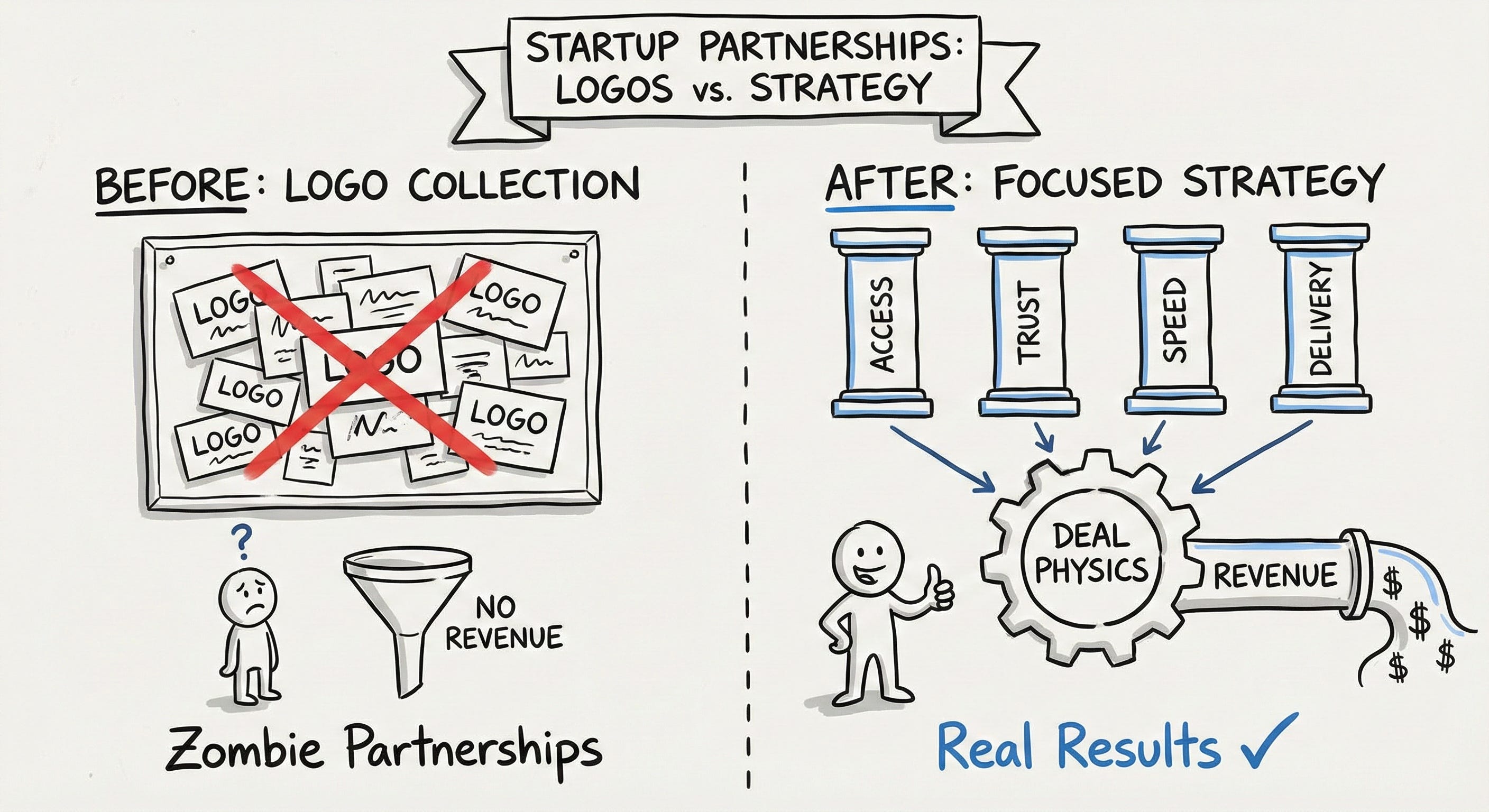
They treat partnerships like Pokémon cards. They want to “collect them all.”
You see this in every pitch deck. There is always that one slide cluttered with 20 different logos. It looks impressive to investors, but if you look under the hood, the reality is usually grim.
The Logos: No revenue attached.
The Co-Marketing: Webinars that generate noise but no pipeline.
The Team: Confused about whether they are Sales, Marketing, or Business Development.
We need to fix this.
If you are a founder or a GTM leader, you do not need more “ecosystem” buzzwords. You need a way to close deals.
This is the plain-english guide to what partnerships actually are, why they exist, and how to stop building “Zombie Partnerships” that look alive on paper but are dead in reality.
The Big “Why”: The Fundamental Truth About Startups
Before we get into tactics, we need to understand why we are doing this at all.
Startups are built on a comforting lie. The lie is that if you build a better product, the market will automatically find you.
They will not.
As a startup, you have a great innovation, but you are terribly inefficient at everything else. You are too small. You are too quiet. You are too risky for conservative buyers. You do not have enough time or money to build direct relationships with every potential customer on earth.
Partnerships exist because you cannot scale alone.
They are the only mechanism that allows you to borrow someone else’s trust, reach, and capacity to sell your innovation. You are trading your product advantage for their market advantage. If you try to do everything yourself, you will run out of cash before you run out of market.
That is the “why.” Now let’s look at the “what.”
Part 1: The Mechanics (Deal Physics)
Let’s strip away the jargon.
At the most basic level, a partnership is another company helping you sell, deliver, or de-risk your product.
That is it.
It is not a “relationship.” It is not “strategic alignment.” In a commercial startup context, a partnership is a tool to change the outcome of a specific transaction.
I call this Deal Physics.
Every deal has a natural trajectory based on your product, your price, and your market reputation. A real partnership applies an external force to that trajectory.
To know if a partner is real, ask yourself these questions about your last “partner-influenced” deal:
Would it have closed anyway?
Would it have closed at the same speed?
Would it have closed at the same contract value?
If the answer is “yes,” then the partner did not matter. They were just a passenger.
Real partnerships change the physics. They turn a “No” into a “Yes.” They turn “Next Year” into “This Quarter.”
Part 2: The 4 specific problems they solve
Large companies, like Microsoft or Adobe, build partnerships to defend market share. Startups are different. You build partnerships to survive.
As a startup, you are naturally constrained. Partnerships are the only lever that allows you to break through four specific walls.
1. Access (Distribution) You do not have the email list or the phone numbers. Cold outbound is getting expensive and inefficient.
The Fix: A partner who already has your buyer’s trust introduces you. It is the difference between a cold call and a warm recommendation.
2. Trust (Credibility) Buyers represent risk. No one gets fired for buying Salesforce, but they might get fired for buying your startup. You are an unknown entity.
The Fix: You borrow the trust of the partner. If a trusted consultant says you are safe, the buyer’s risk perception drops immediately.
3. Speed (Velocity) Deals stall. Legal teams drag their feet. Security reviews take months.
The Fix: Partners can accelerate deals by pre-validating your tech, providing existing contract vehicles, or exerting pressure on the internal champion.
4. Delivery Risk (Scale) Even if you sell the deal, can you deploy it? Startups often lose enterprise deals because the buyer worries about implementation.
The Fix: A service partner assures the client that they will handle the implementation. This removes the burden from your small team.
If a partnership does not solve one of these four constraints, it is a distraction.
Part 3: Focus vs. Scale
The biggest strategic mistake startups make is trying to mimic big companies.
You do not need a “Partner Program” with tiers, portals, and thousands of members. You do not have the resources to manage that.
Partner strategy at the seed or Series A stage is about focus.
You are looking for a small number of partners, perhaps as few as 3 to 5, who can materially change your revenue this year.
When you prioritize scale over focus, you end up with “Zombie Partnerships.” You sign the agreement, do the press release, and then... silence.
Don’t start with outputs (”Let’s sign 50 partners”). Start with the strategy (”Who can help us win the deals we are currently losing?”).
Part 4: The Only 3 Partner Types You Need
Forget the complex taxonomy of ISVs, VARs, OEMs, and Resellers. You only need to understand three roles based on what the partner actually does.
1. Distribution Partners (”The Source”)
Role: They bring you the lead.
Examples: Agencies, consultants, or platforms with overlapping customers.
Use when: Your pipeline is thin and cold outbound is failing.
2. Credibility Partners (”The Vouch”)
Role: They help you close the lead.
Examples: Industry analysts, “Certified” tech badges, or thought leaders.
Use when: You are moving up-market and enterprise buyers are scared to bet on you.
3. Delivery Partners (”The Hands”)
Role: They do the work.
Examples: Systems Integrators (SIs) and implementation agencies.
Use when: Your internal Customer Success team is drowning or you need to keep your margins high.
Part 5: The Litmus Test
Before you spend weeks negotiating a partnership agreement, run the partner through this simple logic gate.
Would this partner:
Bring us buyers we cannot find?
Help deals close faster than we can alone?
Help deals close bigger?
Reduce delivery risk significantly?
If the answer is “No” to all four, do not sign the deal. It might be a nice friendship, but it is not a Go-To-Market strategy.
Part 6: Why Sales Must Own The Motion
Here is the golden rule: If Sales does not know when to use a partner, they will not.
Partnerships do not live in a silo. They must attach to your existing sales motion. The most common failure mode is when a Partnership Manager signs a deal, but the Account Executives (AEs) ignore it.
To fix this, you must give your sales team extreme clarity. You must answer three things for them:
Trigger: “When specifically do I bring this partner in? (e.g., ‘When the prospect mentions they use HubSpot.’)”
Action: “What exactly will the partner do? (e.g., ‘They will email the decision maker to vouch for us.’)”
Benefit: “Why does this help me? (e.g., ‘It increases your win probability by 20%.’)”
If those answers are not clear, the partnership stays theoretical.
Summary
Partnerships do not fail because startups move too slowly. They fail because startups move fast without clarity.
Stop collecting logos. Stop trying to build an “ecosystem” before you have a product-market fit.
Find the 3 to 5 partners who change the physics of your deals. Go deep with them. Make them successful. Ignore the rest.
That is how you build a partnership strategy that actually shows up on the revenue line.
100% !!! Great summary of the start up recipe for a partner program Rob! People over engineer programs at the start and the simplest approach is establish a few and get revenue flowing. When people see a successful partnership in play, more will then approach you for participation and now you have a recipe for what success looks like.
Clear, focused partnerships that directly move deals are far more valuable than collecting logos or chasing scale