


If I looked at your calendar for last week, what would it tell me about your strategy?
For most Partner Managers, the calendar is a lie. It looks busy, back-to-back Zoom calls, “syncs,” “catch-ups,” and “alignment sessions.” It looks like work is happening.
But if we overlay that calendar with a revenue map, the truth comes out. We are often spending 80% of our time servicing partners who generate 20% (or less) of the revenue.
In the partnerships world, we are trained to be relationship builders. We are taught that being responsive, helpful, and “partner-first” is the job. But that mindset turns you into a Coordinator, someone who reacts to inbound noise.
To become an Operator, you need a fundamental shift in perspective. You need to stop viewing your territory as a list of relationships to nurture, and start viewing it as an investment portfolio to manage.
The Mindset Shift: Redefining “Capital”
In finance, portfolio managers allocate cash to generate a return (yield). If an asset underperforms, they don’t schedule a weekly “check-in” to ask how it’s feeling. They divest.
In partnerships, you don’t trade in cash. You trade in two vastly more finite resources:
Your Time: The literal hours in your week.
Internal Political Credibility: Every time you ask a Product Manager for a roadmap favor, or ask a VP of Sales to join a partner call, you are spending political capital.
Every interaction with a partner is an investment decision. You are betting your time and credibility that this specific activity will yield a return in sourced revenue.
If you are spending your capital equally across all partners, you are failing as a portfolio manager. You need to segment aggressively.
Here is the Partner Portfolio Framework: four distinct asset classes and how to manage them.
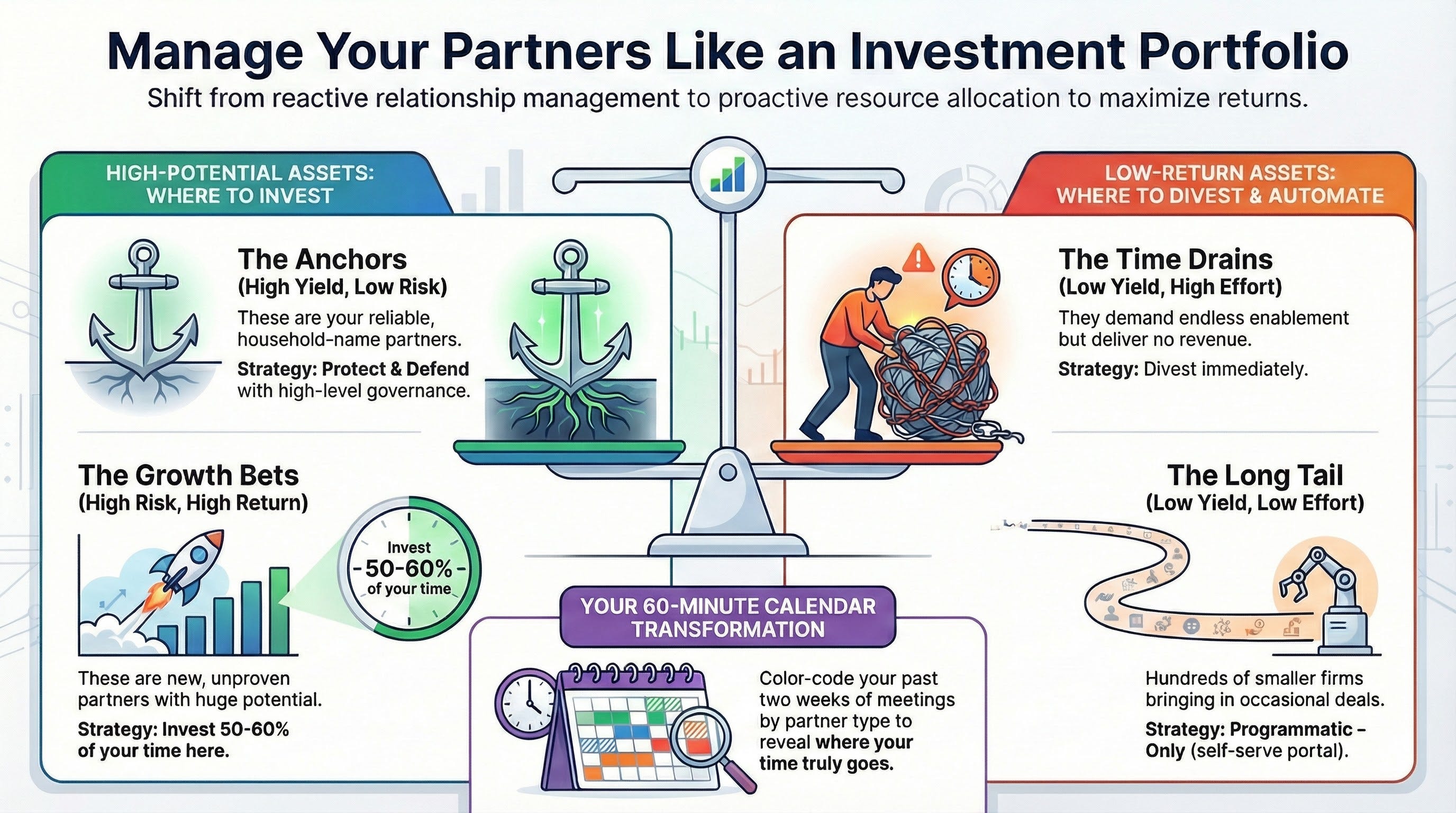
1. The Anchors (High Yield, Low Risk)
The Profile: These are the household names in your ecosystem. They have deep integrations, consistent run-rates, and executive alignment. They are the savings bonds of your portfolio, reliable and essential.
The Mistake: Over-servicing them because they are friendly and easy to talk to. We confuse “having a good relationship” with “generating incremental value.”
The Operator Strategy: Protect & Defend. These partners do not need you to hold their hand to close a deal. Your job is governance. Focus on high-level executive alignment to ensure no competitor wedges in. Keep the engine oiled, but don’t stand over the mechanic while he works.
👉 The Practical Audit: Look at your last three meetings with an “Anchor” partner. Was there a specific, revenue-generating agenda item (e.g., mapping a specific enterprise account), or was it a general “sync”? If it was just a sync, cancel the next one. They don’t need it, and neither do you.
2. The Growth Bets (High Risk, High Return)
The Profile: These are the exciting ones. They are new, high-energy, and perhaps unproven. They have incredible product-market fit with your solution, but they haven’t scaled their GTM motion with you yet.
The Mistake: Treating them like Anchors. Giving them a portal login and waiting for leads. They will fail without hands-on help.
The Operator Strategy: Active Investment. This is where you chase “Alpha” (outsized returns). You should invest 50-60% of your available capital here. You need to be in the trenches with them co-authoring the joint value proposition, manually mapping accounts, and getting on the first 5-10 sales calls yourself to prove the model works. You are their temporary Head of Sales.
👉 The Practical Audit: Scan your calendar for next week. Do you have blocks of time dedicated to proactive work for these partners (e.g., “Drafting joint one-pager for Partner X”), or just reactive meetings? If you aren’t building with them, you aren’t betting on them.
3. The Time Drains (Low Yield, High Effort)
The Profile: The most dangerous asset class. These partners promise the world during recruitment. Now, they demand endless enablement sessions, complain constantly about your product gaps, require custom marketing requests, and yet... have generated zero closed-won revenue in the last two quarters.
The Mistake: Falling for the “Sunk Cost Fallacy.” Thinking, “I’ve already spent so much time with them, I just need one more enablement session to unlock them.”
The Operator Strategy: Divest immediately. Stop the bleeding. In finance, holding onto a losing asset hoping it bounces back gets you fired. In partnerships, we call it “nurturing.” Stop it. “Firing” a partner (or severely demoting them) is a valid management decision.
👉 The Practical Audit (The “Groan Test”): Look at your calendar for tomorrow. Find the meeting that makes you physically groan when you see it. The one you know will be 45 minutes of complaints with no outcomes. Cancel it right now. Send an email moving them to a bi-weekly update instead. Reclaim that capital instantly.
4. The Long Tail (Low Yield, Low Effort)
The Profile: The hundreds of smaller consulting firms or agencies that might bring in one or two nice deals a year.
The Mistake: Giving them 1:1 time. A 30-minute call with a partner who brings in $10k a year is a negative ROI on your salary.
The Operator Strategy: Programmatic Only. Their experience must be entirely digital. Self-serve enablement, community forums, and automated deal registration. If they want to engage, they use the portal.
👉 The Practical Audit: Did you personally answer an email from a Long Tail partner this week regarding a basic program question (e.g., “How do I register a deal?”)? If yes, you failed. You spent expensive human capital on a task that cheap software should handle. Reply with a link to the portal and nothing else.
The Ultimate Takeaway: The 60-Minute Calendar Transformation
You can’t manage what you don’t measure. If you want to shift from relationship manager to portfolio manager, do this exercise on Friday afternoon:
Open your calendar for the last two weeks.
Color-code every single partner-facing meeting based on the four categories above (e.g., Green for Anchors, Yellow for Growth Bets, Red for Time Drains).
Look at the colors.
If your calendar is a sea of red “Time Drains” with sprinkles of yellow “Growth Bets,” your portfolio is failing. You are busy, but you are insolvent.
The goal of the Operator is ruthlessness with their capital. Be ruthless with your time so you can be generous with the partners who actually matter.
Thanks for sharing Rob! For me more than a calendar management issue is a day to day management issues. Responding to emails, phone calls, slack of partners that might not be worth the time. If we don’t offer partner support (automated or in any other way) any ideas on how to improve that?
Thanks for everything you share!