


For thirty years, the most important person in a startup was the one who could build the product.
That era is over.
I don’t say that to be provocative. I say it because the math has changed, and most founders and investors haven’t updated their mental models to match.
The floor just moved.
A non-technical founder can ship a working product in a weekend. Cursor. Lovable. Claude. The tools exist, they’re cheap, and they work. What used to be a two-year hiring problem, a $500k engineering investment, a reason to go find a technical co-founder. is now a Saturday.
That doesn’t mean engineers don’t matter. It means the scarcity that made technical founders uniquely valuable is gone.
When something stops being scarce, it stops being a moat.
Technical founders had a thirty-year run.
And it was earned. Writing software was hard. Finding people who could do it was harder. If you could build, you had leverage the market couldn’t replicate.
That scarcity shaped everything. How venture capital deployed. Which founders got funded. What “co-founder fit” meant. The entire startup ecosystem organized itself around the premise that the hardest problem was building the thing.
We are now living in the aftermath of that premise collapsing.
GTM was always the harder problem.
We just couldn’t say it out loud.
Because if you couldn’t cheaply solve the build problem, admitting that distribution was harder felt like giving up. So we kept funding technical founders and hoping they’d figure out GTM later. Sometimes they did. More often they built something nobody could find, or something a competitor could copy the moment it showed traction.
The founders who won, the ones who built durable companies, won because of distribution. Not because of features. Because of who trusted them, who sold for them, who brought them into deals they never would have found alone.
That was always true. AI just made it undeniable.
But not all GTM is equal.
This is where the nuance matters, and where most of the conversation gets lazy.
Paid acquisition is GTM. So is SEO. So is PLG. And AI is very good at optimizing all of those. You can automate a significant portion of demand generation. You can generate content at scale. You can run experiments faster than any human team.
What you cannot do is prompt your way into a partner’s pipeline.
You cannot automate trust. You cannot generate relationships at scale. You cannot instruct a model to make a channel partner choose your product over a competitor’s when both products are now roughly equivalent.
The part of GTM that AI cannot touch is the relational layer. The ecosystem. The partner network. The co-sell motion. The distribution relationships that take years to build and are nearly impossible to replicate once they exist.
That is the moat now.
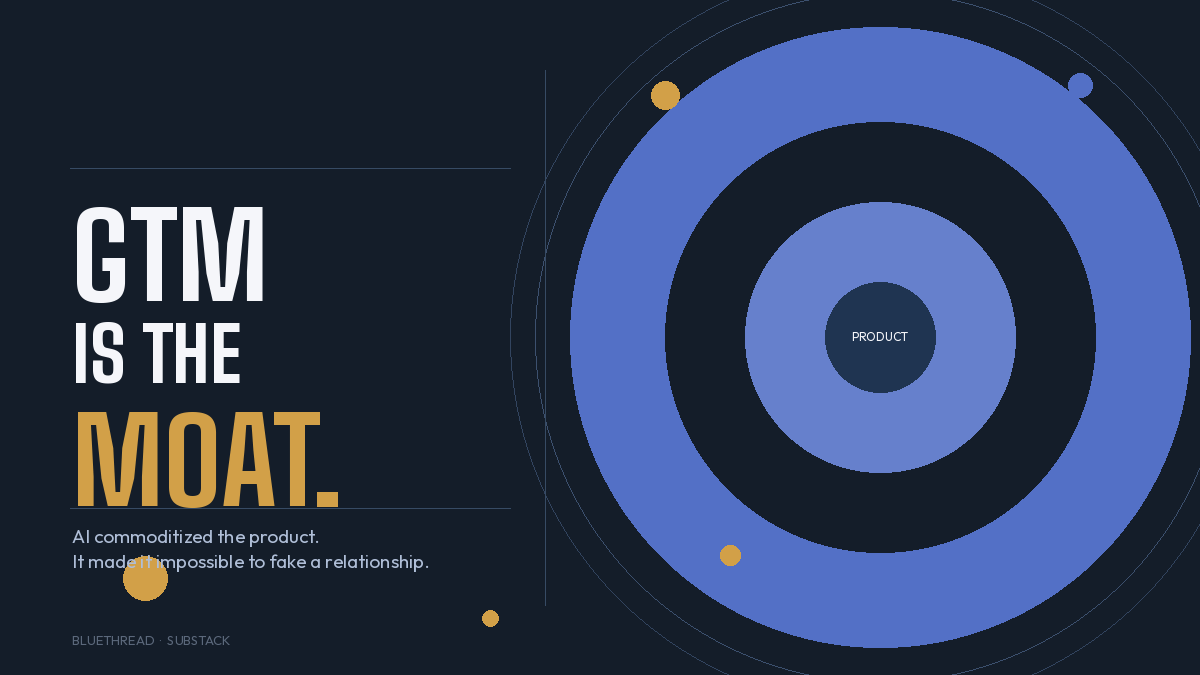
AI made it easy to build a product. It made it impossible to fake a relationship.
Think about what that means for how you hire.
The first ten people at most startups skewed heavily technical. That made sense when building was the scarce resource. It makes less sense now. The team that wins in the next decade looks different. It has people who can build partner ecosystems from scratch. People who can walk into a channel and get traction without a marketing budget. People who understand how to make another company’s sales team care about your product.
The GTM co-founder is now as strategically important as the technical co-founder. In some markets, more so.
What this means for PE.
Every software company in your portfolio is about to face a product parity problem.
A competitor will look at your portco’s features and replicate the core functionality in 90 days with AI assistance. If your portco’s defensibility is the product itself, that is a risk you should be pricing right now.
The companies that hold value through this shift are the ones with embedded distribution. Partner ecosystems. Channel relationships. Co-sell motions that took years to build and are locked in at the customer level.
When you’re underwriting a software company today, the question to ask before anything else is not what the product does. It’s who owns the distribution layer. And can a well-funded competitor with a good AI tool replicate it in a year.
If the answer is yes, you have concentration risk you may not have modeled.
The partnership infrastructure is now part of the asset. It should be in the diligence. It should be in the value creation plan. It should be in the 100-day roadmap.
The operator who was always undervalued.
There is a person who has existed inside software companies for the last decade who built all of this. They ran the partner program. They managed the channel. They sat in QBRs with ISVs and alliances and system integrators and made sure the ecosystem held together.
They were rarely the highest-paid person on the GTM team. They rarely had a seat at the executive table. They were treated as support staff for the sales org.
That person is now the most strategically important hire you can make.
Not because the role changed. Because the world finally caught up to what the role always was.
The bottom line.
If you are a founder and you don’t have a partner ecosystem strategy, you are building on sand. Your product advantage will compress. Your distribution advantage is what survives.
If you are a PE firm and you are not treating partner infrastructure as a core value creation lever, you are leaving return on the table. And you are underestimating a risk that is growing every quarter.
GTM people have always known this. They just didn’t have the moment.
They have it now.
The argument around GTM talent becoming a larger advantage than pure product differentiation feels directionally right in this market. Distribution and execution quality are starting to matter earlier. Curious how you are evaluating GTM strength at the earliest stages today?