


I love measuring partner contribution. I would argue we do not measure it enough.
Better source attribution. Cleaner influence tracking. Honest assist credit. Partner-touched cohorts isolated and compared against a baseline. Every partner program in the world would be in better shape if we put more energy into measurement.
That is not the problem.
The problem is what happens after measurement.
The problem is what the CFO does with the number you just handed them.
Looking back is one problem. Looking forward is another.
Two questions sit at the heart of every partner program.
What did our partners contribute? And what will they contribute next quarter?
These look like the same question. They are not.
The first one is a measurement problem. The data exists. The deals closed. The attribution is recoverable. With enough rigor, you can produce a defensible number. Partner-sourced revenue. Co-sell influence. Cohort lift over a baseline. This is math. Real, hard, useful math.
The second one is a forecasting problem. The data does not exist yet. The deals have not closed. The partner reps have not yet had the conversations. The customers have not yet renewed. The number you produce here is not a measurement. It is a bet.
Most partner programs use the same tool for both. They take the backward-looking attribution number, draw a slope through it, and call it next quarter’s forecast.
That is the mistake.
Why partner forecasting is different from partner attribution
A direct sales team can forecast linearly because they control the inputs. A rep makes the calls. Conversion rates are stable. Pipeline aging behaves predictably. The system is closed enough to project a line through.
Partner programs are open systems.
Your partner’s rep does not work for you. Their compensation does not optimize for your pipeline. Their customer is not pre-disposed to buy from you. Their integration with you is one of forty in their stack.
The variables you do not control outnumber the ones you do.
When you draw a straight line through last quarter’s attribution and call it next quarter’s forecast, you are pretending you control the system. You don’t. Variance compounds with time. The further out you forecast, the wider the real distribution gets.
This is why partner programs underperform their forecasts so reliably. The model assumed deterministic behavior in a probabilistic system.
Two different math problems
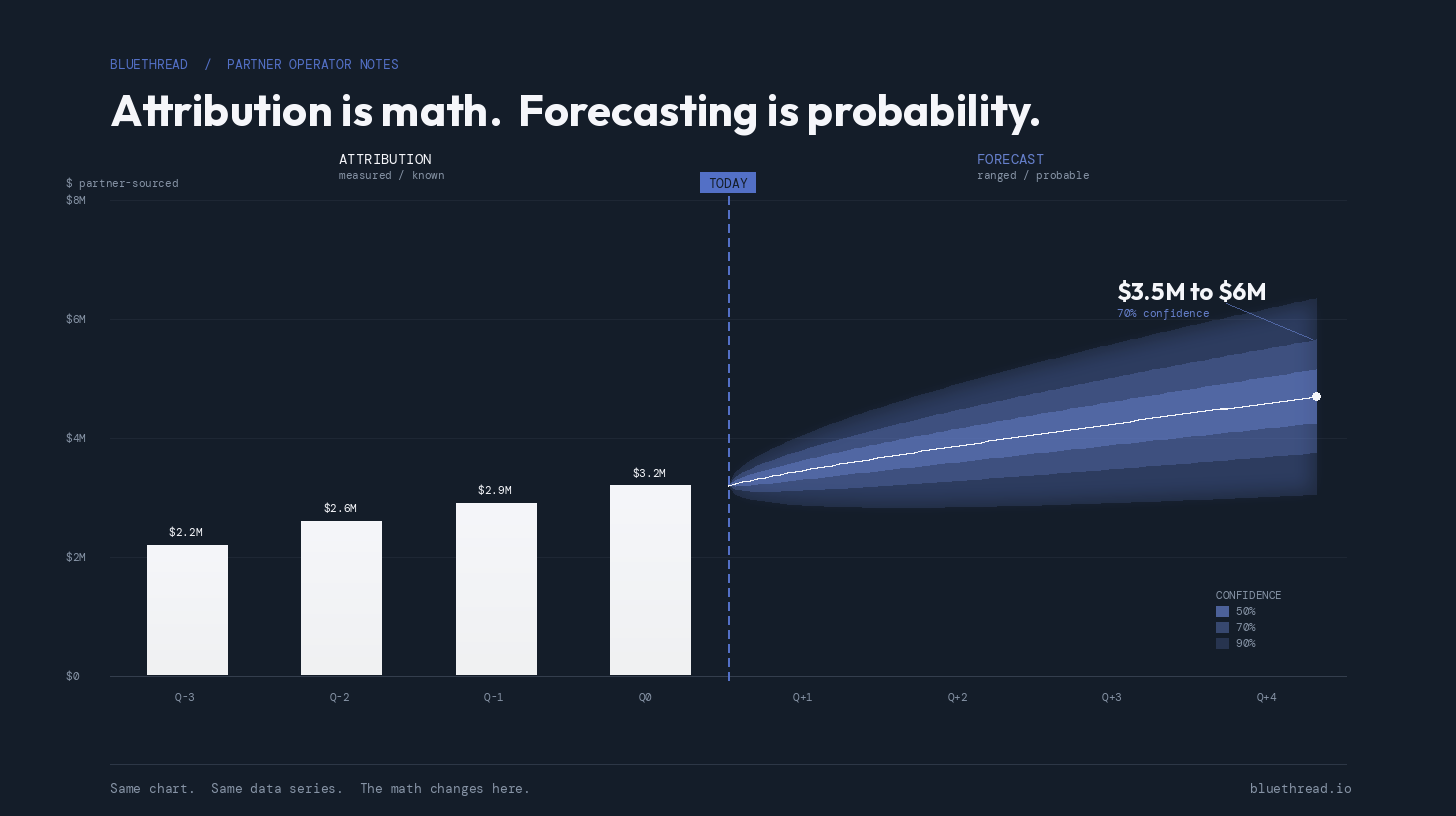
For measurement, you want precision. One number, defended hard, with a clean methodology. You want to be able to say to the CFO: “Partners contributed $3.2M of closed-won revenue last quarter. Here is how we counted it. Here is what we excluded.”
For forecasting, you want a distribution. A range, with confidence bands, and the inputs that move the curve. You want to be able to say: “Partner-sourced pipeline will land between $3.5M and $6M next quarter with 70 percent confidence. Here are the three things that would shift that distribution up or down.”
The CFO can work with both. CFOs run portfolios. They live with variance bands every day. They funded your company as a probabilistic bet.
What they cannot work with is a measurement dressed up as a forecast that keeps missing. That is what breaks the relationship between finance and partnerships.
What changes when you separate the two
Three things.
Measurement gets sharper. You stop watering down attribution to make next quarter’s forecast easier to defend. You report what actually happened. Clean.
Forecasting gets honest. You stop committing to point estimates. You commit to ranges, with confidence, with the leading indicators that move them. You stop being wrong every quarter.
Investment thesis gets clearer. You can finally tell the difference between an investment that improves measurement (attribution tooling, deal registration, source-of-influence tracking) and one that shifts forecast probability (integration depth, partner enablement, trust with senior reps). They are different categories of spend with different returns.
Most partner leaders confuse these because they get measured on the forecast, not the measurement. So they bend the measurement to fit the forecast. Then both go to hell.
The trust gap is your biggest forecast variable
There is one more thing the forecasting-as-probability frame surfaces.
Most of the variance in future partner outcomes is not in your CRM. It is in the gap between what your partner says they will do and what they actually do.
That gap is trust. And trust is the single biggest probability shifter in any partner motion.
Every action that closes the trust gap shifts the curve. Every action that widens it kills the forecast quietly, one missed intro at a time.
This is why the best partner leaders spend so much time on what looks, from the outside, like overhead. The weekly check-ins. The hand-written notes. The intros they make with no expectation of return.
It is not overhead. It is alpha on next quarter’s distribution.
What to try this week
Pull your partner contribution number from last quarter. Defend it hard. Tighten the methodology. Make it your most trustworthy report.
Then pull your forecast for next quarter. Throw out the point estimate. Replace it with a range and a confidence band. List the three inputs you believe will most shift the curve.
Bring both to your next finance review. One looks backward with precision. The other looks forward with humility. Show your CFO you understand which is which.
You do not have to stop driving pipeline. You have to stop forecasting it like it were already in the bag.
Attribution is math. Forecasting is probability. Run both. Just not with the same tool.
Since AI does probabilistic computation (assuming it has the data) it stands to reason we can use AI to forecast with a certain margin of error.