


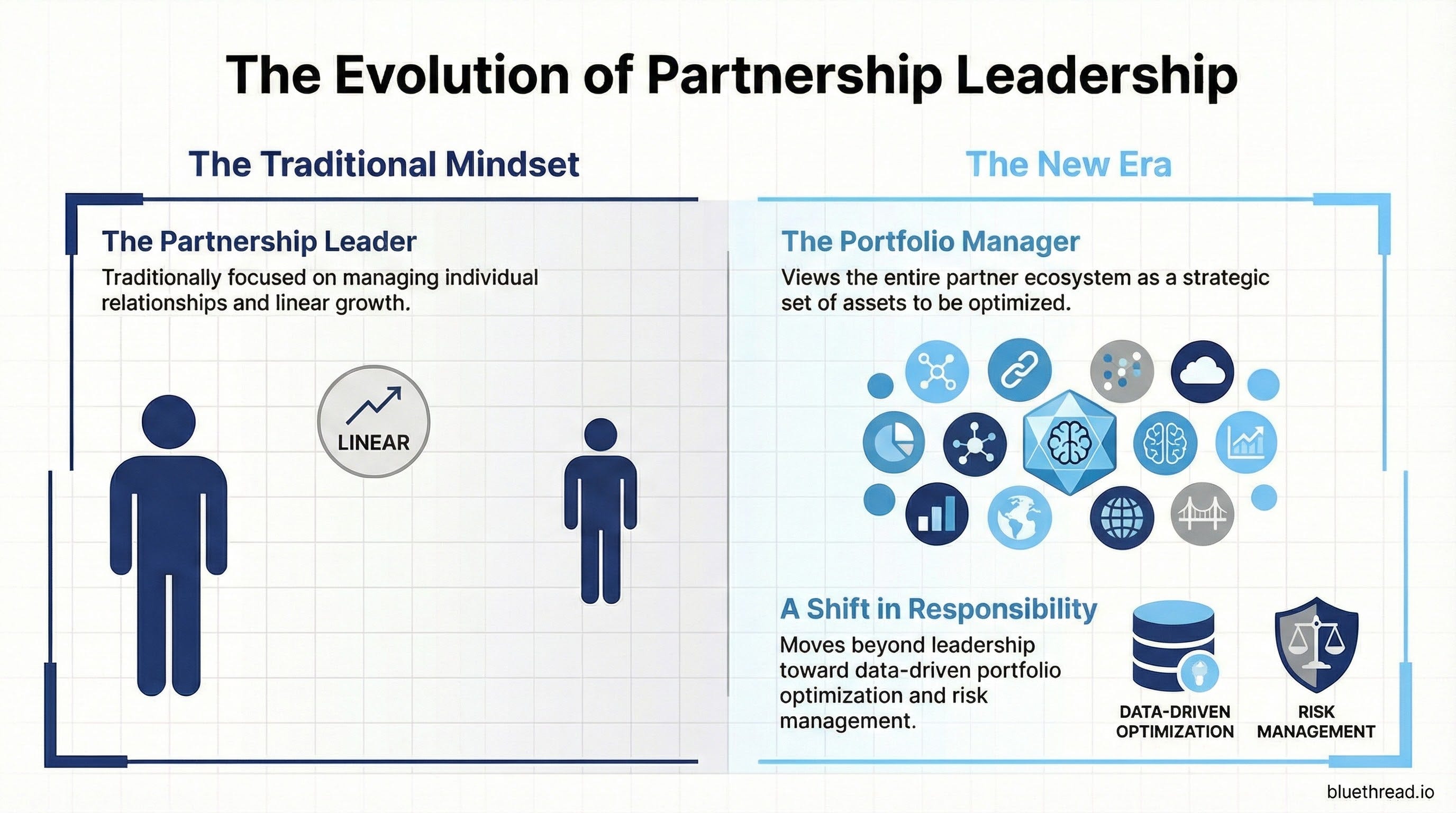
Most partnership leaders manage their partner ecosystem the way a first-time investor manages a Robinhood account. No thesis. No position sizing. Chasing whatever’s hot. Holding losers because “it might come back.” And absolutely zero exit discipline.
Then they wonder why leadership doesn’t take partnerships seriously.
Here’s the thing: Wall Street solved this problem decades ago. Portfolio managers at serious funds don’t collect assets and hope for the best. They research. They model. They allocate with precision. They review positions with religious discipline. And they cut losers without flinching.
The parallels to running a world-class partner program are almost eerie. And once you see them, you can’t unsee them.
Start With an Investment Thesis
A portfolio manager doesn’t buy a stock because someone pitched them at a cocktail hour. They have a thesis. A conviction about where the market is heading, what sectors will outperform, and which assets are positioned to capture that movement. Every position in the portfolio traces back to that thesis.
Partnership leaders should operate the same way.
Before you sign a single partner, you need a thesis about your market. Where is your ICP spending? What adjacencies matter to them? What buying patterns are emerging? Which technology categories are consolidating, and which are fragmenting?
Your partnership thesis should answer one question: Given where our market is going, which partner types will accelerate our ability to win?
That might mean technology partners who complete your platform story. It might mean channel partners who own relationships you can’t build fast enough. It might mean services partners who can deliver outcomes your product enables but can’t deliver alone.
You decide this BEFORE you start signing partners. Most teams do it backwards. They sign 40 partners at a conference, then try to figure out a strategy. That’s like buying 40 random stocks and then writing an investment memo to justify why you own them. Any analyst on Wall Street would get fired for that. In partnerships, it’s standard operating procedure.
Do the Due Diligence
Wall Street PMs spend roughly 80% of their time on research and 20% executing trades. Partnership teams flip that ratio completely. They sign fast and “figure it out later.” Later never comes.
Think about what a buy-side analyst actually does before recommending a position. They read the 10-K. They model the financials. They talk to customers, competitors, and former employees. They stress-test the thesis against bear cases. They map the competitive landscape. They understand the risks before they take the position, not after.
Real partner due diligence should be just as rigorous:
TAM overlap analysis. How much of their customer base overlaps with your ICP? Not their total customer count. The ones that actually look like your buyers. If there’s less than 30% overlap, the partnership will die of starvation no matter how good the relationship is. This is your addressable market calculation, and it matters just as much here as it does in equity research.
Sales motion compatibility. Do they sell the way you sell? A product-led growth company trying to partner with an enterprise field sales org is like pairing a high-frequency trading desk with a long-only value fund. Not impossible, but the friction at every handoff will be significant. You need to plan for it, not discover it.
Technical integration depth. Is this a “logos on a website” partnership or does the integration actually solve a customer problem? Think of this as the difference between a company that has revenue and a company that has a moat. Surface-level integrations produce surface-level results. Deep integrations create switching costs and compounding value.
Channel conflict risk. Are you going to be competing with this partner for the same deals six months from now? A good analyst would never recommend a position without understanding the competitive dynamics. Same principle. Get rules of engagement on paper before you sign, not after the first conflict.
Cultural and operational fit. If their partner team operates at a completely different speed, communication cadence, or commitment level, the day-to-day execution will grind to a halt. This is like evaluating management quality. The numbers can look great on paper, but if the team can’t execute, the thesis is dead.
Reading the 10-K is boring. It’s also the difference between informed conviction and blind speculation.
Size Your Positions
This is where most partner programs go completely sideways, and where the Wall Street analogy gets really sharp.
A portfolio manager doesn’t put 50% of the fund into a single stock. That’s not conviction. That’s concentration risk. They size positions based on expected return, risk profile, and correlation to other holdings. The goal is maximizing risk-adjusted returns across the entire portfolio, not maximizing the upside of any single position.
Partnership teams violate this principle constantly. They go all-in on one anchor partner (usually the biggest logo they can land), pour all their co-marketing budget, enablement time, and executive attention into that single relationship, and starve everything else.
Then that partner changes strategy. Or gets acquired. Or reorganizes their partner team. And suddenly your entire partner-sourced pipeline evaporates overnight. You just experienced the partnership equivalent of a portfolio blowup, and you had zero hedging in place.
Position sizing in a partner portfolio means deliberately allocating your scarce resources (headcount, co-marketing dollars, enablement capacity, executive time) based on expected return and risk:
Your Tier 1 partners might get 60% of your resources, but that should be spread across 3-5 partners, not concentrated in one. Your Tier 2 partners get 30%, allocated across the 8-12 partners showing early traction. And you keep 10% for Tier 3 “exploratory positions,” partners you’re testing a thesis on but haven’t proven yet.
That Tier 3 bucket is your venture allocation. Small bets, high risk, potentially high reward. Some will fail. That’s fine. The ones that hit get promoted to Tier 2, and the cycle continues.
The key insight: diversification isn’t about having more partners. It’s about making sure no single partner failure can blow up your portfolio.
Manage the Portfolio Actively
Buy-and-hold is a fine strategy for index funds. It’s a terrible strategy for partnerships.
Yet most partner teams operate exactly this way. They sign the partner, do a launch webinar, maybe a press release, and then... nothing. The equivalent of buying a stock, deleting your brokerage app, and checking back in a year.
Portfolio managers review their positions constantly. Daily marks. Weekly reviews. Monthly deep dives. Quarterly rebalancing. They’re watching for signals: Is the thesis playing out? Are the leading indicators trending the right direction? Has something changed in the market that invalidates the original position?
For partner portfolios, here’s the cadence I recommend:
Monthly: Check the leading indicators. Co-sell pipeline generated, deal registrations submitted, integration adoption metrics, enablement completion rates. These are your daily marks. They tell you where the portfolio is heading before the revenue numbers confirm it. A Wall Street PM who only looked at stock prices once a quarter would get destroyed. Same principle applies.
Quarterly: Full portfolio review with rebalancing decisions. Revenue attribution by partner. Cost-to-revenue ratio per partner tier. Pipeline velocity comparison (partner-sourced vs. direct). Win rate differential. This is where you decide which positions to increase, decrease, or exit. Every position should earn its allocation every quarter.
Annually: Thesis review. Is your original investment thesis still valid? Has the market shifted? Are new partner categories emerging that you’re underweight in? Have existing categories become crowded or commoditized? This is your annual strategy offsite, and it should start with the market, not with your existing partner list.
The data infrastructure matters here. A portfolio manager without a Bloomberg terminal is flying blind. If you can’t pull partner performance data without three weeks of manual spreadsheet work, your portfolio management will always be reactive instead of proactive. Build the dashboards first. The best PMs don’t make better gut decisions. They make better data-driven decisions faster.
Set Stop-Losses and Enforce Them
This is what separates real portfolio managers from amateurs. And it’s the discipline that partnership leaders almost universally lack.
On Wall Street, a stop-loss is simple: if a position drops below a predetermined threshold, you exit. No emotion. No “but the fundamentals are still good.” No “let’s give it one more quarter.” You set the rule in advance when you’re thinking clearly, and you follow it later when emotions are running high. That’s the whole point.
Partnership teams hold onto dead partnerships for YEARS. The reasons are always the same:
“The relationship is really good.” (Relationships don’t generate pipeline.)
“They’re a big logo and it looks good on our partner page.” (That’s a vanity metric, not a strategy.)
“We’ve invested so much already.” (Sunk cost fallacy. Textbook.)
“It might turn around next quarter.” (It won’t. It almost never does.)
A Wall Street PM who held losing positions because of “good relationships” with company management would get laughed out of the business. Somehow in partnerships, it’s considered sophisticated relationship management.
Here’s what a partner stop-loss framework looks like in practice:
If a Tier 2 partner hasn’t generated a single qualified co-sell opportunity in 90 days, they get downgraded to Tier 3 and lose dedicated resources. If a Tier 1 partner misses their quarterly pipeline target by more than 40% for two consecutive quarters, they get downgraded to Tier 2 and you reallocate their resources to someone who’s performing. If an exploratory Tier 3 partner shows zero engagement (no integration progress, no co-marketing participation, no deal registration activity) after 60 days, you close the position entirely.
Write these rules down before you need them. Share them with your team. Share them with your partners. When everyone knows the criteria, enforcement becomes operational, not personal. Just like a stop-loss order executes automatically. The decision was made when you were rational. The execution happens when it needs to.
Double Down on Winners
Every great PM knows the real money isn’t made by avoiding losers. It’s made by recognizing winners early and having the conviction to add to the position.
Most partner teams are just as bad at this as they are at cutting losers. When they find a partner that’s consistently generating pipeline, closing deals, and driving integration adoption, they give that partner... the same flat allocation as everyone else. Because “we need to be fair to all our partners.”
That’s like a PM finding a stock that’s up 40% on strong fundamentals and saying “I should probably sell some and spread it around to my underperformers.” No serious investor thinks this way. When your thesis is confirmed and the position is working, you lean in.
In partnerships, doubling down means: more co-selling support, more enablement resources, more co-marketing budget, more executive alignment, more joint customer success investment. You are actively increasing your position size because the data confirms the thesis.
Fair is not the same as equal. Fair means every partner gets resources proportional to their contribution and potential. A partner generating 30% of your partner-sourced pipeline should not be getting 10% of your resources because you’re running an egalitarian commune instead of a portfolio.
Benchmark Against an Index
Every portfolio manager measures performance against a benchmark. The S&P 500. The Russell 2000. A sector-specific index. Without a benchmark, you literally cannot tell if you’re outperforming or underperforming. You’re just... performing.
Imagine a hedge fund manager who couldn’t tell you their returns relative to the market. They’d never raise another dollar. But most partnership leaders can’t answer the most basic benchmarking questions about their program:
What’s your cost of acquiring a partner-sourced customer vs. a direct-sourced customer? How does partner-influenced pipeline velocity compare to your direct pipeline? What’s the lifetime value differential between customers acquired through partners vs. direct? What’s your revenue per partner, and how does that compare year-over-year? What percentage of total revenue is partner-influenced, and is that number growing or shrinking?
If you can’t answer these questions, you can’t defend your budget. You can’t make the case for more resources. And you definitely can’t tell your leadership team whether the partner portfolio is generating alpha (outperforming what you’d achieve through direct efforts alone) or just creating activity that looks like progress.
Wall Street has a term for this: closet indexing. It’s when a fund manager charges active management fees but basically just mirrors the index. A lot of partner programs are the partnership equivalent. They look active. They have a lot of partners. They produce a lot of activity metrics. But they’re not actually generating returns above what the company would achieve without them.
Build your benchmarks. Measure against them ruthlessly. This is how you prove that your partner portfolio is generating real alpha.
The Bottom Line
The best partnership leaders I’ve worked with all have one thing in common: they manage their partner ecosystem with the discipline of an investor, not the enthusiasm of a collector.
They have a thesis before they buy. They do the diligence before they commit. They size positions deliberately. They review and rebalance on a cadence. They cut losers without emotion. They add to winners without guilt. And they benchmark relentlessly so they always know whether the portfolio is generating alpha or just generating noise.
The tools exist. Portfolio management is a solved discipline with decades of refinement behind it. The only question is whether you have the rigor to apply them.
Your partner ecosystem is a portfolio. Your resources are capital. Every partner is a position. Manage it like a fund manager, and you’ll start getting the results (and the credibility) that partnership leaders have been chasing for years.