


The most valuable thing flowing through your partnerships isn’t revenue. It’s information.
There’s a truth about technology partnerships that almost nobody talks about publicly because it undermines the entire RevOps framing that the industry has spent a decade building.
The most strategically valuable thing that happens in partnerships is not co-sell revenue. It’s the movement of information and people between organizations.
When Microsoft partners deeply with a startup, the real value to Microsoft is learning about an adjacent market, identifying acquisition targets, and recruiting talent who understand that domain. The real value to the startup is credibility signaling and learning how enterprise procurement works.
The revenue that flows through the partnership is almost a side effect. But you can’t build a partner org’s budget around “intelligence gathering and talent pipeline.” It doesn’t fit in a board deck. So everyone pretends it’s about co-sell revenue, and the actual value remains invisible to the organization.
I want to unpack why this matters and where it’s going.
The integration is the confession
When a customer connects your product to another product, they’re telling you something they’d never tell you in a survey, a QBR, or a sales call. They’re showing you their actual workflow. Not their aspirational one, not the one they described to the sales rep, but the real one. The one with duct tape.
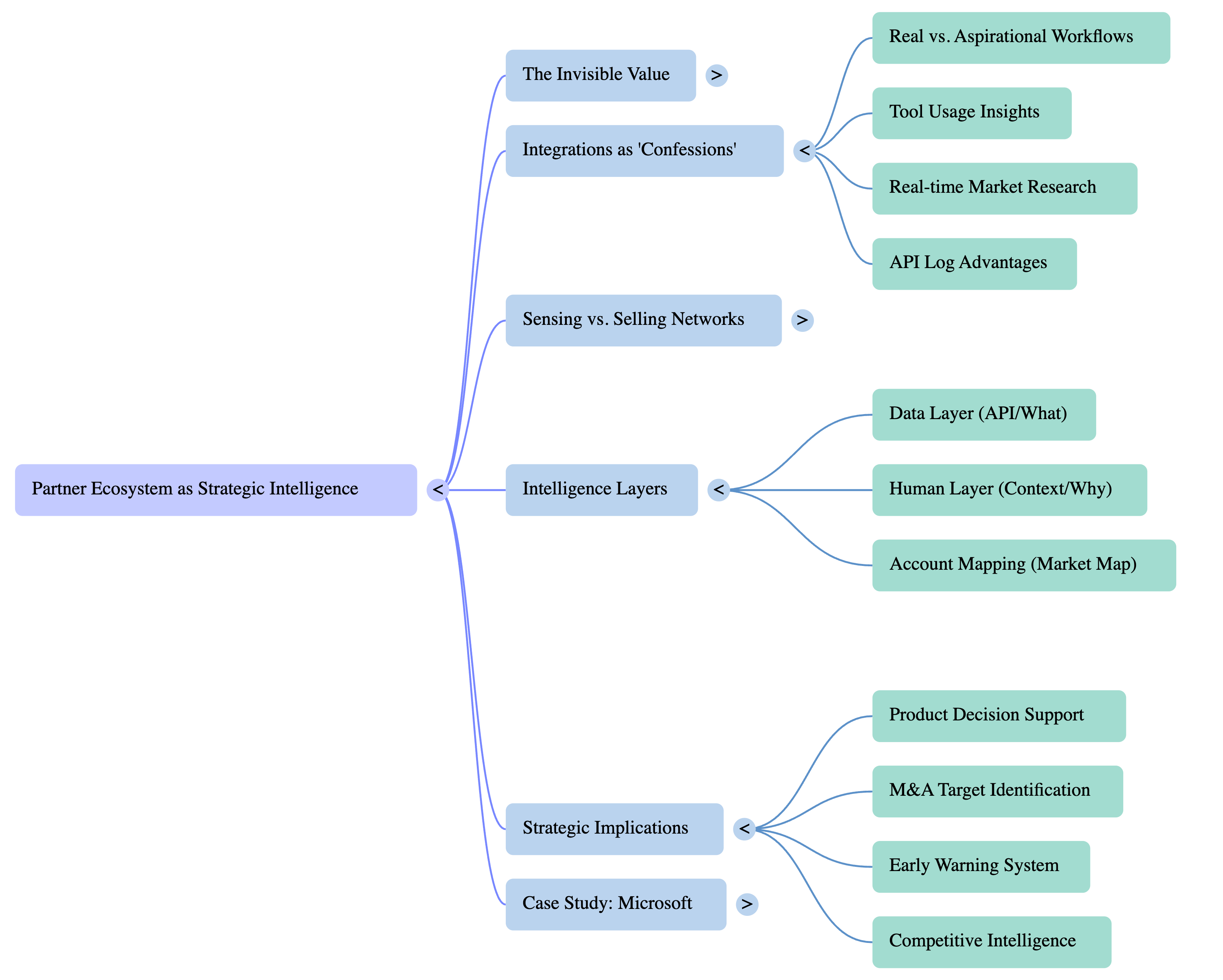
Think about what Slack learned from its integration data before anyone else could see it. They could see which tools were actually being used inside organizations. Not what IT approved, not what procurement bought, but what people actually connected. That’s a real-time market research engine that would cost tens of millions to replicate through traditional means. And it was sitting right there in the API logs.
Every integration is a confession about how work actually gets done. And the companies that pay attention to those confessions have an information advantage that no amount of Gartner reports can replicate.
Your partner community is doing the same thing at the human layer
When partner managers talk to each other, when they share which deals are moving, which segments are growing, which products are getting adopted, they’re creating an intelligence network that mirrors the integration data but adds something the data can’t provide: context.
The API tells you WHAT is connected. The partner community tells you WHY and WHAT’S NEXT.
This is the real reason account mapping platforms are valuable, and it’s not the reason they pitch on their websites. The account mapping isn’t just about finding overlap for co-sell. It’s a proprietary dataset about which companies use which tools together, which is essentially a real-time map of how the market actually works versus how vendors think it works.
But almost nobody is looking at it that way. They’re looking at it as a pipeline tool. Which is like using a telescope as a paperweight.
Sensing networks vs. selling networks
The companies that understand this, truly understand it, treat their partner ecosystem as a sensing network, not a selling network. And the distinction has massive strategic implications.
A selling network optimizes for deal registration, co-sell attribution, and partner-sourced pipeline. It measures success in revenue. It reports to the CRO. It lives and dies by quarterly numbers.
A sensing network optimizes for information flow. It asks fundamentally different questions:
What are customers actually connecting us to? What adjacent problems are they solving with other tools? Where are integration adoption patterns diverging from our product roadmap assumptions? Which partner’s customers churn less, and what does that tell us about ideal customer profile?
The sensing network is exponentially more valuable. But it’s almost impossible to get funded because the value doesn’t show up in a pipeline report.
It shows up in better product decisions 18 months later. It shows up in an acquisition you didn’t overpay for because you already understood the market. It shows up in a competitive move you saw coming because your partners told you before it was public.
The ROI is massive. The attribution is nearly impossible. And so it stays invisible.
The Microsoft example nobody tells correctly
Here’s a historical example that proves this pattern.
Microsoft under Satya Nadella. The single most important strategic signal that drove Microsoft’s cloud transformation wasn’t internal. It was the partner ecosystem telling them, through integration patterns and partner feedback, that customers were building hybrid environments regardless of what Microsoft wanted. The partner channel saw multi-cloud before Microsoft’s product org accepted it.
That intelligence, flowing through the partner layer, is arguably what saved Microsoft from trying to fight AWS head-on and instead finding the enterprise hybrid angle that became their trillion-dollar strategy.
But that story gets told as “Satya had a vision.” It doesn’t get told as “the partner ecosystem was a leading indicator that product leadership initially ignored until the data was undeniable.”
The vision was real. But the vision was informed by signals that came through the partner network before they showed up anywhere else. The partners were the early warning system.
This happens constantly. And it almost never gets credited, because “our partners told us the market was shifting” is a less compelling origin story than “our visionary CEO saw the future.”
What this means for partner leaders right now
If you run a partner org or sit in a partner leadership role, you’re sitting on something far more valuable than your pipeline report suggests.
Your partner community collectively knows more about how the B2B SaaS market actually works than any analyst firm. Because they see the deals, the integrations, the failures, and the pivots in real time. Not 18 months later in a research report.
The question isn’t how to extract more co-sell revenue from your ecosystem. The question is: who inside your organization should be consuming the intelligence your ecosystem generates, and how do you make that information flow?
Product teams should know which integrations are growing fastest and why. Strategy teams should know which adjacent markets your partners are seeing heat up. M&A teams should know which small partners are gaining disproportionate traction (those are your acquisition targets). Customer success should know which partner combinations correlate with lower churn.
None of this shows up in a standard partner dashboard. All of it is more valuable than the pipeline numbers that do.
The opportunity hiding in plain sight
The partner leaders who figure this out first will redefine what a partner organization is for.
Not a channel for cheaper distribution. Not a co-sell engine. Not a marketplace play.
A distributed market intelligence operation that happens to also generate revenue.
The community is the interface. The intelligence is the product. And right now, almost nobody is building for this.
That’s the gap. And it’s enormous.
Rob Moyer is the founder of Bluethread.io, a partnership advisory firm, and the Bluethread Collective, a community for partnership leaders. He writes about partnerships, private equity, and AI at the intersection of how B2B SaaS actually works.
Rob, I would have loved to have this article to prove the value of my role and what Partners can achieve in my previous roles.
Thanks for providing that much clarity into the huge challenge of making Ecosystem partnerships understood and make them the core of the GTM strategy, not an isolated, misunderstood and underestimated "department.
Your article values the reality for the field and explains the "intangible" aspect of it. Bravo !
Spot on Rob. As the Global Technology Alliances Director at SUSE my job was 100% focused on creating ecosystem solutions. The RoI measured over the 2 or 3 years following the launch of the solution was massive, but the attribution was the missing link. We have an opportunity to fix that with AI.