


CRM data is getting cleaner. Account research is getting automated. Scoring models are getting sharper. The gap between signal and action is collapsing. A prospect posts a job description, triggers a workflow, enriches a contact record, routes a personalized sequence to a rep, all before anyone opens a laptop.
This is real progress. The infrastructure is legitimately getting smarter.
But there is a variable it does not have.
Trust.
You Can Automate Outreach. You Cannot Automate Credibility.
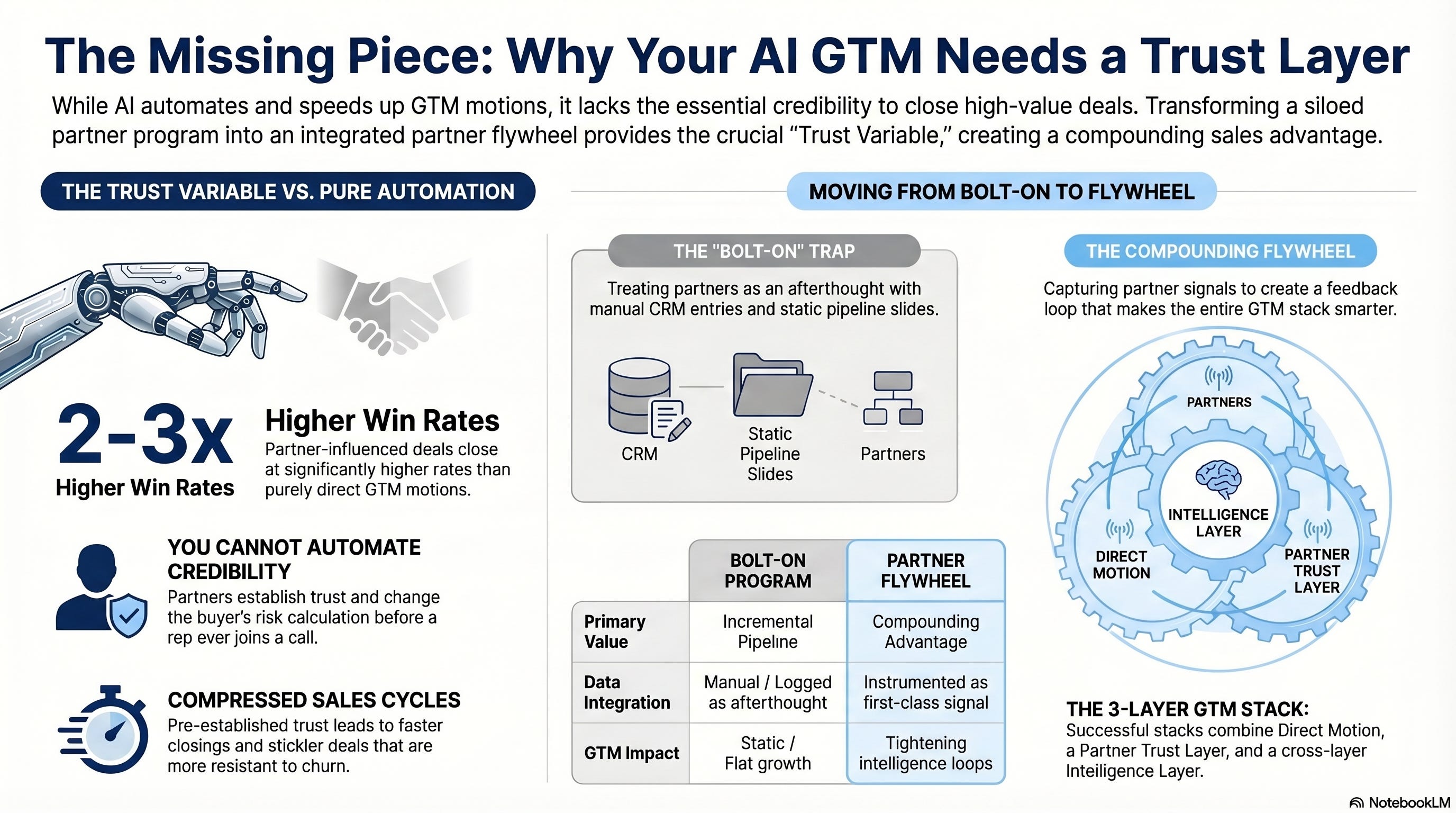
Win rates on partner-influenced deals run two to three times higher than purely direct GTM motion. That number gets cited a lot. It rarely gets explained properly.
The reason is not that partners source better-fit accounts, though sometimes they do. The reason is that a partner-influenced deal arrives with credibility already established. Someone the buyer already trusts has put their reputation behind the recommendation. The buyer’s risk calculation changes before your rep ever gets on a call. The sales cycle compresses. The deal closes stickier.
That is a trust variable. And no amount of enrichment, scoring, or AI-generated personalization replicates it.
Your GTM stack can get very good at reaching the right person with the right message at the right time. It cannot manufacture the standing that comes from a trusted introduction. Those are different problems. Only one of them is solvable with data infrastructure alone.
Everyone Has Partners. Almost Nobody Has a Partner Flywheel.
Here is where most companies fool themselves.
They have a partner program. They have a partner portal. They have an ecosystem slide in the board deck. So they assume the trust layer is covered.
It is not.
What they actually have is a bolt-on. Partners live at the edge of the commercial motion. They source some deals. They get logged in the CRM when someone remembers to do it. They show up in QBRs as a pipeline number without much context underneath it. The relationship exists. The infrastructure treating it as a strategic asset does not.
A bolt-on generates incremental pipeline. A flywheel generates compounding advantage.
The difference is not the number of partners. It is not the size of the partner program budget. It is whether the signal your partners generate flows back into your commercial infrastructure and makes it smarter over time.
Almost nobody has built that. And right now, while everyone is racing to wire AI into their direct motion, this gap is getting wider.
The Signal Nobody Is Capturing
Think about what actually happens in a partner-influenced deal.
A partner has a conversation with a buyer before your rep does. They frame the problem. They handle the first objection. They position your solution against a competitor in a way that shifts the buyer’s frame. They surface a buying trigger your direct team never knew existed.
Then the deal comes in. Your rep gets on a call. The CRM gets updated. The partner gets credit, maybe, if someone remembers to log it.
What got lost: everything that happened before your rep showed up.
Which partners are having the highest-quality conversations? Which partner introductions correlate with sub-60-day sales cycles? Which ones correlate with churn at month nine? What are partners saying about your competitors that your direct team has never heard? What objections are surfacing in partner-led discovery that never make it into your pipeline notes?
This is the highest-leverage intelligence in your commercial motion. It is almost completely invisible in most companies.
The trust network is active. The data it generates is not being captured. And you cannot build a flywheel on data you are not collecting.
The Full Stack Looks Different Than Most People Are Building
When operators talk about AI-enabled GTM infrastructure, the conversation almost always stays inside the boundary of the direct motion. Enrich accounts. Score leads. Automate sequences. Reduce the research burden on reps.
These are real gains. They are also incomplete.
A full GTM stack has three compounding layers.
The first is direct. Your own sourcing, scoring, sequencing, and closing motion. This is where most AI GTM investment is going right now.
The second is the partner trust layer. Deals your partners touched, sourced, or accelerated in ways your direct team could not. Not logged as an afterthought. Instrumented as a first-class signal.
The third is the intelligence layer that runs across both. Partner signals feeding back into how you define ICP. Partner conversation patterns informing how your reps handle objections. Partner win-loss data refining which accounts to prioritize and which to deprioritize.
Companies building only the first layer are automating the lower close-rate motion and leaving the flywheel unwired.
Why This Compounds Faster Than Most GTM Advantages
The data problem in partner GTM is worse than in direct. Partner activity is messier. It happens across more touchpoints, more people, more conversations that were never designed to be tracked.
That makes it harder to instrument. It also means the gap between companies that build the infrastructure and companies that do not will compound faster than almost any other GTM investment.
Here is the mechanic. Companies that instrument the partner trust layer start accumulating signal that their competitors do not have. Which ecosystem relationships drive the fastest cycles. Which trust signals predict expansion. Which partner conversations are worth investing in and which are not producing commercial outcomes.
That intelligence feeds targeting. Targeting improves win rates. Better win rates justify more partner investment. More partner investment generates more signal. The loop tightens with every cycle.
Companies treating partners as a bolt-on stay flat. They optimize a motion that is already producing and leave the compounding motion unbuilt.
What to Do With This
If you are a GTM or revenue leader, one diagnostic question: can you pull a report showing partner-influenced win rate versus direct win rate at the deal level, with enough data underneath it to understand why the gap exists?
If the answer is no, you do not have a partner flywheel. You have a partner program. Those are different things.
The path from bolt-on to flywheel is not a technology problem. The tools to instrument this exist. It is a strategic choice to treat the partner channel as a first-class commercial motion with its own data layer, its own feedback loops, and its own system of action.
Your AI GTM stack is getting smarter every quarter. But smart without trust has a ceiling.
The companies that wire in the trust layer now will be compounding while everyone else is still optimizing the cheaper motion.
The flywheel is available. Most companies just have not decided to build it.