


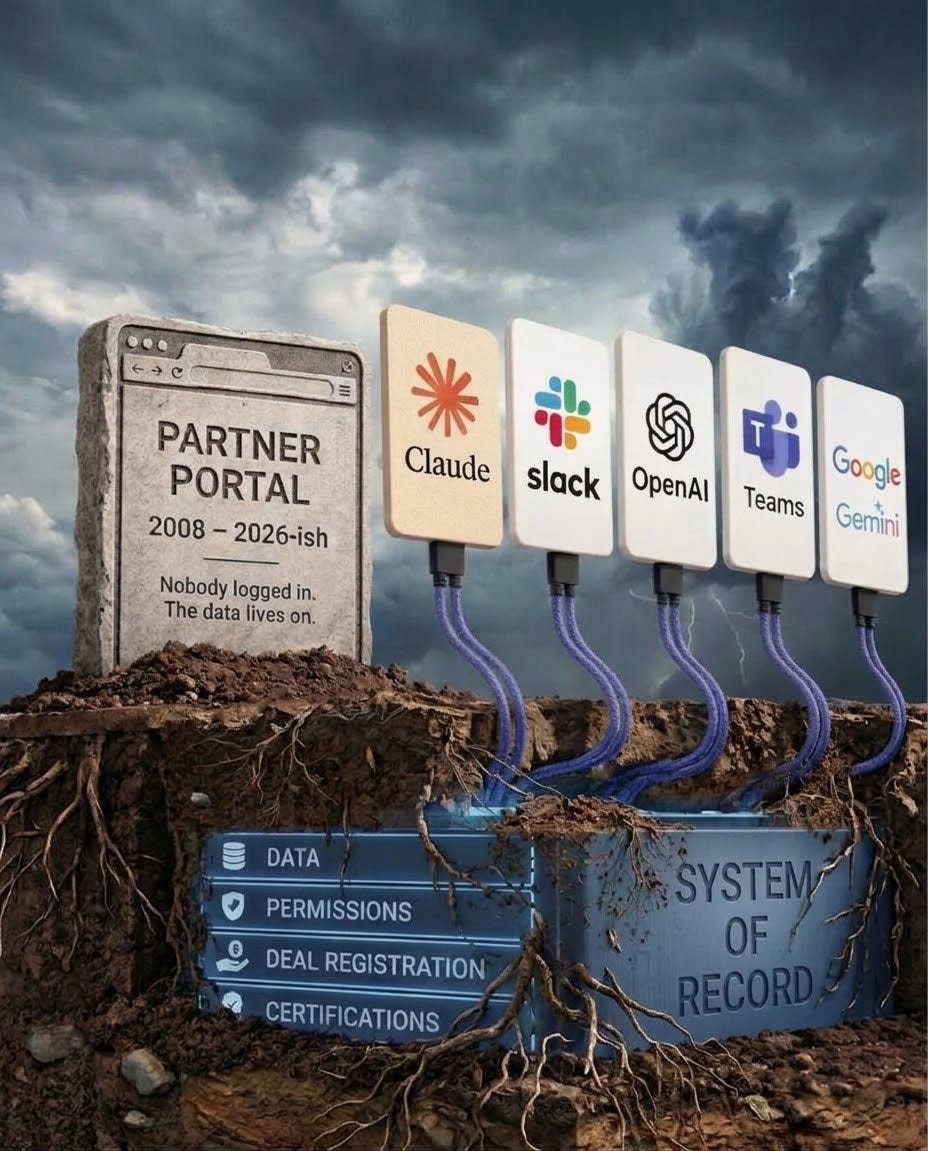
Partner tools are about to change forever.
Not get better. Change.
Look at how most partner programs are built. A portal partners are supposed to visit. A deal registration form they’re supposed to fill out. A certification exam they’re supposed to pass.
Every one of those assumes the partner comes to you.
They learn your system. Remember another password. Find the right content. Enter information they already entered somewhere else. Follow your process so they can help sell your product.
We have spent years trying to make that experience better.
My prediction is that we’re going to spend the next few years making much of it disappear.
The interface is moving to where people already work: their AI assistant, Slack, Teams, their own CRM.
The system of record stays. The screen doesn’t.
If you run a partner program, sit with what that means.
I have been in the partnership business my whole career. One thing has been remarkably consistent: vendors overestimate how much attention partners can give them.
Your program might be the center of your workday. To the partner, it is one of several programs competing with customer calls, renewals, delivery problems, and payroll.
That’s why “we need more partner engagement” has always bothered me.
Sometimes we do. Sometimes we need to stop making people work so hard to do business with us.
A partner rep preparing for a customer meeting needs an answer. They need to know whether your product fits, what it costs, which claims they can make, and who can help close the deal.
They don’t wake up wanting to engage with your portal.
They want to move the customer forward.
AI gives us a reason to rebuild around that reality.
Here are a few of my predictions.
Portals become headless.
The content, pricing, training, and pipeline information still matter. The destination becomes less important.
A partner should be able to ask, “What is the right configuration for this customer?” and get an approved answer inside the tool they already use.
That answer might draw from your product documentation, their customer history, current pricing, and the terms of your partnership.
Today, finding it might require three systems and an email to the channel manager.
Tomorrow, much of that work could happen behind a single question.
The implication is bigger than adding a chatbot to your portal. Your information needs to be structured, current, accessible, and governed well enough to travel.
Which price applies? Which version of the product? Which region? Which partner tier? Is the answer approved for sharing with a customer?
A beautiful portal cannot compensate for unreliable answers.
As the interface becomes easier, the quality of the information underneath it becomes more exposed.
Deal registration becomes an event with evidence attached.
Today, a partner fills out a form and makes a claim.
They identified the opportunity. They introduced the customer. They deserve protection.
Then someone on the vendor side checks the CRM, asks a few questions, and tries to decide whether the claim holds up.
In the model I expect to emerge, registration can begin inside the partner’s workflow.
A qualified opportunity appears in their CRM. A customer call establishes a need. An introduction connects the vendor to the buyer.
With permission, those events could trigger a registration request with evidence attached.
Who spoke to whom? When? What problem did the customer describe? What did the partner contribute? What happens next?
Faith becomes proof.
But easier submission creates another problem: volume.
If registering a deal takes almost no effort, expect more registrations. More overlapping claims. More requests involving accounts your direct team already knows.
Your conflict rules will get tested.
You will need to define what earns protection, how long that protection lasts, what activity keeps it valid, and how competing claims get resolved.
Automating a vague policy helps people encounter its ambiguity faster.
The technology can collect evidence. Leadership still has to decide what that evidence entitles someone to.
Certifications have to prove something different.
If an agent can answer product questions in the moment, a knowledge exam becomes a weaker signal of readiness.
A rep’s ability to remember a feature list tells you less when that information is available during the customer conversation.
I don’t think this makes expertise irrelevant. I think it raises the standard for what we call expertise.
Can the partner diagnose the customer’s problem? Recommend the right solution? Recognize when your product is a poor fit? Handle a difficult implementation? Deliver the outcome they promised?
Those abilities deserve more weight.
For some technical, regulated, or safety-sensitive work, formal certification will remain essential. But even there, we should distinguish between completing training and demonstrating competence.
I expect more programs to move toward verified performance: observed demonstrations, successful implementations, customer outcomes, and evidence of sound judgment.
The badge should tell us what someone can reliably do.
Partner managers spend less time moving information and more time moving deals.
A surprising amount of partner work involves finding something, forwarding something, updating something, or reminding someone.
Send the deck. Find the price. Chase the registration. Confirm the training. Copy the notes into the CRM.
Those tasks exist for a reason. They also consume time that could go toward understanding an account, building a joint plan, or helping two sales teams make a decision.
As more of that work becomes automated, the partner manager’s value becomes easier to examine.
Do they understand the customer? Can they identify where the partner improves the deal? Can they get the right people involved? Can they resolve the disagreement holding up the next step?
That is the operator’s work.
And it is where I think the role gets more interesting.
The hard part that survives is permissions.
Who sees what, across two companies, in real time?
That question sounds technical until you apply it to an actual deal.
Can the partner see your seller’s notes? Can your seller see the partner’s customer history? Which pricing can an agent retrieve? Can it share the answer externally? Can it submit a registration, or only prepare one for review?
What happens when a person leaves, a partnership ends, or an account changes hands?
An agent’s ability to retrieve information does not give it the right to share it. Its ability to take an action does not mean someone authorized that action.
These boundaries need to be explicit.
Identity, access, consent, approval, and audit history become part of the partner operating model. They need to be designed into the workflow from the beginning.
The more useful the system becomes, the more these decisions matter.
There is also a commercial question underneath all of this.
If partners can get answers, access resources, and advance deals without visiting your portal, what should you measure?
Portal logins become a weaker proxy for program health.
You could have fewer visits and more revenue. Less training attendance and better customer outcomes. Fewer manual submissions and more qualified opportunities.
We will need to get closer to the work itself.
How quickly did the partner get an accurate answer? How long did it take to approve the opportunity? Did the introduction lead to a meeting? Did the joint motion help the customer buy? Did the implementation succeed?
Those measures have always mattered. A change in the interface makes it harder to hide behind activity.
At Bluethread, this is where I see the next phase of partner operations heading.
The work is in the connections between systems, the quality of the data, the rules governing access, and the handoffs that help people act.
A practical place to start is one recurring partner task.
Follow it from the partner’s point of view. Count the systems they touch, the information they enter twice, and the people they wait on. Decide which steps can happen automatically and which need human judgment.
Then fix that workflow.
You don’t need to rebuild the entire program at once. You do need to understand what makes it useful when people access it somewhere else.
Ask your team one question this week:
What percent of our partners logged into the portal last quarter?
Then ask what your program looks like if that number goes to zero.
Would partners still get the answers they need?
Could they still register an opportunity, get help, and close business?
Would you still know which partners were producing results?
Build for that.