


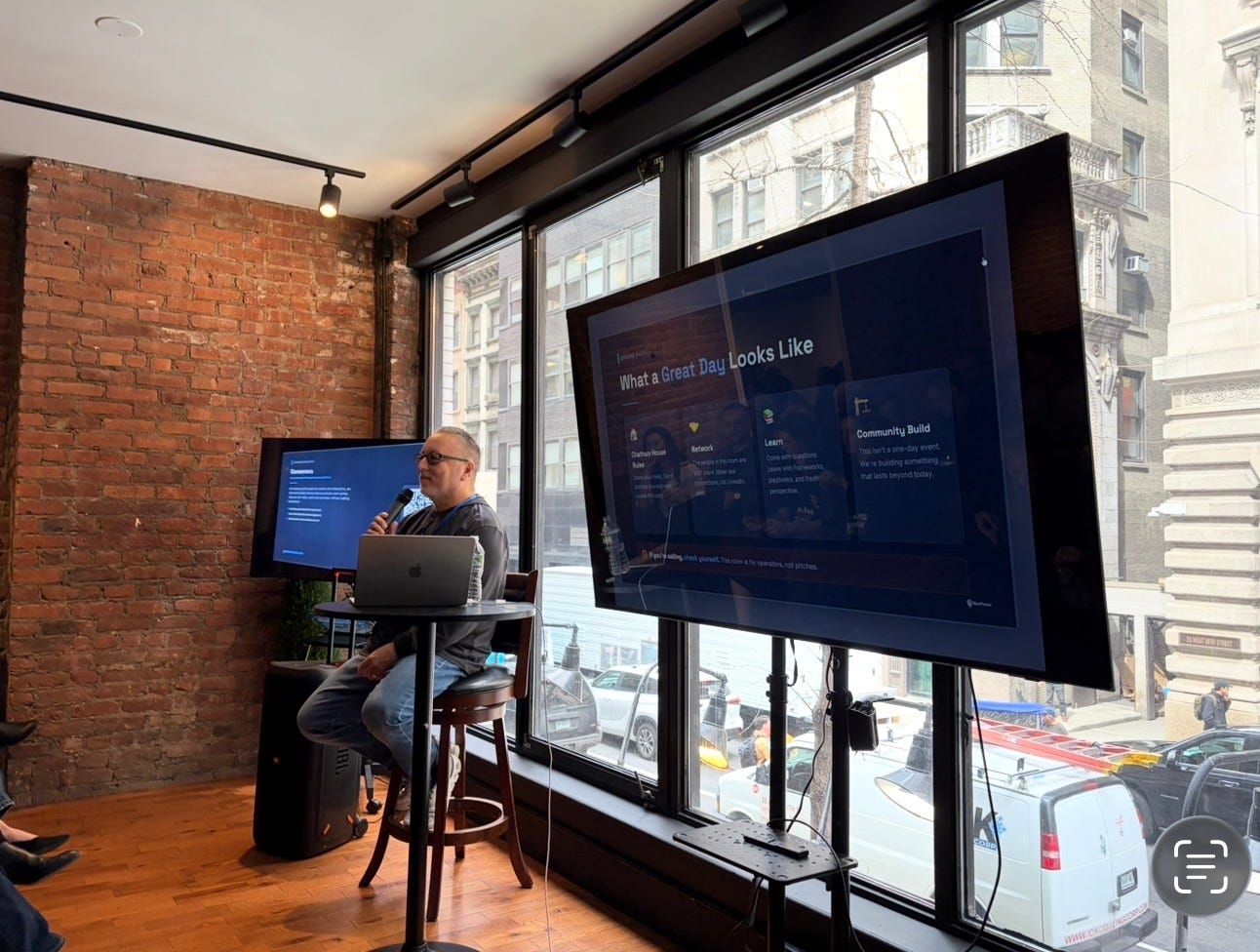
I am too young to retire. at least in my mind.
I am also too old for the grind.
I have no interest in spending the next several years sitting on a beach with nothing to build. But I have equally little interest in returning to the endless meetings, corporate politics, packed calendars, and Sunday-night anxiety that can come with running a large business.
For a long time, those appeared to be the two choices.
Keep grinding or stop working.
I am discovering a third option.
You can build a thriving small business around what you are good at, what you care about, and how you actually want to live.
This is part passion and part lifestyle
When I started BlueThread, I knew I wanted to remain in the partnership world.
I love the work.
I like sitting with a company, understanding how it grows, finding the right partners, and turning a collection of ideas into an operating model that produces revenue.
I still get energy from being in the weeds with customers. Probably more than I ever got from sitting in executive meetings talking about the work.
That is the passion part.
The lifestyle part is just as intentional.
I wanted control over my calendar. I wanted to travel with my wife. I wanted to continue knocking things off the bucket list while I was healthy enough to enjoy them. I wanted the freedom to work from different places without asking anyone’s permission.
I also wanted to create opportunities for a small team of people I enjoy working with.
This was never about working as little as possible.
It was about building a life where work fit into the whole picture instead of consuming it.
A thriving business does not have to become a large company
Corporate life conditions many of us to measure success by size.
How many people report to you? How large is the budget? How much revenue do you control? How quickly can you scale?
When you build your own business, it is easy to carry those same assumptions with you.
More employees. More clients. More products. More complexity.
But I have started asking a different question:
What if the goal is not to build the largest company possible?
What if the goal is to build a highly capable, profitable business that does meaningful work and gives everyone involved a good life?
That is not a lack of ambition.
It is a more precise definition of ambition.
I want Bluethread to thrive. I want our revenue to grow. I want our work to matter. But I do not want to rebuild all the complexity I spent a career learning to navigate.
Small can be a design decision, not a temporary stage before becoming big.
Experience becomes an unfair advantage
Starting a business later in your career has real advantages.
You know what you are good at.
You have lived through enough technology cycles to recognize hype. You have seen strategies fail in the field. You can usually tell the difference between a real customer problem and a fashionable idea looking for a market.
Most importantly, you have accumulated judgment.
I could not have built this business when I was 30.
I might have had more energy, but I would not have had the pattern recognition, relationships, or confidence to ignore what everyone else was doing.
At this stage, I do not need to pretend to know everything. I know where I can create value, and I know when to bring in someone better than me.
That makes the work more focused and, honestly, more enjoyable.
The market still gets the final vote
Experience does not mean you get everything right.
I originally expected Bluethread to be primarily a partnership strategy firm.
Customers pushed us somewhere more interesting.
They did not just need advice about partnerships. They needed help making partnerships work operationally. Their CRM, PRM, automation, attribution, and co-sell workflows were often disconnected.
They needed the machinery fixed underneath the strategy.
That pulled us into Partner RevOps, AI workflows, automation, and hands-on implementation.
The business became better when I stopped protecting my original vision and followed what customers were willing to pay us to solve.
This is one of the things I enjoy most about running a small business.
You can listen, adjust, and move.
There is no eighteen-month transformation plan. There are customers, problems, decisions, and results.
Technology changed what is possible
AI and automation have fundamentally changed the economics of a small company.
A small team can now research markets, analyze accounts, create content, build internal tools, automate workflows, and serve clients with capabilities that once required a much larger organization.
That does not mean everything should be automated.
It means experienced people can spend less time on mechanical work and more time applying judgment.
For someone at my stage of life, that is an incredible combination.
I can bring decades of experience to the work without recreating the infrastructure, headcount, and overhead of the companies where I gained that experience.
We can stay small and operate much larger than we are.
“It doesn’t feel like work” does not mean it is easy
There are still difficult days.
Clients have expectations. Revenue is never guaranteed. Something always needs fixing. When your name is on the business, there is nowhere to hide when you get something wrong.
But difficulty and grind are not the same thing.
The grind is spending your time on work that drains you because the system demands it.
This business feels different because I chose the work, the customers, the people, and the operating model.
Most days, I am doing something I would probably be talking about even if nobody paid me.
Now they do.
That is a pretty good business model.
The third option
We talk a lot about preparing financially for retirement.
We talk much less about what happens when you still have energy, experience, curiosity, and something left to contribute, but no longer want the life that comes with a traditional executive role.
The answer does not have to be another full-time corporate job.
It also does not have to be retirement.
You can build something smaller, more personal, and more aligned with the life you want now.
Something that makes money without making money the only point.
Something built around your experience without being trapped by your past.
Something that gives you a reason to stay engaged while giving you the freedom to enjoy the years you worked so hard to reach.
I am too young to retire and too old for the grind.
It turns out that is a very good age to build.
I’m in my 70s, and this may be the best way to describe where I am.
Too young to retire in my mind. Too old to waste my remaining years on the grind.
I still want to build. I still want to teach. I still want to matter.
I just no longer believe any of those things require sacrificing my time, my health, or the people I love.
Maybe the Third Act isn’t retirement. It’s ambition with better boundaries.
This one resonated a lot. Definitely feeling the pull to simply work for myself and put an end to the crazy expectations others demand of leaders in a company.