


Over the past year, I’ve noticed something happening across nearly every client I work with.
The best operators are accelerating.
Not by 10%.
By multiples.
At first, I assumed they simply had better teams or bigger budgets. But after dozens of conversations, I realized that wasn’t it.
The difference was their tools.
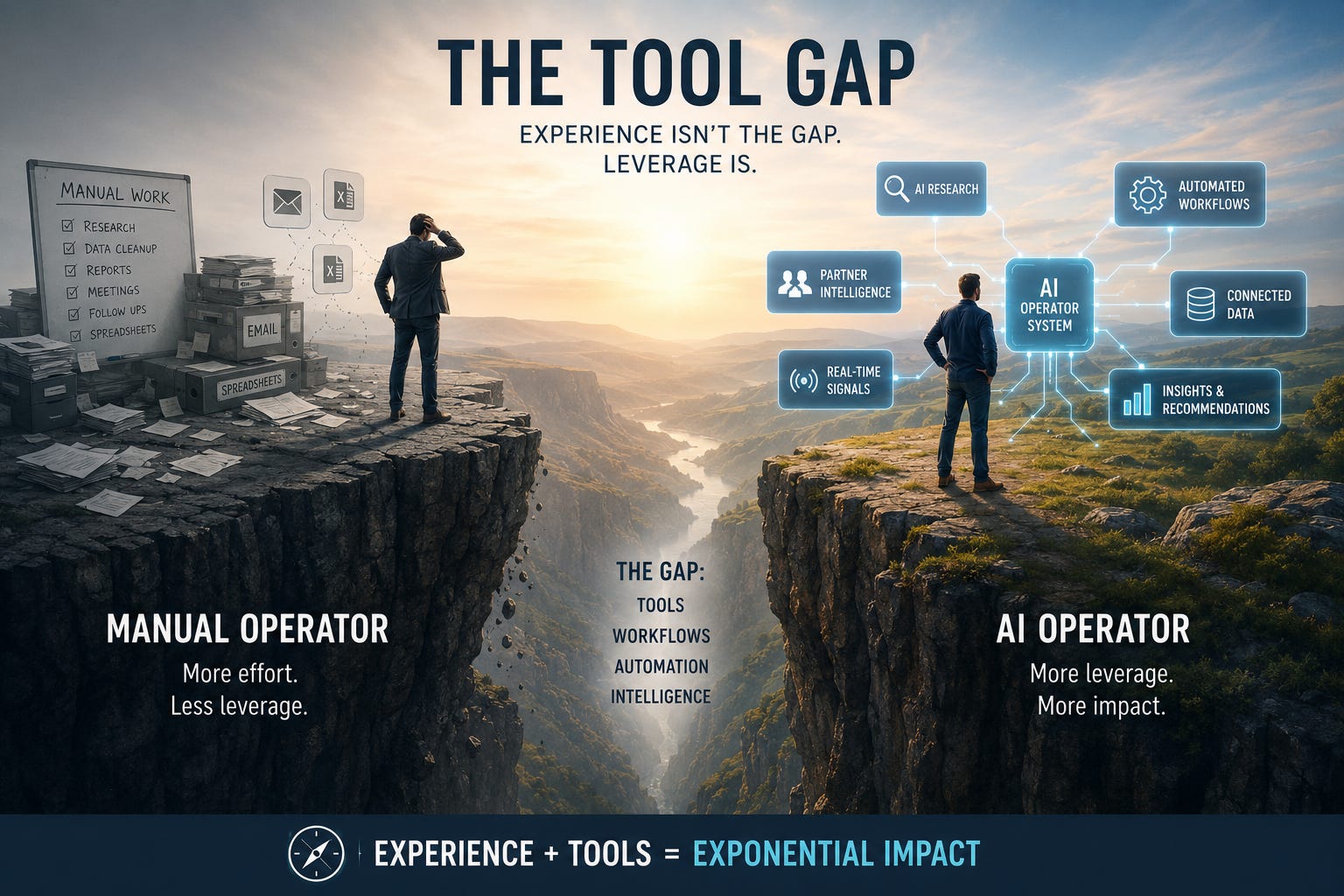
The gap between operators is no longer defined by experience alone. It’s defined by how effectively they combine experience with AI.
I call it the Tool Gap.
The Operator Has Changed
For years, great partnership leaders were measured by their ability to coordinate.
They built relationships.
They navigated internal politics.
They managed partner programs.
They organized meetings, enablement, QBRs, business plans, and executive reviews.
Those skills still matter.
But they’re no longer enough.
Today’s best operators aren’t replacing those fundamentals. They’re amplifying them with an entirely new way of working.
They wake up to overnight market signals.
They use AI to research companies before breakfast.
They automate repetitive work.
They connect data that used to live in five different systems.
They spend less time collecting information and more time making decisions.
The work hasn’t changed.
The leverage has.
The Tool Gap
Every week I hear some version of the same sentence.
“I know AI is important. I just don’t know where to start.”
That’s the gap.
It’s not a lack of intelligence.
It’s not resistance.
It’s not even fear.
It’s simply that the people pulling ahead have developed workflows that compound their judgment.
Think about two partnership operators with ten years of experience.
Both understand ecosystems.
Both know how to build partner motions.
Both can lead executive conversations.
One still spends hours gathering information manually.
The other has AI researching accounts, summarizing partner activity, enriching CRM data, monitoring ecosystem changes, drafting content, and preparing recommendations before the workday begins.
They’re equally experienced.
They’re no longer equally productive.
This Isn’t About Becoming an Engineer
Here’s the interesting part.
I don’t consider myself a software engineer.
In fact, I still tell people I don’t know how to code.
Yet over the past year I’ve built research workflows, AI-powered dashboards, market intelligence systems, and products that simply wouldn’t have been possible for me a few years ago.
Not because I learned to write software.
Because I learned to work alongside AI.
That distinction matters.
Most business leaders don’t need to become developers.
They need enough technical literacy to understand what’s possible.
Just like we all learned CRM twenty years ago, today’s operators need to become comfortable with concepts like connected data, APIs, AI agents, automation, and intelligent workflows.
Not to build everything themselves.
To ask better questions.
To design better systems.
The Four Stages of the Modern Operator
I think we’re moving through four distinct stages.
Stage 1: Manual Operator
Everything runs through spreadsheets, email, meetings, and manual research.
Stage 2: AI Assistant
ChatGPT, Claude, or Gemini help with writing, summarizing, brainstorming, and research.
This is where many organizations are today.
Stage 3: AI Operator
AI becomes part of the workflow.
Research is automated.
Market signals arrive daily.
Partner intelligence is continuously updated.
The operator spends less time finding information and more time acting on it.
Stage 4: AI Operating System
Routine work happens automatically.
AI gathers evidence, surfaces opportunities, drafts recommendations, and monitors change.
Humans focus on judgment, relationships, and decisions.
We’re only beginning to see what this looks like.
The Competitive Advantage Isn’t AI
The biggest misconception I see is that AI itself is the advantage.
It isn’t.
The advantage is how experienced operators use AI to multiply decades of judgment.
Experience without modern tools is becoming less valuable.
Tools without experience create noise.
The winners will combine both.
That’s why I believe the next generation of leaders won’t simply have better technology.
They’ll have better systems.
Better workflows.
Better leverage.
Closing the Tool Gap
The good news is that this gap is still early.
Unlike experience, which takes years to accumulate, modern workflows can be learned surprisingly quickly.
You don’t have to become a programmer.
You don’t need to replace your team.
You don’t need to rebuild your business.
You simply need to start thinking like an operator who designs systems instead of completing every task manually.
That’s the shift I’m seeing.
Not AI replacing operators.
Operators becoming dramatically more capable because they’ve learned how to combine experience with better tools.
The Tool Gap is real.
The question isn’t whether it will affect your business.
The question is whether you’ll be on the widening side of it.