


There’s a moment in a lot of careers that nobody prepares you for.
You’ve done the thing. You climbed the ladder, ran the team, hit the number, earned the title. You’re good at what you do. Maybe great. And yet something shifted, and you can’t quite name it.
You’re not burned out. You’re not failing. You’re just... done building someone else’s thing.
If you’re sitting in that gap right now, 20-ish years of experience, kids in school, mortgage locked in, too much runway left to coast but too much pride to keep phoning it in, I want to help you think through it.
Not sell you on anything. Just think.
Most Careers Have Two Acts. Yours Needs a Third.
Act 1 was the climb. You learned the craft, proved yourself, got promoted, built your reputation. This is the decade where you figured out what you’re good at.
Act 2 was the operator phase. You ran things. Teams, budgets, P&Ls, programs. You went from doing the work to leading the work. This is where most “successful” careers are supposed to peak and then plateau into comfortable seniority.
But there’s a problem with Act 2. At some point, the org stops needing what made you great and starts needing you to manage what someone else is building. The politics get heavier. The distance from real work grows. And you start to notice that the role is shaping you more than you’re shaping the role.
Act 3 is ownership. Not just of a business (though maybe that too), but of your time, your expertise, and your direction. It’s the chapter where you stop asking “what does the company need from me?” and start asking “what do I want to build with everything I’ve learned?”
This isn’t retirement. It’s not a sabbatical. It’s not a crisis. It’s the natural next stage for someone who’s spent two decades becoming world-class at something and is ready to deploy that on their own terms.
The problem is that most people don’t have a framework for Act 3. So they either stay stuck in Act 2 waiting for the next reorg to decide their future, or they make an impulsive leap without a plan. Neither works.
Let me offer a different way to think about it.
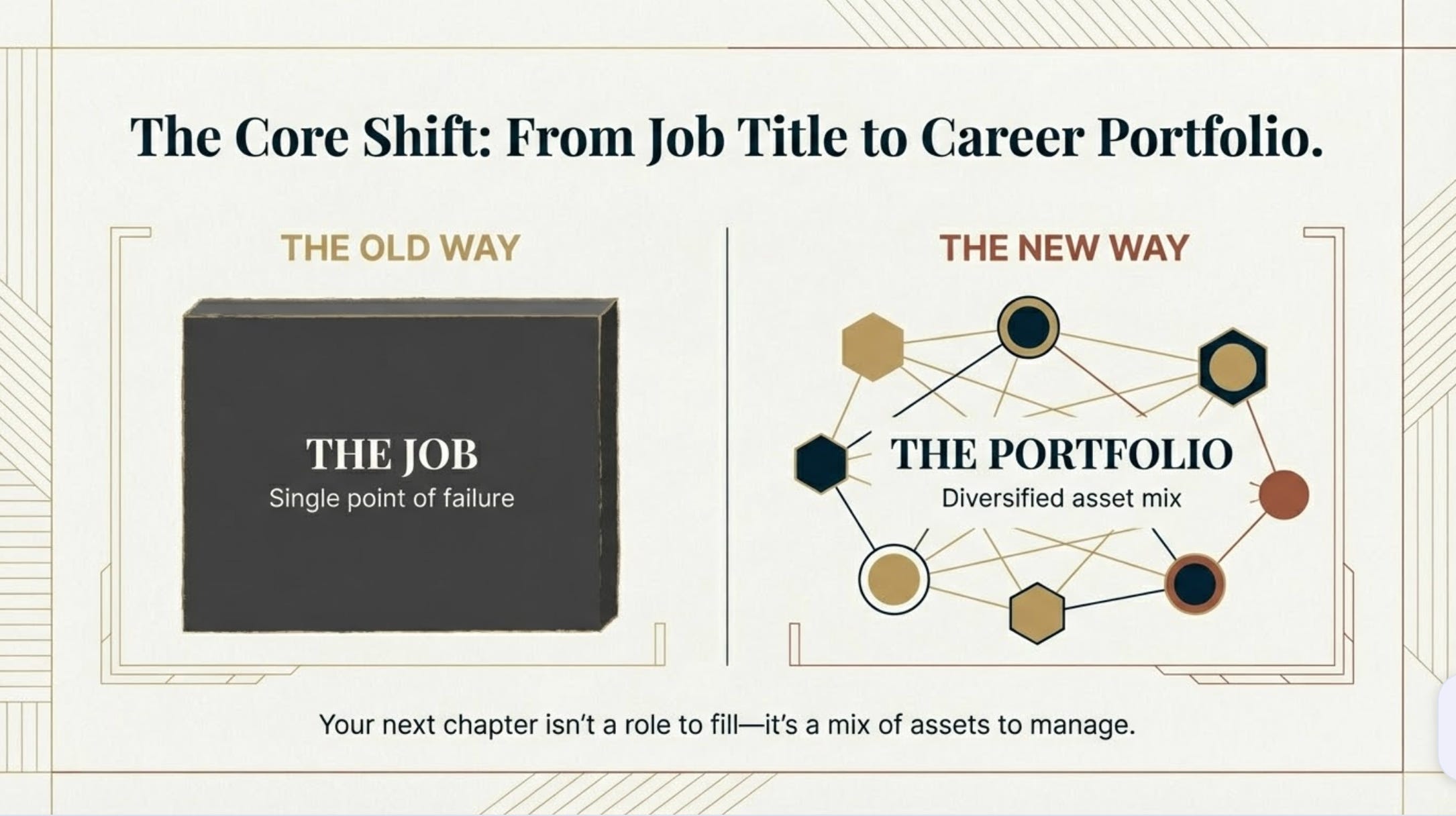
The Portfolio Life: Your Next Chapter Isn’t One Thing
Here’s the mental shift that changed everything for me: your next move doesn’t have to be a single job.
We’ve been trained to think in job titles. “I’m a VP of Partnerships.” “I’m a CRO.” “I’m a GM.” One title. One company. One identity. And when you leave that, the instinct is to find the next version of the same thing, just at a different logo.
But what if the next chapter isn’t a role? What if it’s a portfolio?
Think about what you actually bring to the table after 20 years. You have deep domain expertise. You have a network of relationships built on trust. You have a point of view that companies would pay for. You have the ability to build, teach, connect, and advise.
No single job uses all of that. But a portfolio does.
Here’s what I mean by portfolio:
Advisory work, where you help 2-3 companies solve problems you’ve already solved. Consulting, where you go deeper with one client on a specific initiative. Content, where you share your point of view and build an audience. Community, where you gather the people in your orbit around a shared mission. Training, where you package what you know and teach others.
You don’t need all of these. But you probably need more than one. Because the magic of Act 3 isn’t doing one thing full-time. It’s designing a mix of work that keeps you sharp, keeps you learning, and keeps you connected to the problems you actually care about.
How to Think Through the Transition
If you’re reading this and feeling the pull, here’s a framework that might help.
Start with the 20% question. In your current role, roughly 20% of what you do is the work that lights you up. The stuff where you lose track of time. The problems you’d solve for free. What is that 20%? Name it specifically. That’s the seed of your Act 3.
Audit your expertise like an asset. You’ve been renting your knowledge to an employer at a fraction of what it’s worth on the open market. The playbooks in your head, the frameworks you’ve built, the pattern recognition you’ve developed, those are assets. Not job skills. Assets. What would it look like to deploy them across multiple contexts instead of giving them all to one company?
Map your network honestly. Not your LinkedIn connections. Your real network. The people who take your call, trust your judgment, and would vouch for you without hesitation. That network is your distribution channel for whatever you build next. And here’s the thing most people underestimate: it comes with you. It was never the company’s.
Give yourself a 90-day runway to explore, not execute. The biggest mistake smart operators make is thinking they need a full business plan before they move. You don’t. You need 90 days of conversations, experiments, and small bets. Have 30 coffees. Do two projects for free. Write five posts about what you know. The business model will reveal itself through doing, not planning.
Design for sustainability, not scale. Not everyone needs to build a venture-backed startup. Most people in this gap are looking for meaningful, well-compensated work that gives them autonomy and intellectual stimulation. A portfolio of advisory work, a small community, and a consulting practice can get you there without needing to hire a team of 50.
Your Brand Comes With You
This is the thing I wish someone had told me before I made the move.
I spent years thinking my credibility was tied to the companies I worked for. That the logos were doing the heavy lifting. That without the title and the team, I’d be starting from scratch.
I was wrong.
The relationships I built followed me. The reputation I earned in every room I walked into came with me. The way people described me when I wasn’t around, that was never the company’s brand. It was mine. And yours is yours too.
When you’ve spent 20 years showing up, delivering, and building trust, that doesn’t evaporate when you change your LinkedIn headline. It compounds. And when you finally point all of that credibility at something you own? The leverage is unlike anything you experienced inside a company.
The Real Risk Calculation
Everyone focuses on the risk of leaving. That’s the obvious math. Income, benefits, stability, identity.
But nobody does the math on the risk of staying.
What does another 5 years look like on your current trajectory? Not the best case. The realistic case. Another reorg. Another boss who doesn’t get it. Another year where the distance between you and the work you care about gets a little wider. Another annual review where you perform gratitude for a raise that doesn’t match your impact.
The “safe” path has its own risks. They’re just slower. Quieter. Easier to ignore until you can’t.
I’m not saying everyone should quit tomorrow. That’s not the point.
The point is this: if you’ve been feeling like you’ve outgrown the container, that feeling is data. The most important data you have. And the framework for what comes next isn’t “find another job” or “start a company.” It’s something more intentional than either of those.
It’s designing your Third Act.
One More Thing
You’re not starting over. That’s the fear, but it’s not the reality.
Every hard conversation you navigated, every deal you closed, every team you built, every executive you brought along, all of it is inventory. It’s not behind you. It’s available to you, in ways a corporate role never fully let you use.
The logo was never the thing.
You were the thing.
Now it’s time to build around that.
This could not have come at a better time. The Third Act could be the most dynamic and fulfilling. I am excited about the next chapter. My son said mom, " I am so proud of you". I am writing my own playbook.
Absolutely spot on and really well reasoned. The asset portfolio of experience and expertise is far more valuable on the open market. There's a tradeoff of risk and comfort ... but a lot more freedom and energy from work you actually care about. I've said it to many execs over the past 15 years: come on in ... the water's fine ... as long as you're cool with a bit of uncertainty. But that's why subscription-based service models exist. :-)