


The technology industry has been cycling through two emotional states for the better part of three years.
The first is existential dread. AI is coming. Jobs are evaporating. The future is uncertain. Every week brings another analysis of what will disappear, what can’t be replicated, what humans will be left doing when the machines get good enough. The tone is apocalyptic. The subtext is helplessness.
The second is its mirror image: obsessive optimization. Move faster. Ship more. Stack your routines. Maximize your output windows. Sleep less. Systemize everything. If you’re not compounding, you’re falling behind. The tone is relentless. The subtext is that rest is a form of failure.
Both of these are responses to the same anxiety.
Neither one is a framework for a life.
I had lived in California all my life, a large part of it, in the Bay Area.
People come here for a lot of reasons. The opportunity. The energy. The proximity to things that matter in tech. The gold rush, in whatever form it’s taking this decade.
What I’ve noticed is that the people who came to chase something are often the most anxious. The locals, the people who were already here, who built their lives here before the industry arrived, tend to have figured something out that the chasers haven’t.
They’re not slower. They’re clearer.
The ocean doesn’t care about your valuation. The beach at 6am doesn’t care about your pipeline. There’s something that happens when you actually live somewhere instead of just occupying it while you chase the next thing.
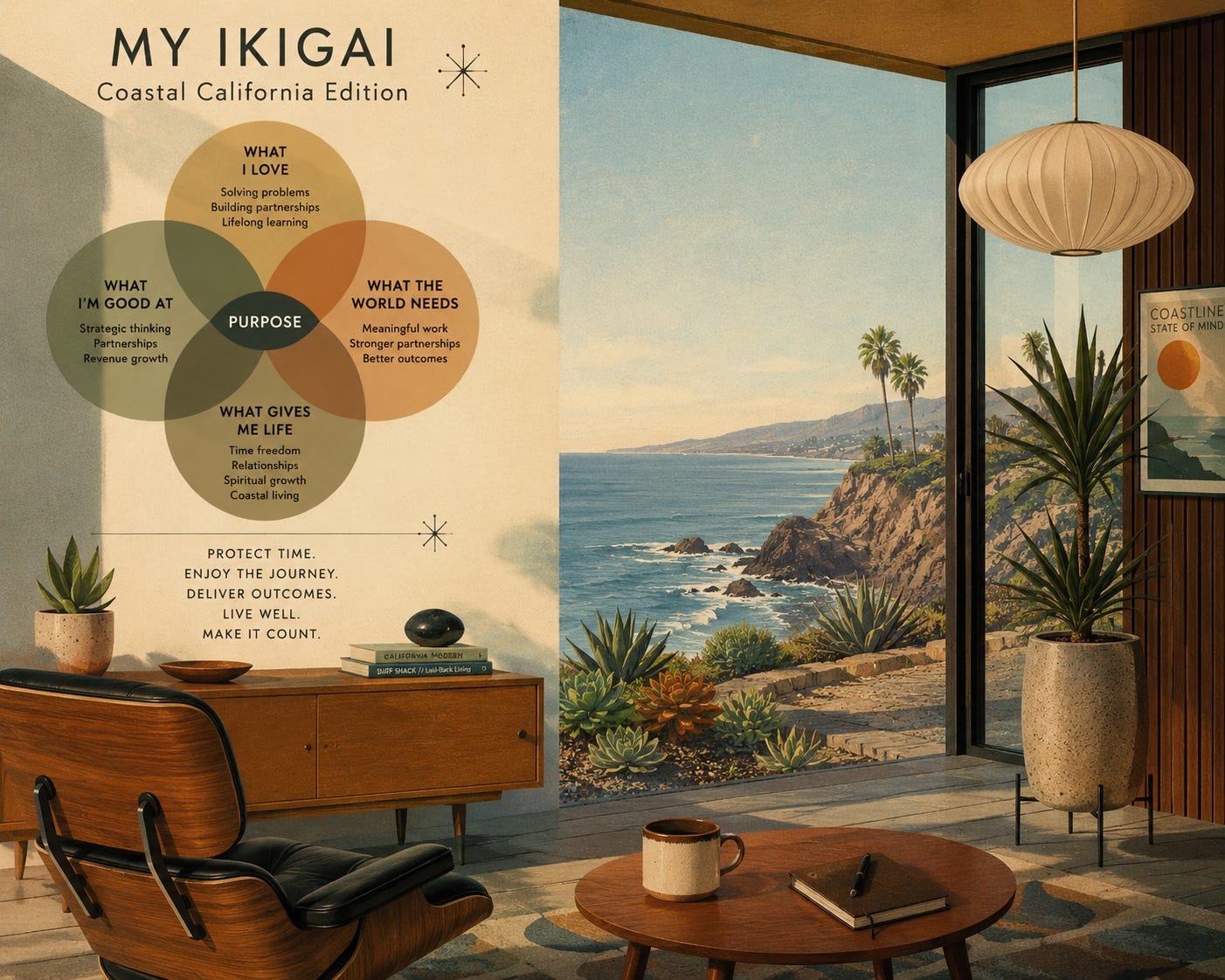
I’ve been building Bluethread for a year. Partnership advisory, RevOps, community. A small team. Clients I respect. Work that has evolved in ways I didn’t fully anticipate when I started.
What I’ve arrived at, after 25+ years in this industry and two years building something of my own, is a set of filters I apply to almost every decision.
Time. Will this protect or consume it? I’m fiercely protective of time now in a way I wasn’t at 35. Not because I have less of it, but because I finally understand what it’s worth. The work that belongs in the business is work that earns its place on the calendar. Everything else is noise.
Enjoyment. Will I actually want to do this? Not in a soft, preference-based way. In a practical, sustainability way. Work you resent is work you eventually do poorly. The clients I’ve kept longest are ones I genuinely want to solve problems with. That’s not coincidence.
Outcomes. Can we create something that actually matters? Not impact in the vague sense. Specific, measurable movement for the people I work with. If the answer is unclear at the start, we figure it out before the engagement begins.
These aren’t values statements. They’re filters. And they’ve shaped every decision I’ve made since I started Bluethread.
The tech industry doesn’t talk much about this kind of deliberateness.
It talks about disruption. Velocity. Market positioning. Competitive moats. Growth trajectories.
The doomer conversation and the hustle conversation share more DNA than either side would admit. Both are obsessed with external forces. Both measure success in terms of what’s happening to you, or what you’re producing, rather than what kind of life the work is actually supporting.
The question nobody asks in a pitch deck is: does this founder sleep?
The question nobody asks in an AI displacement conversation is: what would you actually choose to do with your time if you had more of it?
I don’t wake up with Sunday dread anymore. That sounds small. It isn’t.
For most of my career, the Sunday feeling was background radiation. The cost of playing the game. You absorbed it the way you absorbed airport delays and all-hands meetings and quarterly reviews that moved the goalposts.
I don’t miss it.
The beach is six miles away. My succulent garden is thriving. My spiritual life is trending in the right direction. I’m still on the adventure with my wife of 30+ years. These aren’t footnotes to the professional story. They are the point.
The business works because the life works. Not the other way around.
The people who come to Northern California to chase something often burn out or move on. The people who stay, who actually plant themselves here and build a life instead of a career, tend to understand something that the rest of the industry is still working out.
That the goal was never the gold.
It was always what you were going to do once you stopped running.
If you’re in the tech industry and you’ve been oscillating between the doom scrolling and the optimization content, I’d offer a third option.
Get clearer about what you’re actually building toward.
Not the product. Not the company. The life.
The work should support that. If it doesn’t, it’s not a strategy problem. It’s a design problem.
The window for building something deliberate doesn’t close at 40 or 50. In many ways it opens. You finally know enough about yourself to stop making choices based on what looks impressive and start making choices based on what actually fits.
That’s not a soft take.
That’s what the data looks like after enough time in the industry.
Rob Moyer is the founder of Bluethread LLC, a B2B partnerships advisory firm. He writes about partner revenue infrastructure, ecosystem strategy, and the operational mechanics of building something that lasts.