


Welcome to 2026.
If you work in Partnerships or Business Development, take a moment to look around. The landscape hasn’t just changed; it has transformed.
Five years ago, the industry was rife with anxiety. There were whispers—sometimes shouts—that Artificial Intelligence would automate the “human touch” out of business. The fear was that algorithms would replace the handshake, and automated outreach would replace the relationship manager.
The reality has proven otherwise. Technology has not replaced relationships; it has enhanced them. It cleared away the administrative clutter, leaving us with the pure essence of what we do best: connection.
We have officially entered the era of the Data-Driven Diplomat.
The Death of the “Just a People Person”
For decades, the stereotype of the BD professional was the “schmoozer”—the person who was great at dinners, golf courses, and conferences. While charisma is still valuable, in 2026, it doesn’t scale.
The modern partnership leader is a hybrid professional. They serve as the bridge between human trust and measurable ROI. They operate at the intersection of empathy and analytics.
Why the shift? Because in the modern enterprise, “trust” gets you in the room, but “data” keeps you at the table. We can finally demonstrate our value and scale our impact, making Partnerships not just a department, but the primary growth engine for the organization.
The 2026 Partnership Skill Stack
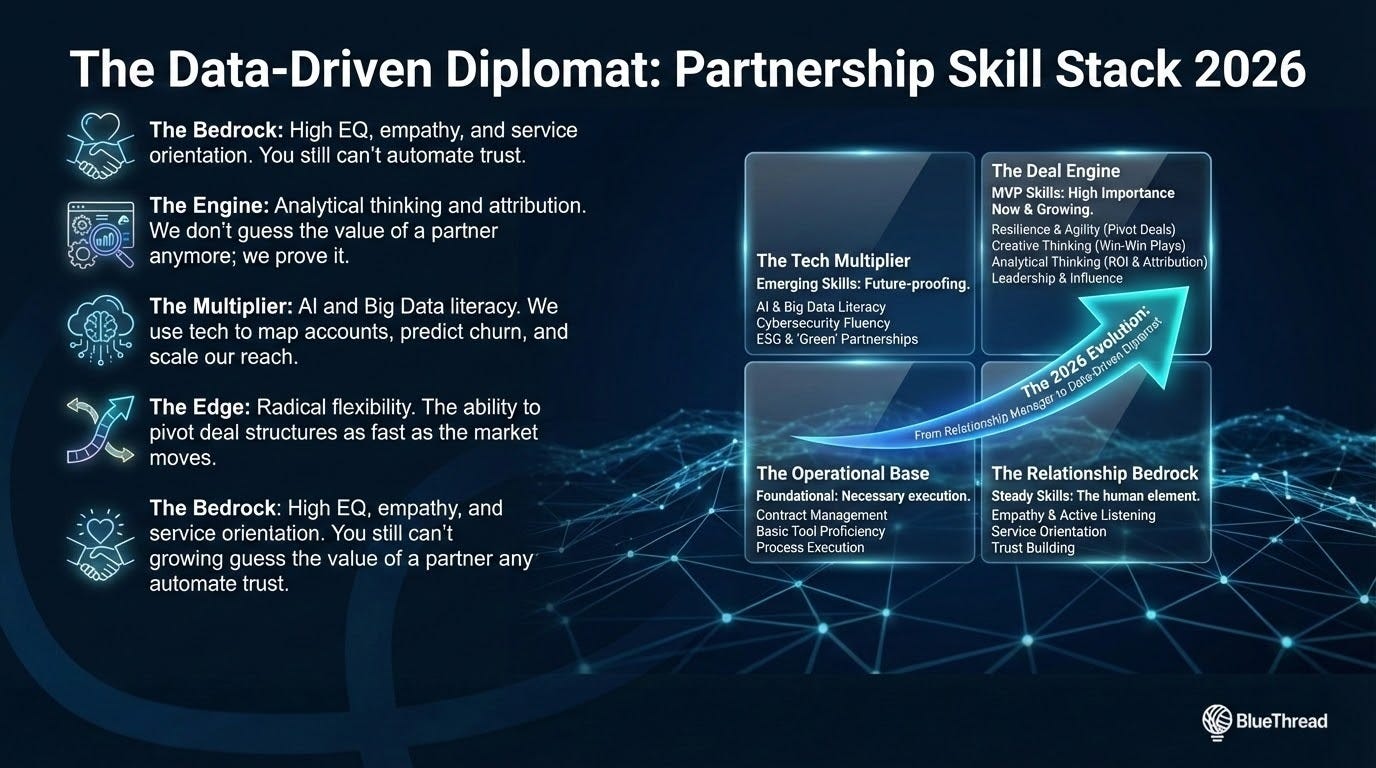
To thrive in this new environment, we have to look at our skills in quadrants. Here is the framework for the modern Data-Driven Diplomat:
1. The Bedrock: EQ and Service Orientation
What it is: High emotional intelligence, deep empathy, and a service-first mindset.
Why it matters: You cannot automate trust. As AI handles the quantitative side of deal-making, the premium on genuine human connection has actually gone up. The ability to read a room, understand unstated motivations, and navigate complex internal politics is the foundation that everything else is built upon.
2. The Engine: Analytical Thinking and Attribution
What it is: The ability to trace revenue back to influence.
Why it matters: We no longer guess the value of a partner; we prove it. The days of “fuzzy KPIs” are over. The modern BD leader speaks the language of the CFO. They understand attribution modeling, ecosystem-qualified leads, and can draw a straight line from a partnership activity to the bottom line.
3. The Multiplier: AI and Big Data Literacy
What it is: Proficiency in leveraging technology to do the heavy lifting.
Why it matters: This is where we scale. We use AI not to write our emails, but to map our accounts, predict churn before it happens, and identify “white space” opportunities in partner ecosystems that a human eye would miss. If you aren’t using data to inform your outreach, you are flying blind.
4. The Edge: Radical Flexibility
What it is: The agility to pivot deal structures instantly.
Why it matters: The market moves faster than ever. Rigid, template-based partnership agreements are fossils. The “Edge” belongs to those who can adapt deal structures swiftly in response to market changes, regulatory shifts, or new technological capabilities.
Looking Ahead
The best part about operating in 2026 is the clarity. We are no longer fighting for a seat at the table or trying to justify our existence with vague promises of “brand awareness.” We have the receipts.
The Data-Driven Diplomat is the most valuable asset in the modern company because they possess the unique ability to humanize the data and quantify the relationship.
I’d love to hear from you in the comments: Looking at the Skill Stack above, which quadrant are you doubling down on this year? Are you sharpening your “Engine” (Analytics) or polishing your “Bedrock” (EQ)?