


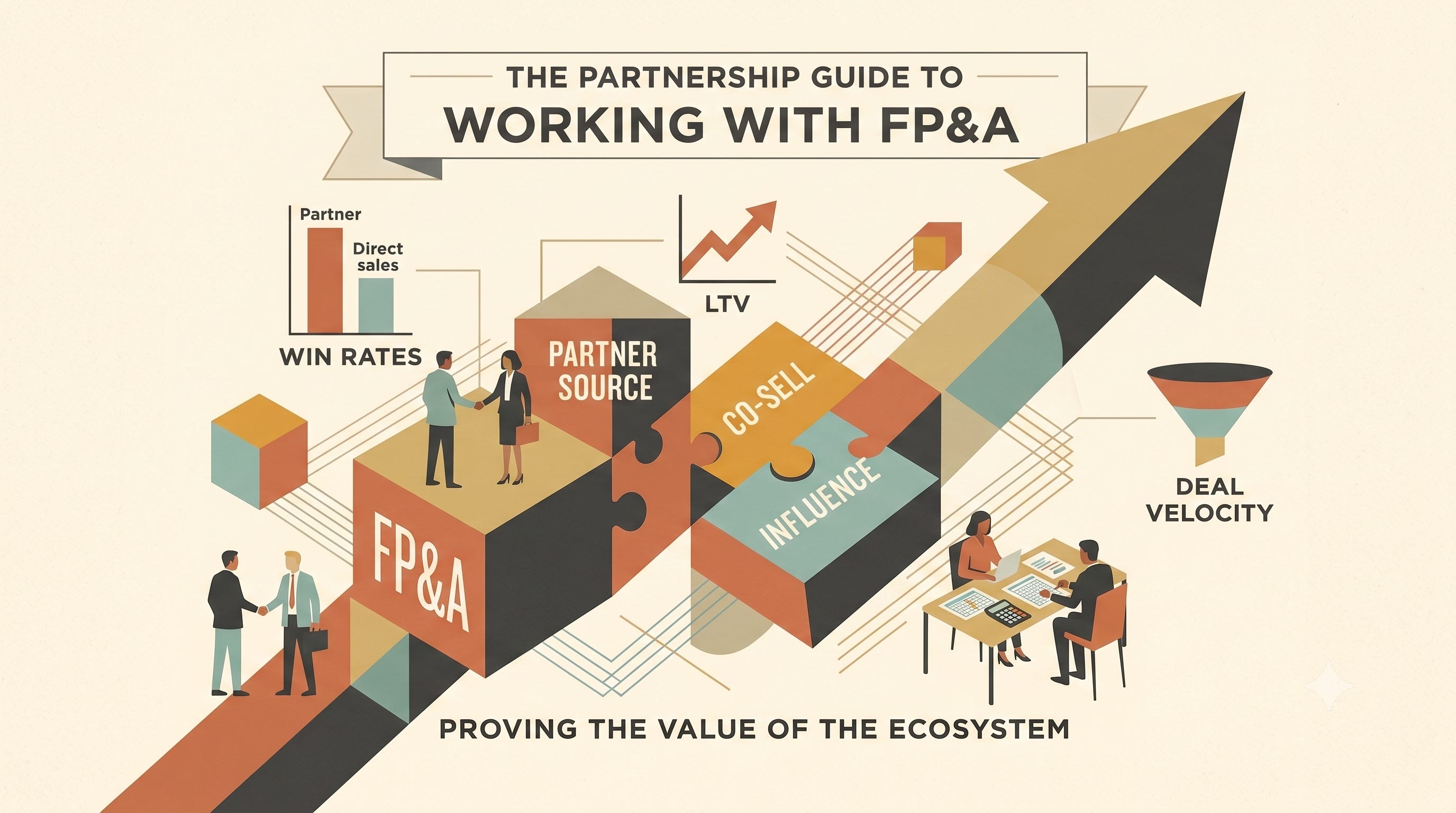
If you’re a partnership leader, you’ve probably had a conversation that felt a bit like a cultural mismatch. You’re talking about “ecosystem synergy,” “co-sell momentum,” and “influence loops.” Meanwhile, the person across the table is staring at a spreadsheet, asking about customer acquisition cost (CAC) and payback periods.
Welcome to the world of FP&A (Financial Planning & Analysis).
If you want to protect your budget, scale your team, and unlock serious resources for your partner program, FP&A shouldn’t be a department you fear. They should be your closest strategic ally.
Here is your Substack guide on how to speak their language, align on the metrics that actually move the needle, and prove why partnerships are finance’s best friend.
1. First Things First: What is FP&A (and Why Should You Care)?
Think of FP&A as the navigation system of the company. While the accounting team looks backward to record what has happened, the FP&A team looks forward to project what will happen. They manage the company’s budget, forecast future revenue, and decide where the business should invest its next dollar.
💡 Why they matter to you: FP&A holds the keys to the castle. If they don’t understand how partnerships drive the bottom line, your program will always be viewed as a “discretionary cost” rather than a “growth engine.” When macroeconomic shifts happen and hard choices must be made, discretionary costs are the first to get cut.
To win them over, you have to move past vanity metrics (like “number of registered partners”) and talk about the mechanics of revenue efficiency.
2. Why Partner Attribution is Non-Negotiable
FP&A loves predictability. If they put $1 into marketing, they want to know exactly how many dollars come out the other side. Because partnerships can be structurally complex, strict partner attribution is your ticket to internal credibility.
You need to cleanly categorize your revenue into three clear buckets:
Partner-Sourced: Net-new pipeline brought entirely by a partner. Finance views this as highly efficient, ultra-low CAC revenue.
Co-Sell: Deals where a partner and your direct sales team worked hand-in-hand to navigate the account and close the business.
Partner-Influenced: Deals where a partner didn’t originate the lead, but accelerated the deal velocity, shaped the scope, or unblocked a stuck executive stakeholder.
Why FP&A cares: If you can’t accurately attribute revenue, FP&A automatically assumes it was a pure direct sales win. By cleanly segmenting sourced, co-sell, and influence, you give FP&A the exact data points they need to build accurate revenue forecasting models and calculate the true ROI of your channel.
3. The Metrics FP&A Actually Cares About: Partner vs. Direct
To really grab finance’s attention, you need to show how partner-assisted deals compare to pure direct-sales deals. When you pit them head-to-head, partnerships almost always win on unit economics.
Here are the specific comparisons you should bring to your next FP&A alignment meeting:
📊 Win Rates (Partner vs. Direct)
The Metric: The percentage of pipeline opportunities that successfully close.
Why FP&A cares: A higher win rate means your sales team wastes less time on dead ends. If partner-led or co-sell deals have a 15% higher win rate than direct deals, FP&A realizes they can model higher future revenue without needing to hire additional high-cost sales reps.
⏱️ Deal Velocity (Sales Cycle Time)
The Metric: How many days it takes a deal to move from initial creation to closed-won.
Why FP&A cares: Time is money. If partner influence shrinks the sales cycle by 20%, it means working capital frees up faster, cash flow improves, and revenue is recognized on the balance sheet much sooner.
💰 Average Contract Value (ACV) & LTV
The Metric: The size of the initial deal, and the lifetime value of the customer.
Why FP&A cares: Co-sell and partner-influenced deals often result in larger initial contract sizes and better long-term retention (lower churn). When FP&A sees that partner-backed customers stay longer and buy more, your channel instantly becomes a capital-allocation priority.
Quick-Reference Comparison Table
Win Rate * Direct: Baseline
Partner Co-Sell / Influenced: Higher
Why FP&A cares: More predictable revenue, less wasted sales effort.
Sales Cycle * Direct: Baseline
Partner Co-Sell / Influenced: Faster
Why FP&A cares: Accelerates cash flow and revenue recognition.
ACV / Deal Size * Direct: Baseline
Partner Co-Sell / Influenced: Larger
Why FP&A cares: Better utilization of account executives.
The Bottom Line
FP&A isn’t trying to slow you down; they are trying to optimize the business.
When you show up to a finance meeting armed with clear attribution data and a side-by-side comparison of partner efficiency versus direct sales, you change the conversation entirely. Stop asking for budget based on “ecosystem potential.” Start proving your impact using win rates, deal velocity, and ROI.
Once FP&A sees that partnerships are the most efficient growth lever in the company, they won’t just fund your program—they’ll help you scale it.
What about you? How does your organization handle partner vs. direct attribution in your financial models? Drop a comment below or reply directly to this email newsletter to share your strategies!
This is exactly the conversation channel leaders need to be having more often.
FP&A should not be seen as the group that blocks channel investment. They should be seen as the team that helps validate, protect, and scale it.
The challenge is that partnerships often create value in ways that are not always cleanly captured by traditional attribution models. Partner-sourced is important, but partner-influenced and co-sell motions are where a lot of real revenue acceleration happens.
If a partner helps shorten the sales cycle, open an executive door, improve win rates, increase deal size, or reduce CAC, that is measurable value, but only if we are disciplined enough to track it.
Channel leaders cannot go into budget conversations with “we need more because partners matter.” We have to walk in with data, business impact, and a clear story around revenue contribution.
That is how channel moves from being perceived as a cost center to being recognized as a strategic growth engine.