


Ask a partner leader what makes a great hire, and you’ll usually get some version of the same answer.
Someone who builds relationships.
Someone who can run a joint pitch without a script.
Someone the field trusts.
Those things still matter.
But they are no longer a very good description of what the market is actually hiring for.
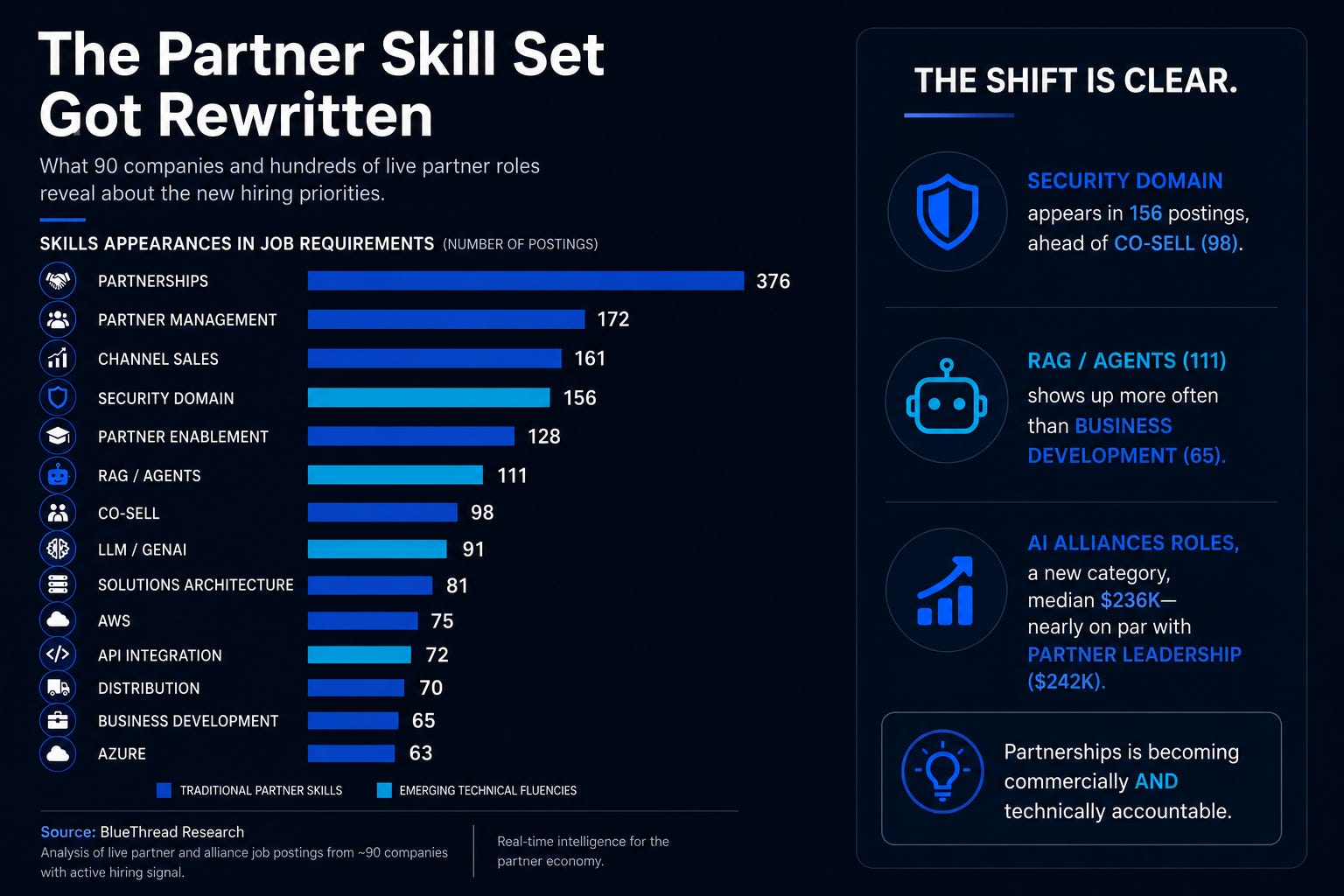
We pulled every skill listed across the live partner and alliance job postings we track at BlueThread, covering roughly 90 companies with active partner hiring signal, and ranked them by how frequently they appeared in the requirements.
Not what partnership leaders say they want.
What companies are actually putting into job descriptions.
The results suggest the partner skill set is undergoing a fairly significant rewrite.
Look at what companies are actually asking for
Among the most frequently appearing skills and domains in the roles we track:
Partnerships: 376
Partner management: 172
Channel sales: 161
Security domain: 156
Partner enablement: 128
RAG / agents: 111
Co-sell: 98
LLM / GenAI: 91
Solutions architecture: 81
AWS: 75
API integration: 72
Distribution: 70
Business development: 65
Azure: 63
Some of those rankings are intuitive.
Others are not.
Security domain knowledge appears in 156 of the postings we track.
Co-sell appears in 98.
RAG and agent experience appears in 111.
Business development, arguably the credential that has anchored partner hiring for the last two decades, appears in 65.
That is a meaningful difference.
It suggests something bigger than companies simply adding a few AI keywords to existing partner jobs.
The underlying skill profile is changing.
Partnerships are becoming a technical discipline
For most of the modern SaaS era, partner organizations were fundamentally commercial organizations.
Their job was to build relationships, recruit partners, create joint value propositions, enable sellers, generate pipeline and help deals move through the field.
Technical expertise existed inside the ecosystem, of course.
But it often sat somewhere else.
Solutions engineering handled architecture.
Security handled security.
Product handled integrations.
Partner managers coordinated the relationships between all of them.
That model is getting harder to maintain.
Two forces are pushing technical fluency directly into the partner role.
Force #1: Security moved into the revenue process
Enterprise deals increasingly route through security before they reach a purchase decision.
That changes the job of anyone responsible for helping those deals move.
A partner professional who can create pipeline but cannot navigate a conversation about SOC 2, data residency, identity, permissions or a vendor security review becomes dependent on someone else to advance the deal.
Companies appear to have noticed.
Instead of treating security knowledge as something a partner manager can borrow from another team, they are increasingly putting that fluency directly into the hiring requirements.
That is why the security number matters.
It is not simply evidence that cybersecurity companies hire partner people.
It reflects a broader change in where technical credibility sits inside an enterprise buying process.
The closer partnerships move to revenue execution, the harder it becomes for the function to remain technically abstracted from the product being sold.
Force #2: AI created an entirely new partner surface area
The second force is happening even faster.
Every hyperscaler, infrastructure company and software vendor with an AI strategy is building some form of ecosystem around it.
That ecosystem includes model providers, cloud platforms, vector databases, observability companies, agent frameworks, data platforms, implementation partners and application vendors.
Those relationships require a different type of conversation.
A partner leader does not need to become a machine learning engineer.
But increasingly, they do need to understand enough to answer questions like:
Where does the model sit?
Where does the customer’s data sit?
What does retrieval actually do?
What is the difference between a workflow and an agent?
Where does an orchestration framework fit?
How does the integration work?
Who owns the customer relationship?
What happens to the data moving between systems?
Those aren’t edge-case technical questions anymore.
They determine whether two companies actually have something meaningful to partner around.
And you cannot fake that fluency very long in front of a technical buyer.
That helps explain why RAG / agents appears in 111 postings in our tracked cohort while business development appears in 65.
The partner function is not becoming less commercial.
It is becoming commercially AND technically accountable.
The compensation data points in the same direction
Skill requirements tell one side of the story.
Compensation tells another.
If technical ecosystem roles were simply an experiment by hiring managers, you might expect companies to add new titles without meaningfully changing what they were willing to pay.
That isn’t what we see.
Across roles in BlueThread Mesh where employers disclosed compensation, the median for AI Alliances is approximately $236,000.
For context:
Partner Leadership: $242,000 median
AI Alliances: $236,000 median
Partner Manager: $186,000 median
There is an important caveat here.
The AI Alliances number comes from only nine disclosed postings in our current coverage, compared with forty disclosed ranges for partner leadership.
It is a small sample.
I would not treat $236,000 as some definitive market benchmark for AI alliance professionals.
But I do think the relative positioning is interesting.
A role family that barely existed as a distinct hiring category a few years ago is being priced surprisingly close to roles responsible for running entire partner organizations.
That is a market signal worth watching.
The floor didn’t disappear. The ceiling moved.
This is where I think the interpretation matters.
Classic partnership skills are not becoming obsolete.
You still need to build trust.
You still need to understand incentives.
You still need to get two sales organizations to cooperate.
You still need to create joint value propositions, enable sellers and generate revenue.
Those skills remain the foundation of the profession.
But foundations rarely create differentiation.
The emerging premium appears to be going to people who can layer another capability on top of those traditional partnership skills.
Partner + security.
Partner + AI infrastructure.
Partner + solutions architecture.
Partner + cloud.
Partner + APIs.
That changes both how companies should hire and how partnership professionals should think about their careers.
If you’re hiring, stop writing generic partner job descriptions
Look at almost any partner job description and you’ll still find some variation of:
“Excellent relationship-building skills.”
“Strong communicator.”
“Ability to influence cross-functional stakeholders.”
“Experience building strategic partnerships.”
None of those requirements are wrong.
They are simply insufficient.
If the role requires someone who can navigate an enterprise security process, say that.
If they need to understand AI infrastructure, say that.
If they need to work alongside solutions architects, specify what level of technical fluency that actually requires.
“Technical aptitude” is not a useful requirement.
Security review experience and AI infrastructure literacy are not interchangeable skills.
Neither is equivalent to API integration experience.
The more specific the requirement, the more likely you are to hire the person you actually need.
And companies should be equally honest about which role family they are hiring into.
A Partner Manager role and an AI Alliances role should not be identical job descriptions with different titles.
The skill data suggests they are different jobs.
The compensation data suggests the market knows it too.
If you’re already in partnerships, build a second fluency
The career implication is equally important.
If your resume still leads with pipeline influenced, deal registrations, partner recruitment and co-sell wins, keep those things.
They prove you understand the core job.
But they increasingly describe the baseline.
The next question is:
What else can you speak fluently about?
Security might be that second language.
AI infrastructure might be another.
Cloud architecture, APIs, data infrastructure or solutions engineering could be others depending on the ecosystem you work in.
You do not need to become the technical expert in the room.
You need enough fluency that the technical experts don’t have to translate the entire conversation for you.
There are practical ways to start.
If you have never sat through a security review, join the next one as an observer.
If you work around AI but cannot explain RAG without using marketing language, spend an afternoon building a basic retrieval workflow.
Sit in on architecture calls.
Talk to your solutions engineers.
Ask technical buyers why they chose one integration architecture over another.
Read the documentation for the products your partners actually sell.
Technical credibility compounds surprisingly quickly when you are already good at the commercial side of partnerships.
This may also change who becomes a partner leader
There is a second-order effect here that I think is even more interesting.
Historically, partnership leadership has often grown out of business development, sales or existing alliance organizations.
That made sense when the core competency of the function was primarily commercial orchestration.
But if technical fluency becomes a bigger part of the job, the talent pool changes.
Some of the best future ecosystem leaders may come from solutions engineering.
Some may come from product partnerships.
Some may come from cloud architecture.
Some may come from security.
And some will be traditional partner professionals who deliberately built enough technical depth to operate across those worlds.
That could reshape the profession more than any individual AI tool does.
Because once the hiring profile changes, the leadership profile eventually changes with it.
A caveat about the data
This analysis reflects the companies currently tracked in BlueThread Mesh, not the entire partner job market.
Our current cohort includes roughly 90 companies with live partner hiring signal collected from public job postings.
That creates selection effects.
The companies hiring aggressively today are not necessarily representative of every company with a partner organization.
Our AI Alliances compensation sample is particularly small.
And job descriptions themselves are imperfect indicators of what people actually do once they get hired.
So I would treat the precise counts as a view into the market we are watching, not a census of the profession.
But the directional signal is difficult to ignore.
Security and AI fluency are appearing alongside, and in several cases ahead of, skills that have traditionally defined partnership careers.
That is enough to make the shift worth paying attention to.
The job description is catching up to the job
For years, the archetype of a great partner professional was someone who could walk into a room, build trust quickly, understand the incentives on both sides and get two organizations moving in the same direction.
I don’t think that archetype disappears.
I think another requirement gets added to it.
The next generation of great partner professionals will still know how to build relationships.
They will still know how to sell.
They will still know how to navigate organizations.
But increasingly, they will also understand the technology well enough to participate in the conversations that determine whether the partnership actually works.
The partner skill set already started rewriting itself.
The job descriptions are beginning to show it.
The resumes will be next.