


Last week I finished a discovery call and did what I always do. I made a note to follow up later in the day.
When I sat down to do it, it took about ten minutes to go from “time to follow up” to a proposal and email in the prospect’s inbox.
Dust pulled everything it needed: the call from Granola and Gong, the email thread from Gmail, and the deal history from HubSpot. Then it went into my Obsidian vault for the frameworks and precedent I use in engagements like this, and wrote a directional brief: what they need, what to scope, what to price, what to leave out. I handed that to Claude. Claude wrote the proposal, then helped me draft the email. I read both, made my edits, and hit send.
That same follow-up used to take me a few hours.
And since I put this system in place, my close rate has been above 50%.
This isn’t a post about how great my agency is. BlueThread is nine months old. It’s a post about the operating model underneath it, because I think any small firm, or any partner team inside a bigger company, can run the same thing. So steal it.
The problem: context is the job
A small firm doing enterprise-grade work lives or dies on context.
What did we scope for a similar client last time? How did we price it? What did this prospect say on the call about their partner program, their board, their timeline? What’s our position on co-sell versus resale for a company at their stage?
In most firms, that context is scattered across six tools and one founder’s head. Every proposal starts from a blank page and a memory search. That’s where the hours go, and it’s why quality drifts depending on how tired you are.
I didn’t want to hire my way out of that. I wanted to build a brain first.
The model, layer by layer
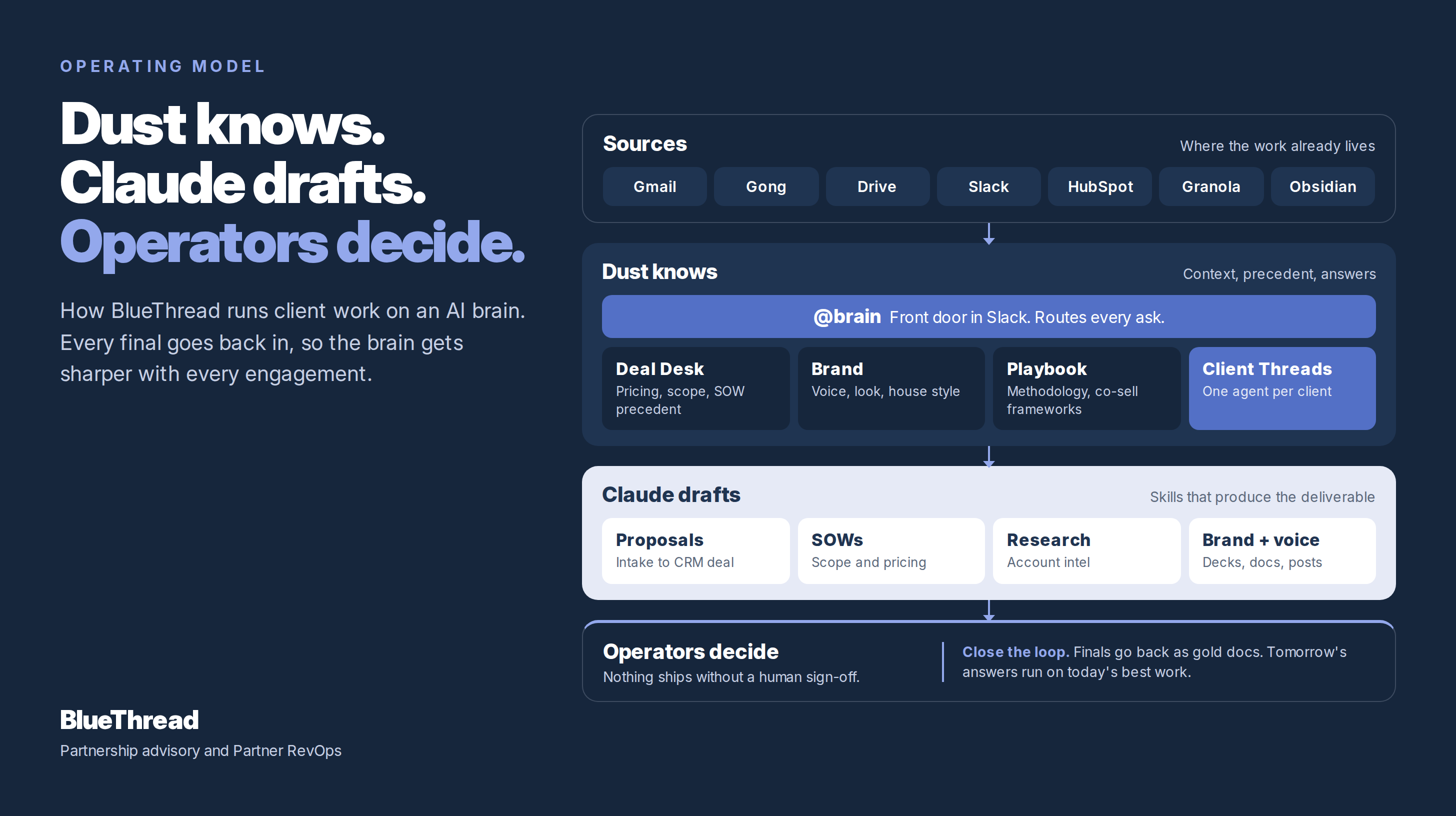
1. Sources: where the work already lives
Gmail, Gong, Drive, Slack, HubSpot, Granola, Obsidian.
The first rule: don’t move the work. Connect to it. Every system you ask people to copy things into is a system that goes stale in three weeks. The calls are already recorded. The emails are already in Gmail. The deals are already in HubSpot. The brain reads from where the work happens. The one exception is our Obsidian vault, which we maintain on purpose. It lives in GitHub so the whole team shares it, and we update it every Friday.
In practice, that means when I sit down to follow up, Dust already has the call, the emails and the deal record. I don’t go hunting for anything.
2. Dust knows: context, precedent, answers
Dust is the knowledge layer. There’s one front door, @brain in Slack, and it routes every question to the right specialist:
Deal Desk: pricing, scope and SOW precedent. “What did we charge for a partner program assessment at a company this size?”
Brand: voice, look and house style, so nothing we send sounds like a template.
Playbook: our methodology and co-sell frameworks. This is the IP.
Client Threads: one agent per client, so the full history of an engagement is one question away.
The point of splitting it up is trust. When Deal Desk answers a pricing question, I know it’s drawing on real deals, not a guess.
3. Claude drafts: skills that produce the deliverable
Dust knows things. Claude makes things.
The difference matters. I don’t want a chat reply about what a proposal could say. I want the proposal. So Claude runs as a set of skills, each built to produce one specific deliverable in our format:
Proposals: from intake to a deal in the CRM
SOWs: scope and pricing
Research: account intel before a call
Brand and voice: decks, docs and posts
Dust hands over the context. Claude hands back a draft that’s close to final.
4. Operators decide: nothing ships without a human
This is the non-negotiable. Every proposal, every SOW, every email gets my sign-off before it leaves.
AI gets me to 90% in minutes. The last 10% is judgment: reading between the lines of what the prospect said, knowing when to push on scope and when to leave room. That part is the job, and it’s the part clients are paying for.
The part most people miss: close the loop
Here’s the idea that makes the whole thing compound.
When a proposal or SOW is final, meaning signed off, sent and ideally signed, it goes back into the brain as a gold document. Tomorrow’s answers run on today’s best work.
That’s why the proposal I sent last week was better than one I would have sent in month two. The system isn’t just faster. It gets sharper with every engagement, because it learns from what actually shipped, not from drafts.
Most people using AI skip this step. They use it as a vending machine: ask, receive, move on. The value is in the loop.
What broke along the way
The biggest problem was the brain itself. It lived in an Obsidian vault on my Mac.
That vault holds everything: our methodologies, all our client work, a breakdown of our HubSpot, and our website. It’s the best record of how BlueThread thinks. But it sat on one laptop, so the only person who fully benefited from it was me. Everyone else was working from partial context, and we spent extra cycles chasing consistency. Which version of the framework is current? Did that pricing change make it into the SOW? Is this the latest client summary?
The fix was simple. We pushed the vault to a GitHub repository. Now the whole team works from the same source, Dust reads from it, and it gets updated every Friday. One brain, one version, shared by everyone.
The lesson: a brain only one person can reach is just a very good notebook. The value shows up when the whole team, and the AI, draws from the same place.
How a partner team could run this inside a company
This isn’t only a solo-founder play. Swap the deliverables and it’s a partner operating model:
Sources: the partner CRM or PRM, co-sell call recordings, partner Slack channels, marketplace data.
Brain: agents for partner program rules, co-sell precedent, and one thread per strategic partner.
Drafts: joint account plans, co-sell briefs, QBR decks, partner business reviews.
Operators decide: the partner manager signs off. Always.
Close the loop: every approved account plan and winning co-sell brief goes back in.
Most partner teams spend their week rebuilding context that already exists somewhere. This gives that time back to the work that actually moves pipeline.
If you’re starting Monday
Don’t build all of it. Build the smallest version that closes the loop:
One source. Your call recordings.
One brain. A single knowledge space with your five best past deliverables in it. Ours is an Obsidian vault in a shared GitHub repo, covering our methodologies, client work, HubSpot and website, updated every Friday. Start smaller than that. Five great documents beats five hundred average ones.
One skill. Whatever you write most often. For most of us, that’s the follow-up.
One rule. Nothing ships without your read.
One habit. Every final goes back in.
Do that for a month and you’ll feel the compounding.
Dust knows. Claude drafts. Operators decide.
What does your operating model look like? Reply and tell me what’s in your stack.