


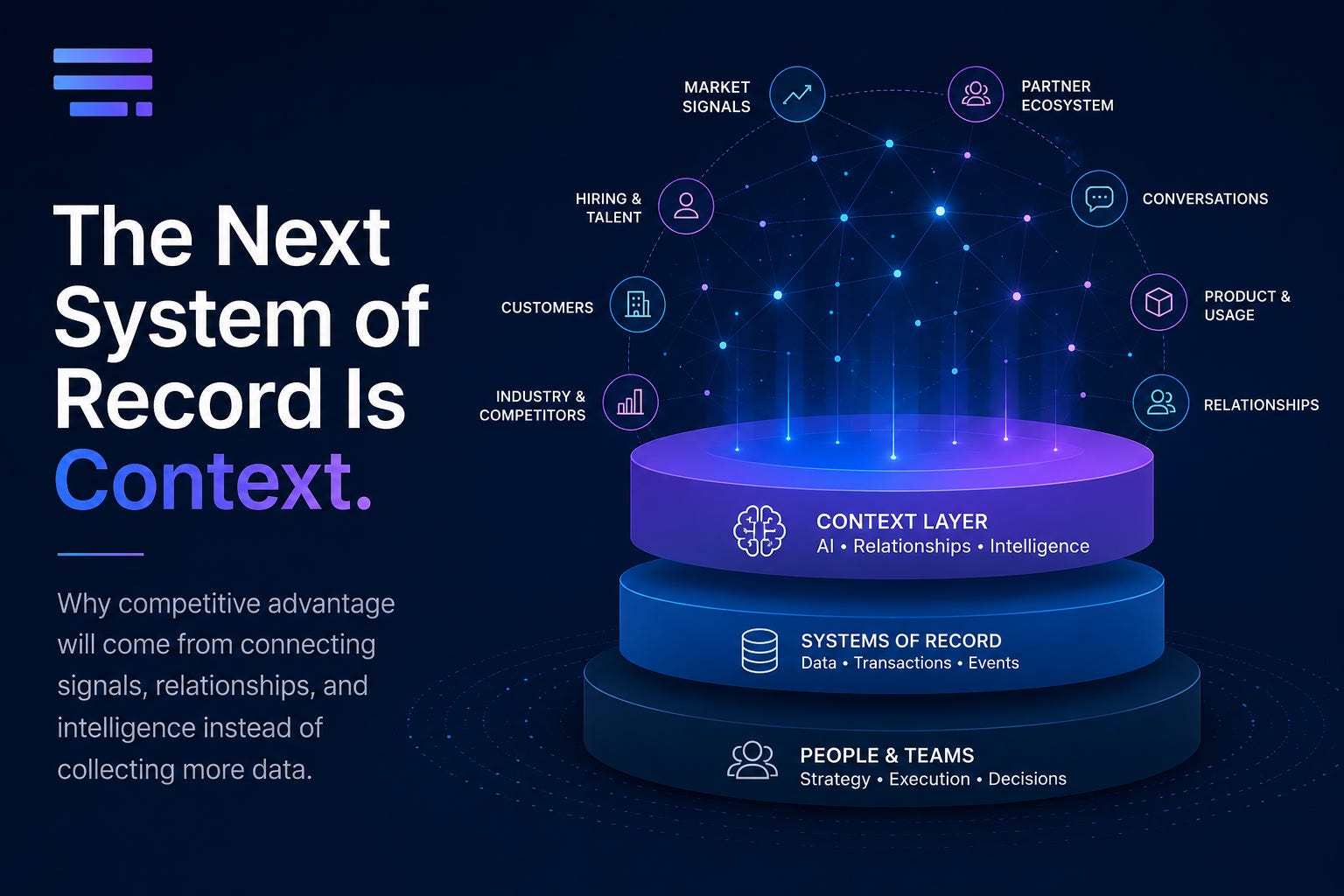
For the last twenty years, we’ve built systems of record.
CRM became the system of record for customers.
ERP became the system of record for finance.
HRIS became the system of record for employees.
Marketing automation became the system of record for campaigns.
These platforms answered one fundamental question:
What happened?
That was enough when business moved slower.
It isn’t enough anymore.
Today, competitive advantage isn’t determined by who has the most data.
It’s determined by who understands the most context.
Every Team Has a Different Window
An Account Executive opens Gong before a customer call.
A RevOps leader opens Salesforce to understand pipeline.
A marketing leader opens HubSpot to measure campaigns.
A product manager opens Jira to review the roadmap.
A partnership leader opens Crossbeam to identify shared accounts.
An executive asks ChatGPT what it all means.
Every team has a different window into the business.
Almost no one has the whole picture.
The information exists.
It’s just fragmented.
The Most Important Signals Live Between Systems
Think about what actually changes your strategy.
Not another opportunity entering Stage 2.
Not another customer record.
Instead...
Your largest cloud partner launches a new marketplace program.
A competitor hires twenty AI partnership specialists.
Microsoft changes partner incentives.
Three implementation partners begin winning deals together.
Five enterprise customers all adopt the same technology stack.
A startup you’ve never heard of suddenly appears in every strategic account.
None of those events live neatly inside your CRM.
But every one of them changes how you should operate.
That’s context.
Context is the layer between systems.
It’s where relationships, timing, market shifts, and business decisions intersect.
AI Changes the Rules
This is why AI feels both incredible and, at times, underwhelming.
AI can summarize.
Analyze.
Code.
Write.
Reason.
But its conclusions are only as good as the context it receives.
An AI connected only to your CRM answers questions about customers.
Connected only to Gong, it understands conversations.
Connected only to your product analytics, it explains adoption.
Useful.
But incomplete.
The real breakthrough happens when AI understands the relationships between all of those systems and the world outside your company.
Customers.
Partners.
Products.
Communities.
Hiring.
Marketplaces.
Industry trends.
Competitors.
That’s when context becomes intelligence.
Why I’m Watching GTM Engineers
One trend I’m paying close attention to is the rise of the GTM Engineer.
The title is appearing everywhere.
The mission is usually the same.
Connect the tools.
Automate the workflows.
Bring AI into the revenue engine.
I think that’s an important step.
But I also think we’re defining the role too narrowly.
Most GTM Engineer roles today are built around the direct sales motion.
CRM.
Marketing automation.
Sales engagement.
Conversation intelligence.
Product usage.
Those are critical systems.
They’re just not the entire go-to-market motion anymore.
Modern growth happens across an ecosystem.
Partners influence buying decisions.
Cloud marketplaces accelerate procurement.
Implementation firms shape adoption.
Communities generate trust.
Customers become advocates.
Developers create momentum.
AI connects it all.
The next generation of GTM Engineers won’t simply orchestrate internal systems.
They’ll orchestrate entire ecosystems.
The Next Competitive Advantage
For years, we’ve invested in systems of record.
The next decade belongs to systems of context.
Not software that stores information.
Software that explains why it matters.
Software that identifies what changed.
Software that connects customers, partners, products, conversations, market signals, hiring trends, and relationships into one operating picture.
The companies that win won’t necessarily have more data.
They’ll have better context.
And better context leads to better judgment.
In a world where AI makes execution increasingly accessible, judgment becomes one of the few sustainable competitive advantages.
That’s why I believe context is becoming the next system of record.
Not because it replaces the systems we’ve built.
Because it connects them into something far more valuable: understanding.