


ERP created Accenture and Deloitte.
Infrastructure created CDW and SHI.
Cloud created a generation of AWS, Azure, and Google Cloud consultancies.
AI will create a new category:
AI Deployment Firms.
Not resellers.
Not traditional systems integrators.
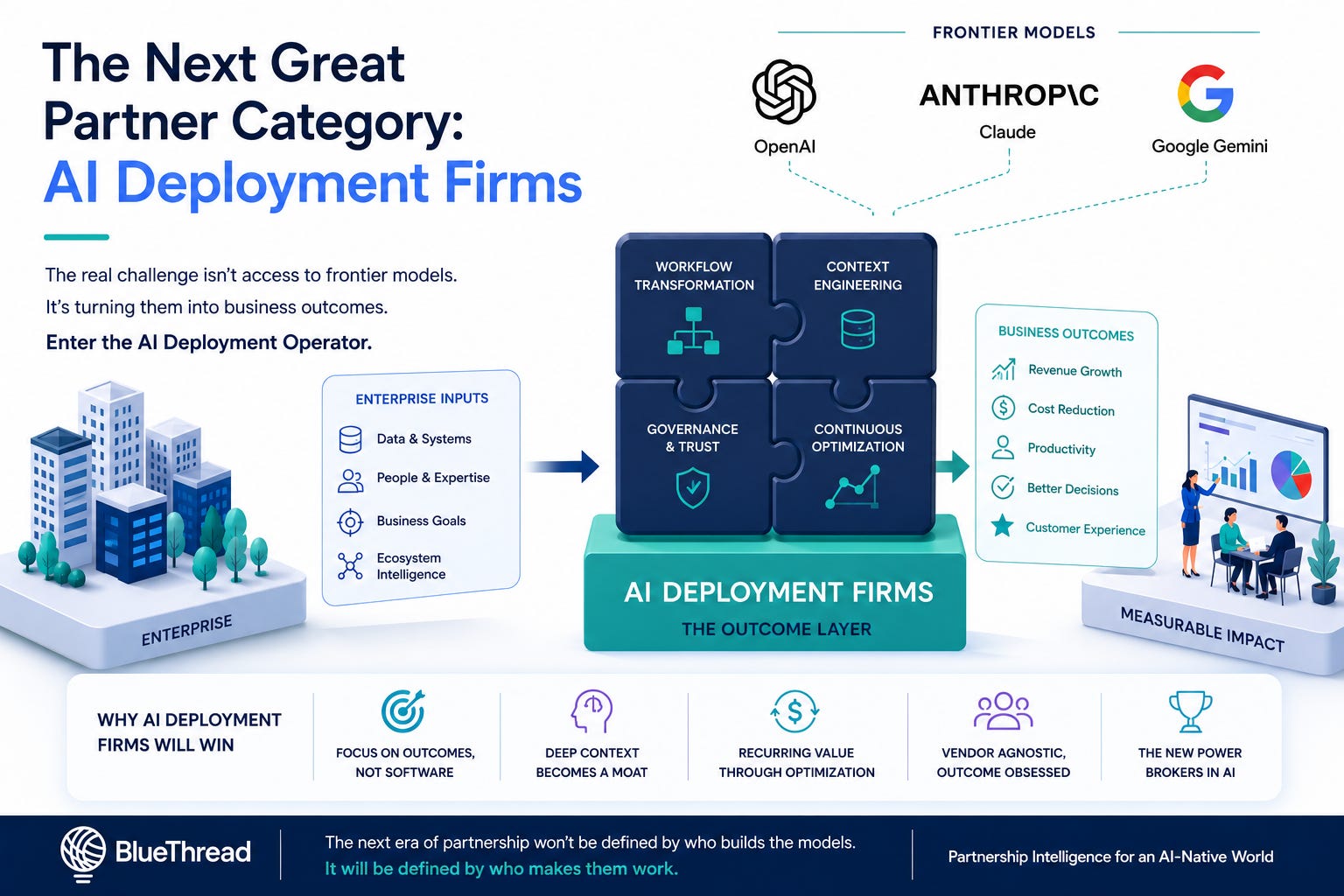
Organizations focused on turning frontier models into business outcomes.
Today, much of the AI conversation centers on the model providers themselves.
OpenAI.
Anthropic.
Google Gemini.
Meta.
The assumption is that the winners will be determined by model performance.
Reasoning benchmarks.
Context windows.
Agent capabilities.
Model quality matters.
But history suggests something else.
The biggest economic opportunity may emerge in the ecosystem surrounding the models rather than the models themselves.
The Real Challenge Isn’t Access to AI
Most enterprises can already access frontier models.
They can purchase ChatGPT Enterprise.
They can deploy Claude through Anthropic.
They can access Gemini through Google Cloud.
The challenge isn’t obtaining access.
The challenge is transforming how work gets done.
That’s where a new partner category emerges.
What AI Deployment Firms Actually Sell
The first misconception is that these firms will sell AI.
They won’t.
Customers don’t buy AI.
Customers buy outcomes.
They buy:
Faster sales cycles
Lower support costs
Improved productivity
Better forecasting
Faster onboarding
More effective partner programs
The model is simply the engine behind the outcome.
Workflow Transformation
Most organizations don’t need another chatbot.
They need someone who can answer:
Which workflows should be automated?
Which decisions should remain human?
Where do agents fit?
What changes operationally?
This looks more like business transformation than software implementation.
Context Engineering
The industry spent the last two years talking about prompt engineering.
The next phase will be context engineering.
A model becomes valuable only when connected to:
CRM data
Knowledge bases
Product information
Operational systems
Ecosystem intelligence
The deployment partner becomes responsible for connecting intelligence to context.
Governance and Trust
As AI becomes embedded into core business processes, organizations need governance.
Questions quickly emerge:
Which models can access customer data?
How are decisions monitored?
Who approves autonomous actions?
How is performance measured?
These are operational challenges, not technology challenges.
Why Frontier Model Companies Need Them
This isn’t unique to OpenAI.
Anthropic is increasingly building enterprise relationships around trusted adoption and responsible deployment.
Google is embedding Gemini across Workspace, Cloud, and enterprise workflows.
Each company faces the same challenge:
Building a world-class model does not automatically create organizational change.
Someone still has to redesign workflows, train teams, integrate systems, and measure outcomes.
Historically, vendors struggle to scale this function themselves.
That’s why partner ecosystems emerge.
The New Power Brokers
Partnership leaders often ask:
“Which AI vendor should we partner with?”
A more strategic question may be:
“Which firms are becoming trusted advisors for AI deployment?”
Those firms will increasingly influence:
Model selection
Technology architecture
Workflow design
Platform adoption
Long-term AI strategy
Just as cloud consultancies became influential during the AWS migration era, AI deployment firms may become the decision-makers enterprises trust most.
What This Means for SaaS Companies
Many SaaS companies are racing to add AI features.
That’s necessary.
But it may not be sufficient.
The winners may not be the platforms with the most AI features.
They may be the platforms most frequently recommended by AI deployment firms.
This creates a new ecosystem strategy.
Instead of focusing solely on technology partnerships, SaaS companies may need to build relationships with organizations responsible for AI transformation.
A Prediction
The most influential AI partners of the next decade probably aren’t household names today.
Some will emerge from consulting.
Some from cloud services.
Some from niche industry specialists.
But the biggest winners will likely be the organizations that learn how to combine:
Frontier models
Business context
Workflow redesign
Organizational change
into repeatable outcomes.
The AI race won’t be won solely by the companies building the smartest models.
It will also be shaped by the firms that make those models useful inside real organizations.
And that may become the most important partnership category of the next decade.