


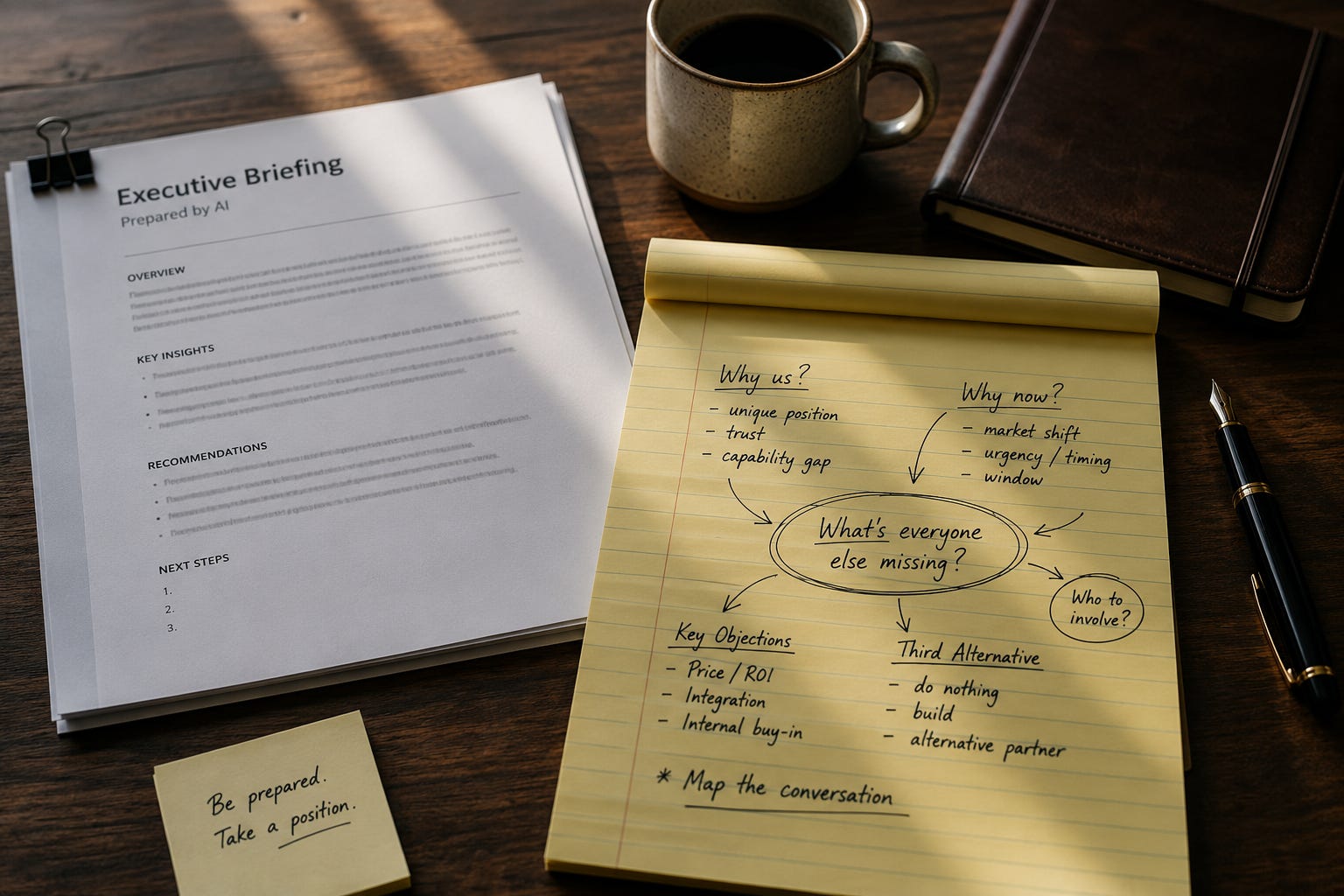
“The will to win means nothing without the will to prepare.”
For decades, that was obvious.
Preparation meant late nights. Reading annual reports. Researching stakeholders. Mapping partner ecosystems. Watching product demos. Rehearsing the meeting. Doing work no one ever saw.
Then AI arrived.
Today you can generate an executive briefing, summarize a 10-K, analyze a company’s ecosystem, build an account plan, and draft a partner strategy before your coffee gets cold.
It feels like preparation.
Sometimes it isn’t.
The biggest misconception about AI is that it replaced preparation.
It didn’t.
It repriced it.
The work that used to take six hours now takes thirty minutes.
That’s incredible.
It’s also dangerous.
Because when everyone has access to the same models, the same prompts, and the same public information, preparation itself stops creating an advantage.
It becomes the minimum requirement.
That’s the new preparation gap.
It isn’t between people who use AI and people who don’t.
It’s between people who stop at the output and people who use that output to develop an original point of view.
The New Split
I think every knowledge worker now has two jobs.
Machine work
Research
Summarization
First drafts
Competitive intelligence
Formatting
Briefing documents
Account plans
Let AI own as much of this as possible.
Doing all of it manually isn’t diligence anymore.
It’s usually just expensive nostalgia.
Then comes the work that actually creates leverage.
Operator work
Forming the opinion
Choosing the strategy
Predicting objections
Knowing which partner to involve
Understanding the politics inside both organizations
Deciding what not to do
Making the call when the answer isn’t obvious
AI can inform these decisions.
It can’t be accountable for them.
And that’s where careers will increasingly separate.
Partnerships Make This Even More Obvious
I’ve spent my career building partnership programs at Microsoft, SYNNEX, Gong, and now Bluethread.
One thing has never changed.
Revenue comes from people trusting other people enough to work together.
You can generate the perfect account map.
You still have to convince an account executive to bring in the partner.
You can summarize a customer’s business.
You still have to earn enough credibility that the customer believes your recommendation.
You can build the cleanest QBR deck anyone has ever seen.
If the partner doesn’t answer your text when the deal gets stuck, none of it matters.
AI accelerates preparation.
Relationships accelerate outcomes.
Those aren’t the same thing.
Where the Best Operators Are Winning
The highest performers I know aren’t using AI to avoid preparation.
They’re using AI to eliminate the parts of preparation that don’t require them.
Instead of spending six hours collecting information, they spend thirty minutes.
Then they invest the recovered time where no model has context.
They call the partner before the meeting.
They pressure test the strategy with someone they trust.
They identify the political risk inside the account.
They prepare three different paths depending on how the conversation unfolds.
They walk into the room with something AI still can’t generate.
Conviction.
What This Means for the Next Generation
If you’re early in your partnerships career, here’s the trap.
You can now produce work that looks remarkably polished.
Beautiful briefs.
Perfect formatting.
Thoughtful summaries.
The danger is believing polished work is valuable work.
Your manager isn’t hiring you because you can create a document.
AI can already do that.
They’re hiring you because someone has to decide what matters.
Someone has to connect the right partner.
Someone has to make the judgment call when the data is incomplete.
Someone has to earn trust.
Those skills just became dramatically more valuable.
The New Definition of Preparation
The old definition of preparation was collecting information.
The new definition is creating perspective.
Everyone will walk into the meeting with an AI-generated briefing.
Not everyone will walk in with an original point of view.
That’s the new preparation gap.
It isn’t about who has access to better models.
It’s about who can combine AI with experience, relationships, and the courage to take a position.
The will to prepare was never about spending more hours than everyone else.
It was about refusing to show up with someone else’s thinking.
Today, everyone can generate someone else’s thinking in ninety seconds.
The operators who build the next generation of partnerships will use AI for everything they can.
Then they’ll invest themselves where no model can.
Because in the age of AI, preparation isn’t the competitive advantage.
Perspective is.