


On the surface, AI looks like the ultimate equalizer. Anyone can now write a decent cold email, build a basic dashboard, or synthesize a competitive analysis in minutes. The tools are getting cheaper and the outputs are getting better.
If you squint, it looks like domain expertise is becoming a commodity.
It’s not.
If anything, it’s becoming the only thing that matters.
AI Doesn’t Flatten Expertise. It Amplifies It.
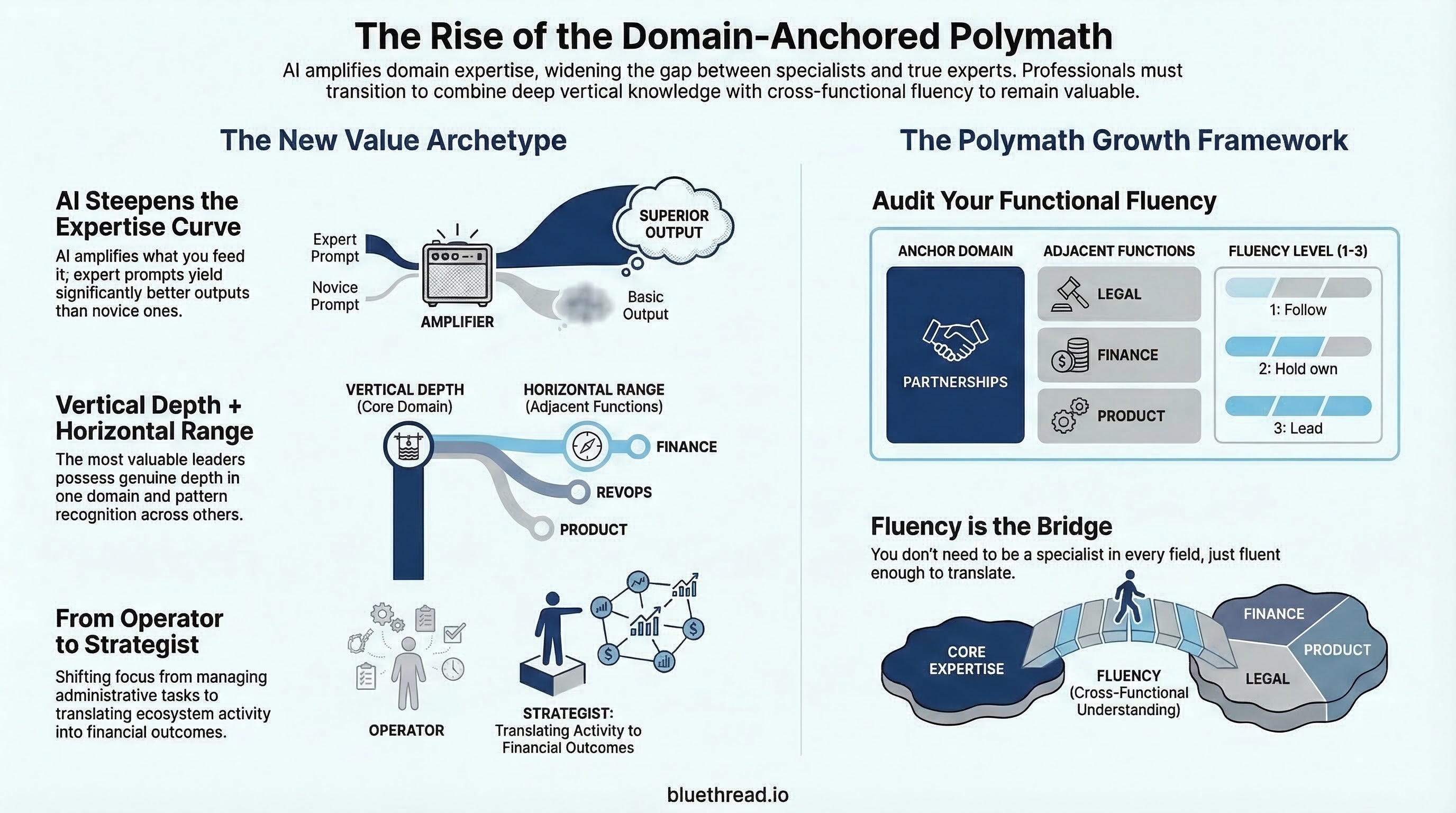
AI amplifies whatever you feed it.
A prompt from someone who has spent ten years in the channel is not the same as a prompt from someone who just learned what a distributor is.
The model is the same.
The output is not.
The delta between those two outputs is domain expertise. And that gap is widening, not closing.
AI doesn’t flatten the expertise curve. It steepens it.
The Old Model of Expertise Is Breaking
For a long time, the most valuable professional was the deep specialist. The person who knew one thing better than anyone else.
That model made sense in a world where information was scarce and specialization created a moat.
AI just blew a hole in that moat.
If your entire value is knowing a lot about a narrow thing, a well-prompted model can approximate that knowledge faster than you’d like to admit.
This doesn’t mean expertise is dying. It means the type of expertise that matters is shifting.
The Rise of the Domain-Anchored Polymath
What AI cannot approximate is the person who has genuine depth in one domain and the pattern recognition to connect it to adjacent ones.
Call it vertical depth with horizontal range.
Examples are already everywhere:
A partnerships leader who understands revenue operations
A channel strategist who can read a private equity waterfall
A partner marketer who can structure a business case a CFO will actually approve
This is the convergence happening across modern GTM teams.
Not a blurring of roles.
A compression of the most valuable capabilities into fewer, sharper people.
Partnerships Is Already There
In the partnerships world, this shift is visible right now.
The partner managers who are winning are not the ones who know how to manage a portal or run an MDF process.
They are the ones who can sit across from a CRO and translate ecosystem activity into pipeline math.
They speak RevOps.
They speak finance.
They speak product.
They can connect ecosystem strategy to revenue outcomes.
And they can do it because they built genuine depth in partnerships while deliberately expanding their range.
AI becomes their co-pilot, not their replacement.
They use it to move faster, explore more ideas, and cover more ground.
But the judgment about where to point it still belongs to them.
The Quiet Risk Most Professionals Are Missing
Right now, many professionals are treating AI purely as a productivity tool.
They’re using it to do the same job faster.
That works for the moment.
But it misses the larger shift.
AI isn’t just changing how work gets done. It’s redrawing the map of what valuable looks like.
The people who thrive will reposition themselves accordingly.
The New Archetype
The future does not belong to specialists.
It also doesn’t belong to traditional generalists.
The new archetype is something in between.
A domain-anchored polymath.
Someone with a clear center of gravity in a specific field and the fluency to operate across the functions that field touches.
In partnerships, that’s the person who:
Understands ecosystem economics
Can build attribution models
Runs discovery like a consultant
Articulates the P&L impact of a partner program to a CFO
Five years ago, that person looked like a unicorn.
Today, they’re becoming the baseline expectation.
The real question is whether you’re building toward it.
A Simple Exercise
If you want to start moving in that direction, try this exercise this week.
Draw three columns.
Column 1: Your anchor domain
The thing you’d bet your reputation on knowing cold.
For many reading this, that’s partnerships.
Column 2: Adjacent functions your work actually touches
Not aspirationally. Practically.
Think about the conversations you’re already in:
CRO pipeline reviews
RevOps handoffs
Legal contract negotiations
Finance reviews
Product roadmap discussions
List them all.
Column 3: Your fluency level
Score yourself from one to three.
1 — You can follow the conversation
2 — You can hold your own
3 — You can lead it
Most partnership professionals will discover they have a lot of ones.
That’s not a problem.
That’s the map.
Where to Invest Next
You don’t need to become a CFO.
You don’t need to become a RevOps architect.
You just need enough fluency to translate between worlds.
Fluency in a single adjacent domain, built deliberately over six months, can completely change how the room perceives you.
It shifts you from operator to strategist.
From program manager to business leader.
And in the AI era, that shift matters more than ever.
The domain-anchored polymath isn’t born.
They’re built.
One column at a time.