


The discipline of partnerships is undergoing a fundamental market correction.
For the past decade, the role was largely defined by “soft” metrics: relationship building, brand visibility, and activity volume. In a low-interest-rate environment where growth was prioritized at all costs, this lack of rigor was permissible.
In today’s economic climate, where capital efficiency and predictable revenue are the primary directives from the CFO office, the role has changed. The “Relationship Manager” model is obsolete. It is being replaced by the “Ecosystem General Manager.”
This evolution is not a stylistic preference; it is an operational necessity. Modern partnership leaders are no longer judged by the breadth of their network, but by the depth of their integration into the company’s core business functions.
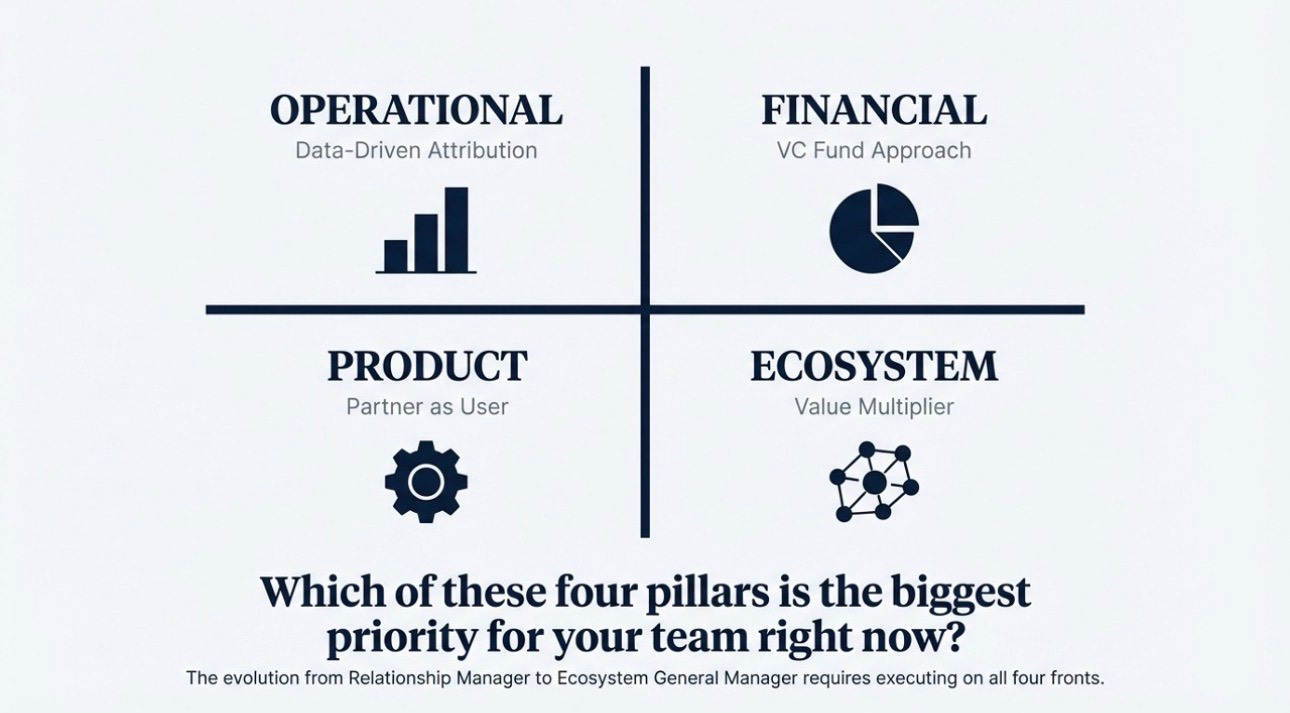
The following framework outlines the four pillars of this new operating model. It serves as a guide for leaders looking to professionalize their partnership function.
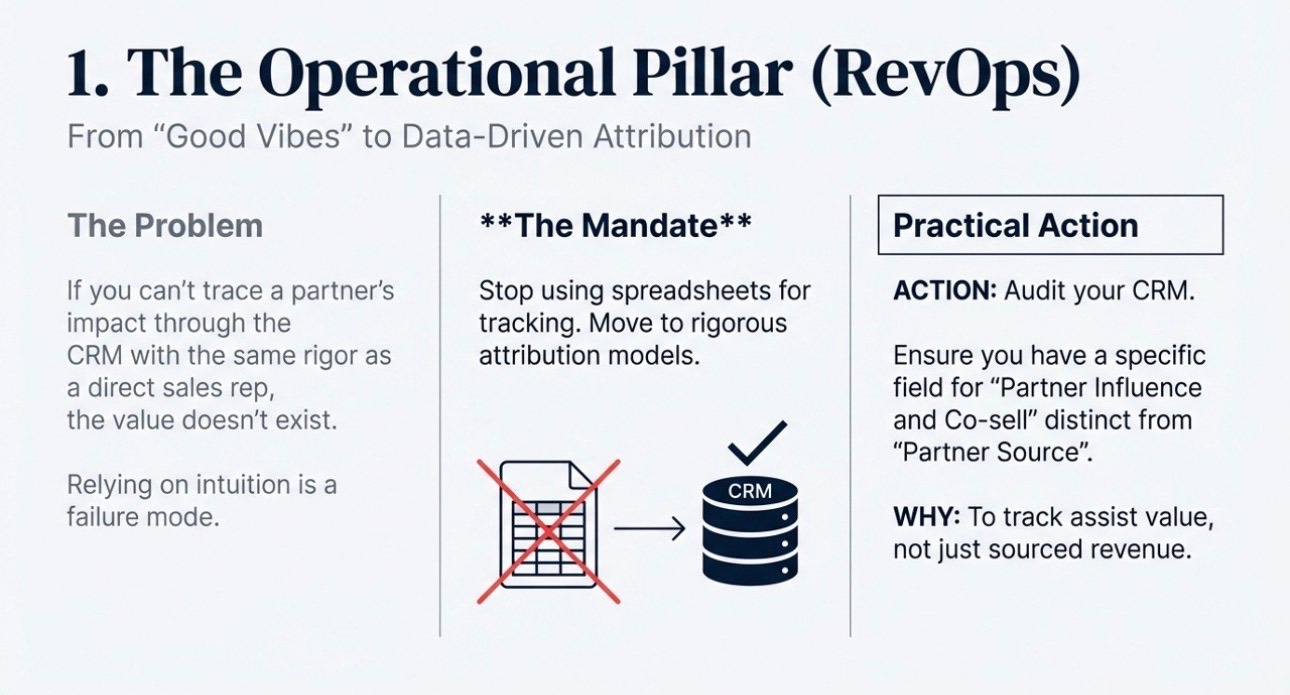
1. The Operational Pillar: Integration with Revenue Operations (RevOps)
The Context Historically, partnerships operated in a silo, often tracking progress in offline spreadsheets or separate portals that did not speak to the company’s central CRM. This created a disconnect between partner activity and verifiable revenue impact.
The Evolution The modern mandate is total integration with Revenue Operations. Partnerships must be tracked with the same rigor as direct sales channels. The focus has shifted from simple “source” attribution (who brought the deal) to “influence” attribution (how the partner accelerated or closed the deal).
Practical Application Operational maturity requires the ability to report on the “shadow funnel”—deals where partners are assisting but not sourcing.
Action Step: Audit your CRM architecture with your RevOps leader. Ensure there is a distinct mechanism—separate from “Lead Source”—to track partner influence on active opportunities. If you cannot produce a report showing how partners improved velocity or close rates on direct deals, your data infrastructure is incomplete.
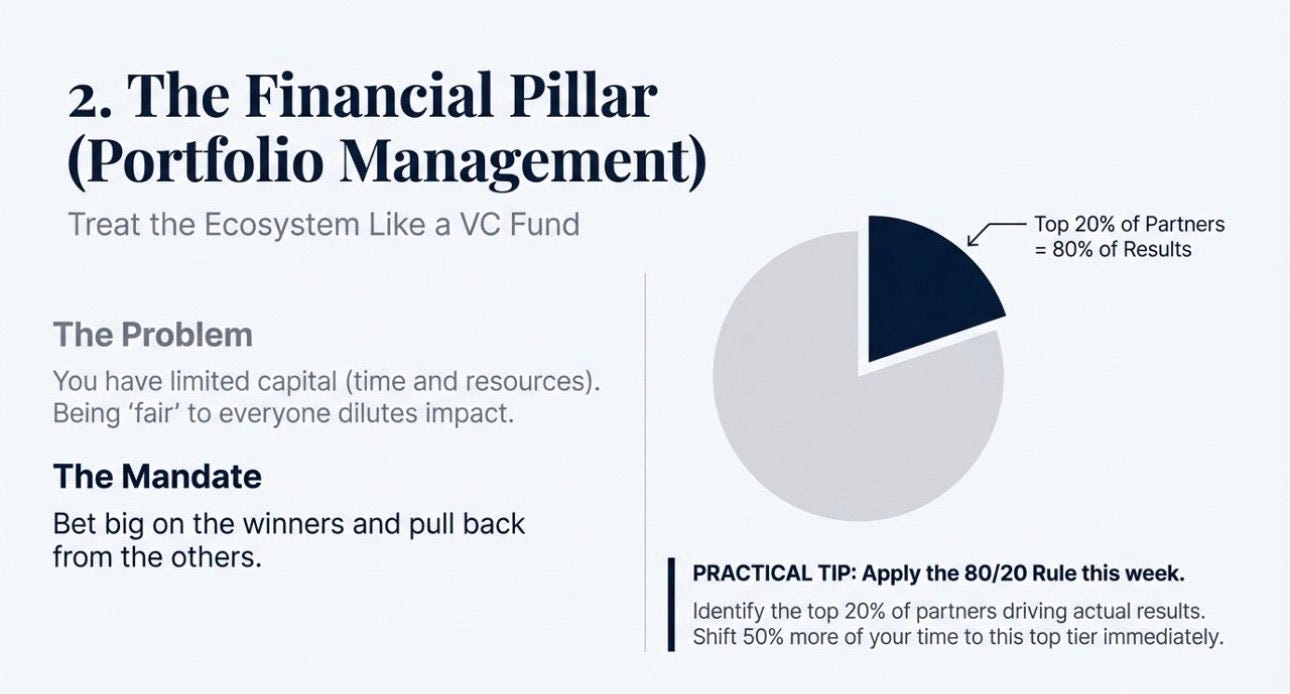
2. The Financial Pillar: Portfolio Management
The Context Many legacy programs suffered from a “more is better” philosophy, recruiting large volumes of partners and attempting to support them equally. This resulted in diluted resources and low average revenue per partner.
The Evolution The General Manager mindset applies Venture Capital principles to the partner ecosystem. The partner leader acts as a Portfolio Manager with limited capital (time, budget, technical resources). The objective is not “fairness,” but Return on Invested Capital (ROIC). This requires ruthless prioritization of high-yield partners and divestment from underperformers.
Practical Application Resources must be allocated according to the Pareto Principle.
Action Step: Conduct a quarterly portfolio audit. Identify the top 20% of partners contributing to 80% of your outcomes. Reallocate 50% of the resources (time and MDF) currently spent on the bottom tier to this top tier. The goal is to maximize the yield of winners, not to rehabilitate the entire long tail.
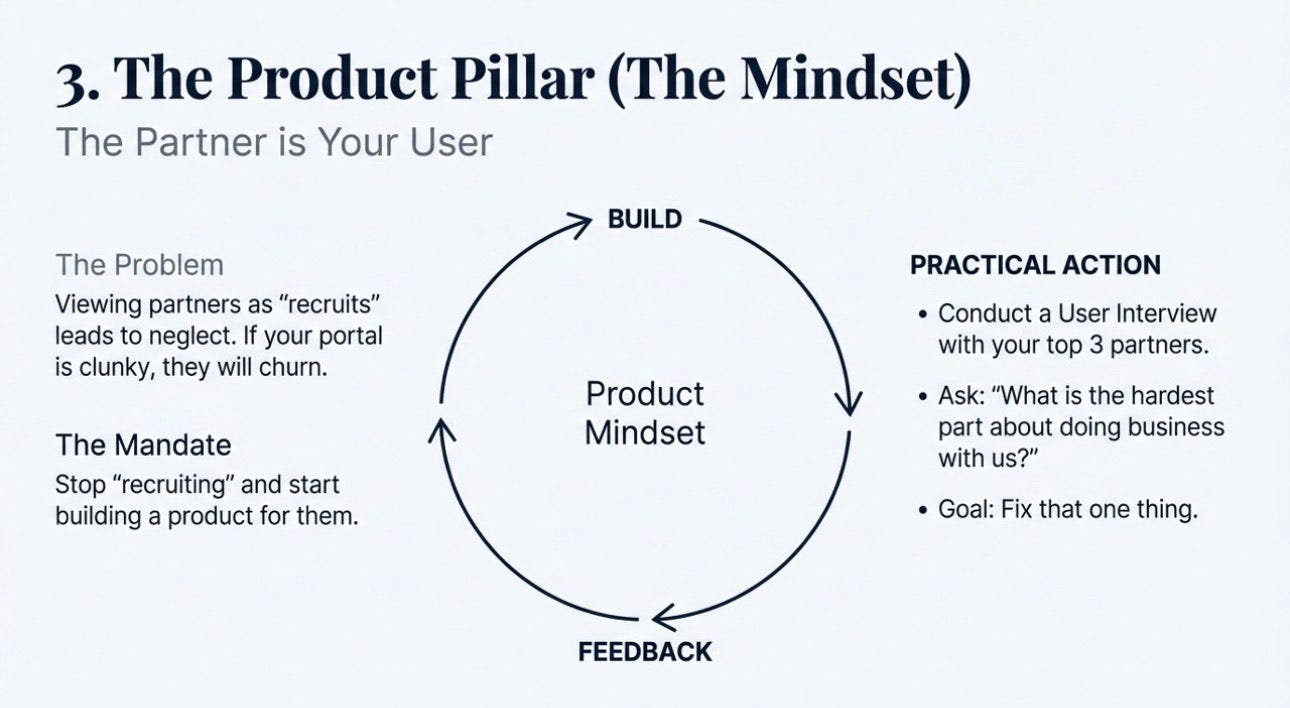
3. The Product Pillar: The Partner as User
The Context Partnership programs were often viewed as a recruitment function. Once a partner signed a contract, the focus shifted to the next prospect, leaving the existing partner to navigate complex, friction-heavy internal processes.
The Evolution The partnership program must be viewed as a product, and the partner as the end-user. If the “User Experience” (UX) of the program—the portal, the deal registration process, the enablement assets—is difficult, partners will churn. The modern leader applies Product Management thinking to reduce friction and increase adoption.
Practical Application Adoption is a lagging indicator of product quality.
Action Step: Treat your top partners as a focus group. Schedule a “User Research” session with your three most valuable partners. Ask a single diagnostic question: “Where is the greatest friction in our current process?” Prioritize the removal of that friction point in your next quarterly sprint.
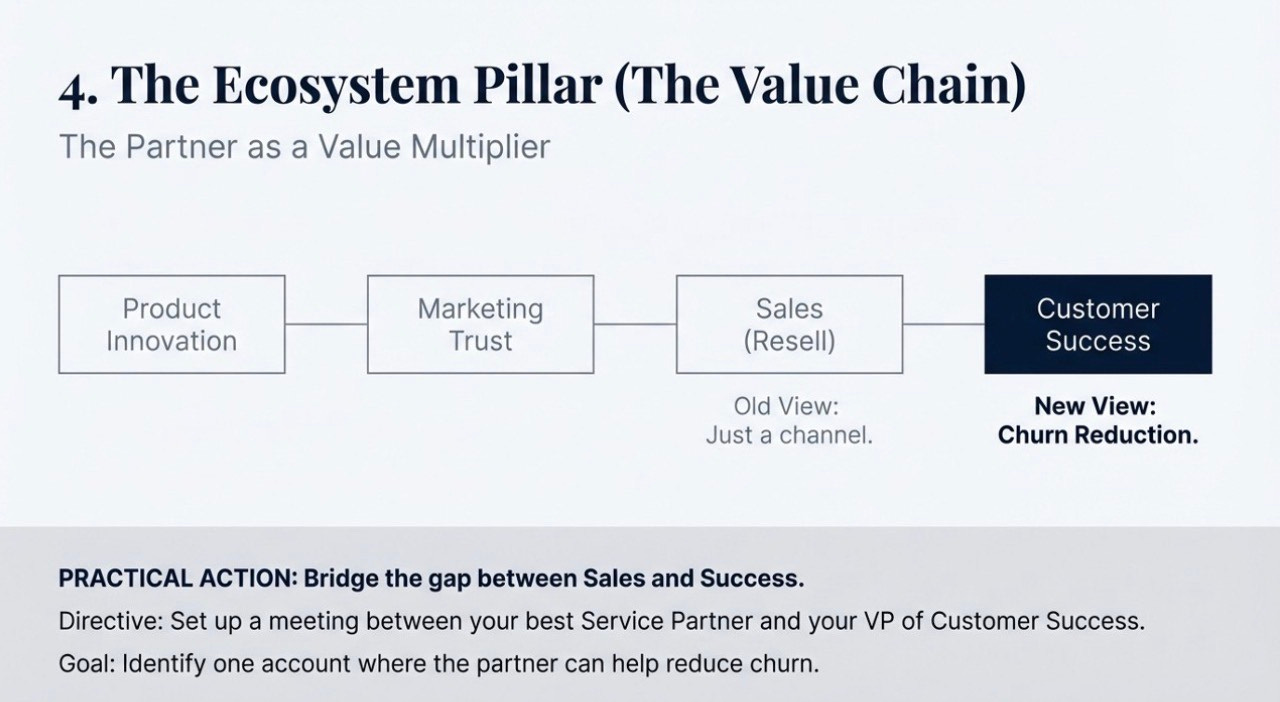
4. The Ecosystem Pillar: The Value Chain
The Context Traditionally, partners were categorized strictly as a sales channel—a means to distribution. This limited view ignored the impact partners have on the rest of the business lifecycle.
The Evolution The “BlueThread” concept suggests that partners are value multipliers across the entire business value chain. This includes Innovation (product feedback/integrations), Marketing (trust validation), Sales (co-selling), and Delivery (customer success/retention).
Practical Application Partnerships must be aligned with retention metrics, not just acquisition metrics.
Action Step: Facilitate cross-functional alignment by connecting your leading Service/Implementation partner with your VP of Customer Success. Identify one at-risk strategic account and deploy the partner to assist in retention efforts. This establishes the precedent that partnerships is a net-retention lever, not just a new-business lever.
Conclusion
The transition from Relationship Manager to Ecosystem General Manager is the defining career challenge for partnership professionals in this decade.
Those who cling to the old model of “networking and influence” will find themselves increasingly sidelined as cost centers. However, those who adopt this four-pillar framework—Operational, Financial, Product, and Ecosystem—will find themselves with a seat at the executive table.
When you can prove that your ecosystem lowers CAC, increases NRR, and accelerates product velocity through rigorous data, you are no longer just running a department. You are running a business.
Really great point Rob! I’ve led partner GTM through both eras, and the shift from Relationship Manager to Ecosystem GM is very real. The clearest signal is org design: when Partnerships has a direct (or tight dotted) line into the CRO/RevOps operating rhythm, it scales predictably. When it’s still treated as “sales-adjacent,” results are unpredictable.