


I built an advisory agency, and have been very public about the build.
This article is part observation, part operating note. I’m sharing what is working, what I’m learning, and how content is becoming a real inbound motion for Bluethread.
My hope is that other entrepreneurs and partnership professionals can use some of these principles to build trust, grow their networks, and create stronger opportunities over time.
Most people measure content by what happens in the first 24 hours.
How many likes?
How many comments?
How many impressions?
Those numbers are visible, immediate, and mostly incomplete.
Lately, I have been paying attention to something more interesting.
Prospects are showing up to our first conversation already familiar with how we think.
They have read an article. Then another. They have looked through the website, explored our Field Notes, joined the community, or followed the work for a while.
By the time we meet, they are often not asking:
“What does Bluethread do?”
They are asking:
“How would you approach our situation?”
That is a very different sales conversation.
I thought I was writing for LinkedIn
For a long time, I thought the value of publishing was mostly distribution.
Write a LinkedIn post. Get some engagement. Stay visible. Repeat.
LinkedIn still matters. It is often where the first interaction happens.
But I increasingly see LinkedIn as the front door, not the whole house.
The more durable value sits on the website.
A LinkedIn post may get attention for a day or two. A useful article on your own site can keep working for months or years. It can show up in search, get shared privately, support a sales conversation, or help someone understand how you think long before they are ready to buy.
That is where the compounding starts.
The signals are becoming easier to see
I have started building a lightweight system around this.
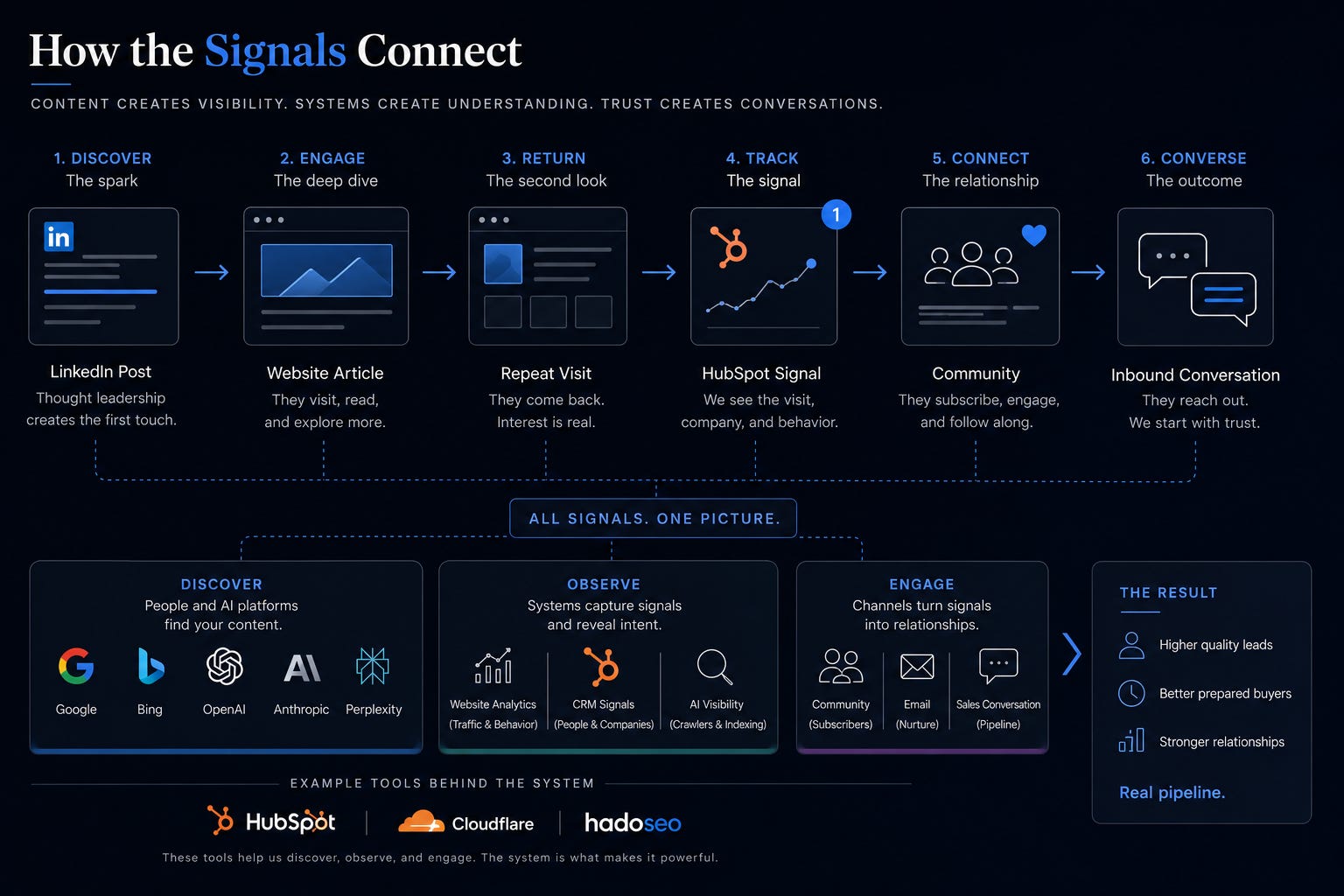
I use HubSpot to track website activity and identify engagement from people and companies already in our orbit. I get regular notifications when people are visiting the site, returning to certain pages, or moving through the content.
I use Cloudflare to understand traffic patterns and keep the site fast, secure, and available.
I use Hado to see crawler activity across search, social, and AI platforms. I can see traffic from sources such as Google, Bing, OpenAI, Anthropic, and Perplexity interacting with the site.
None of these tools tells the whole story by itself.
A website visit is not a lead.
A crawler is not a customer.
An article view is not revenue.
But the signals begin to matter when they stack up.
Someone follows a post on LinkedIn.
Then they visit the website.
Then they read two or three articles.
Then someone from the same company returns.
Then they subscribe to the community.
Then they fill out a form or send a message.
Then they tell us on the first call:
“We have been reading your content.”
That is not attribution in the clean, spreadsheet-friendly sense.
It is still a motion.
And it is becoming a strong inbound motion for us.
Content is not a campaign
The mistake is treating content like a campaign with a start date, an end date, and a short reporting window.
Good content behaves more like infrastructure.
Each piece adds another path into your business.
Each article answers another question.
Each framework gives someone another way to understand your point of view.
Each example gives a buyer more confidence that you have seen their problem before.
One article does very little.
Ten articles begin to create a body of work.
Fifty articles begin to create a category of expertise.
Add a few hundred community subscribers, consistent LinkedIn publishing, a useful website, and years of practical experience behind the ideas, and the effect becomes difficult to measure through any single channel.
That is the point.
The value is cumulative.
The first sale is trust
Most buyers are not ready to talk to you the first time they encounter your company.
They are gathering evidence.
Do these people understand the problem?
Do they have a real point of view?
Have they done this before?
Are they teaching something useful, or are they simply promoting themselves?
Content helps answer those questions without requiring a meeting.
It gives the buyer space to evaluate you privately.
That matters because people rarely tell you they are researching your company while they are doing it.
You see the evidence later.
They reference a phrase you wrote six months ago.
They mention an article you had forgotten about.
They already understand your framework.
They have forwarded your work to someone else on the team.
The sales process did not begin when they booked the meeting.
It began when they started reading.
AI makes the body of work more valuable
AI is adding another layer to this.
People are no longer only typing keywords into Google. They are asking ChatGPT, Claude, Perplexity, Gemini, and other systems to help them research problems, compare approaches, and identify experts.
That does not mean every article will suddenly become an AI-generated lead source.
It does mean useful, original, well-structured thinking has more ways to be discovered.
The old content playbook often focused on producing pages for search engines.
The better play now is producing the clearest, most useful answer you can to a real question your market is asking.
Not keyword filler.
Not generic thought leadership.
Not a rewritten summary of what everyone else already said.
Real experience. Clear thinking. Useful teaching.
That is the material people remember, share, and eventually buy from.
A practical way to think about it
You do not need an elaborate content machine.
Start with the questions you hear repeatedly from clients and prospects.
Write down your real answer.
Publish it somewhere you control.
Share it through the channels where your audience already spends time.
Connect the basic systems so you can observe what happens next.
LinkedIn can create discovery.
Your website can build depth.
HubSpot can help track engagement.
Cloudflare can show traffic patterns and protect the experience.
Haddo can help you see how search and AI systems are interacting with the site.
Your community can turn occasional readers into a recurring audience.
The goal is not to obsess over every signal.
The goal is to see the pattern.
The payoff is not always more leads
Sometimes the payoff is fewer bad conversations.
People read your work and decide they disagree with your approach.
That is useful.
Others read it and understand exactly what you believe before they speak with you.
That is even more useful.
Strong content qualifies both sides.
It helps the right buyers recognize themselves in your thinking. It also helps the wrong buyers move on without wasting anyone’s time.
The best result is not simply more inbound.
It is better inbound.
Better prepared buyers.
More relevant conversations.
Less time explaining the basics.
More time solving the actual problem.
The compound interest is trust
I used to think I was writing for this week’s audience.
I was actually building next year’s sales conversations.
The posts, articles, Field Notes, community discussions, search traffic, website visits, and AI crawlers all look like separate activities.
They are not.
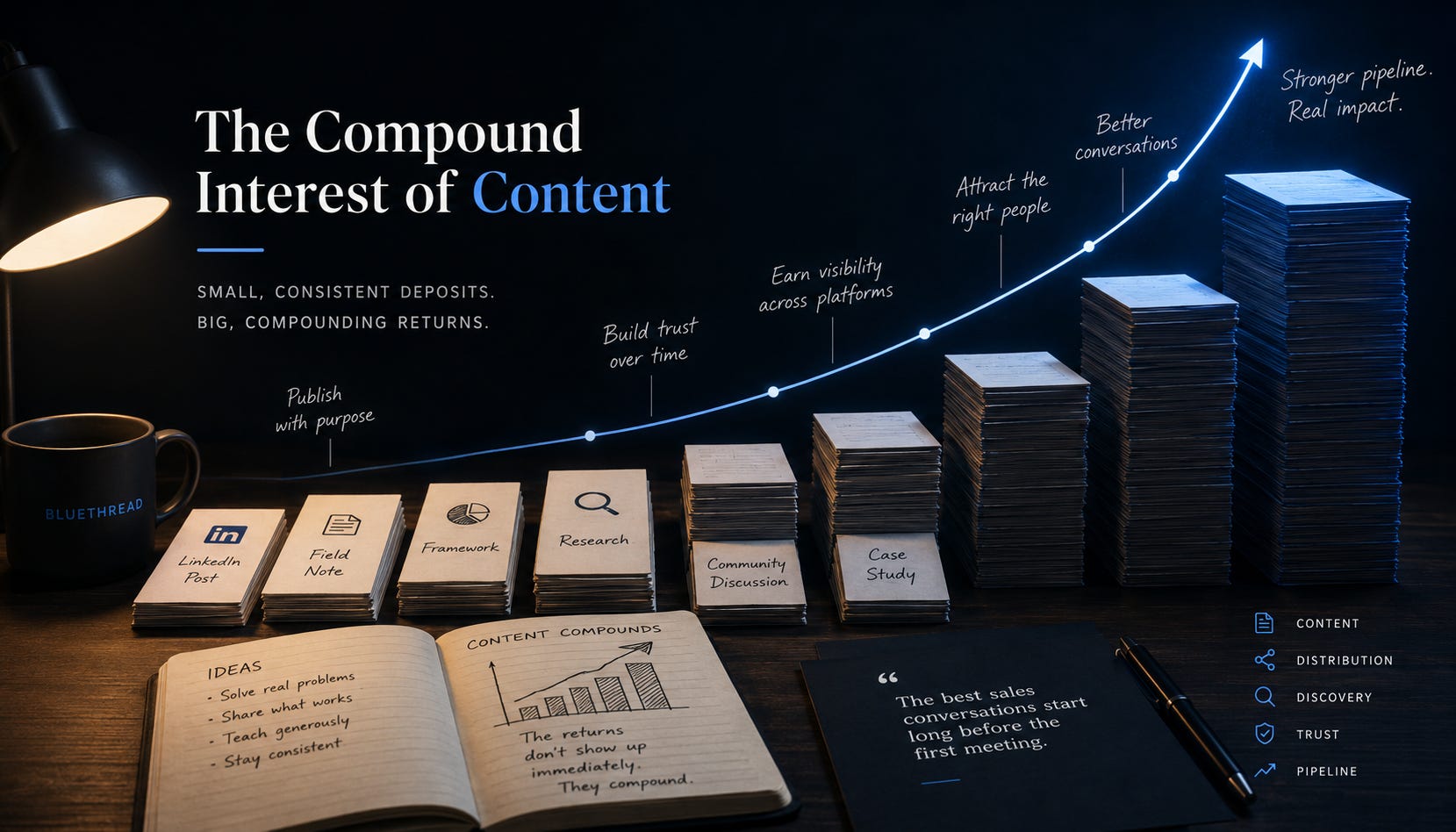
They are small deposits into the same account.
Most of them produce very little on their own.
Together, over time, they create familiarity.
Familiarity creates credibility.
Credibility creates trust.
And trust is what eventually turns attention into a conversation.
The compound interest of content is not measured in likes.
It is measured in how much less selling you have to do when the right person finally reaches out.