


I want you to think about the last enterprise deal your team closed.
Not the pipeline metrics. Not the stage progression. Think about the actual human story of how that deal happened.
Somewhere in that story, there’s a moment your buyer decided you were worth talking to. And I’d bet real money it wasn’t because of your SDR’s cold email.
It was because someone they already trusted mentioned you. A vendor they were already paying. A consultant who helped them build their tech stack. A peer at another company who’d solved the same problem.
That trusted conversation happened before your sales team ever showed up. And increasingly, that conversation is the deal. Everything after it is just procurement.
If your GTM strategy doesn’t account for this, you’re building on a foundation that’s already cracking.
The trust problem nobody wants to talk about
Here’s the uncomfortable truth that most sales leaders won’t say out loud: your buyer doesn’t trust you.
Not because you’re untrustworthy. Because you’re a seller. And buyers have been trained, through years of bad outbound, gated content, and “just checking in” follow-ups, to treat every seller as noise until proven otherwise.
The data backs this up. Buyers are 70% through their decision process before they talk to sales. Gartner has been saying this for years and the number keeps climbing. But what nobody talks about is where that 70% happens.
It happens in conversations with people the buyer already trusts.
Their existing vendors. The ones already in the stack, already in the budget, already with a quarterly business review on the calendar. When your buyer has a new problem, the first person they ask is often the vendor they’re already paying. “Hey, have you seen anyone solving X?”
Their consultants and advisors. The people who helped shape the buying criteria in the first place. If a trusted advisor recommends three vendors, those three are the shortlist. Everyone else is an afterthought.
Their peers. Other operators who’ve dealt with the same challenge. Slack communities, dinner conversations, LinkedIn DMs. The informal network where real recommendations happen.
Your SDR is not in any of those conversations.
Your retargeting ads are not in any of those conversations.
Your content marketing might influence those conversations over time, but it’s not sitting at the table when the decision gets made.
You know who is? Partners.
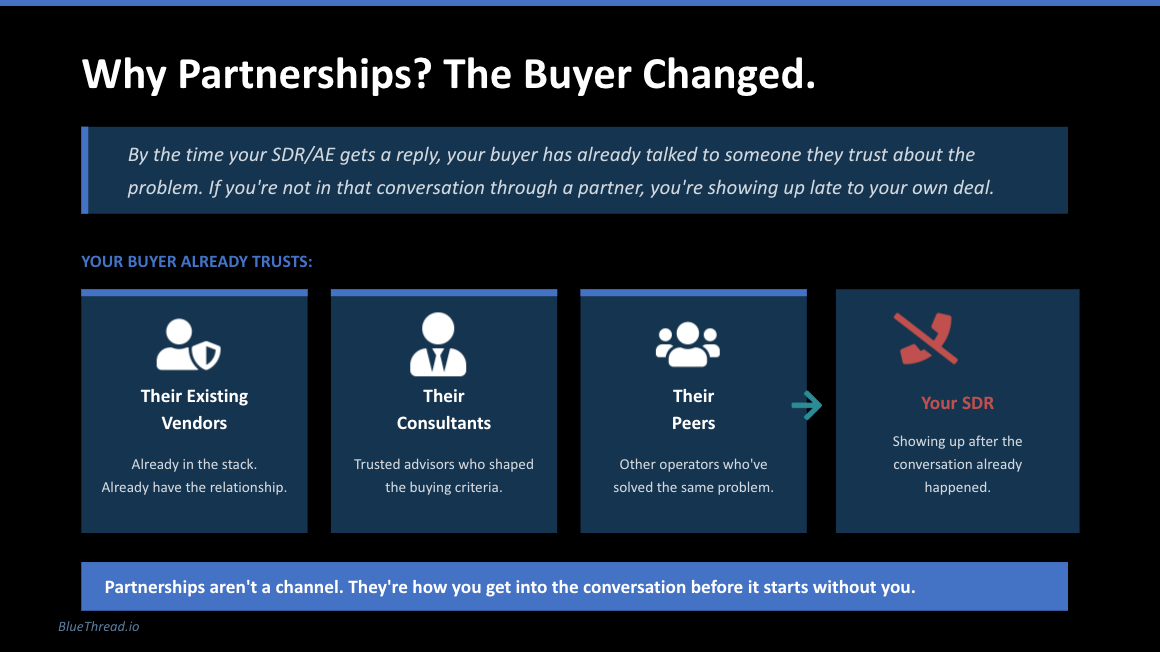
Partnerships aren’t a channel. They’re a trust shortcut.
I’ve spent my career in the partnerships and revenue operations space, and the single biggest misconception I still hear is that partnerships are a “channel.” A pipeline source. A lead gen motion with extra steps.
That framing misses the point entirely.
Partnerships are how you borrow trust you haven’t earned yet.
When a vendor your buyer already pays introduces your product, that’s not a lead. That’s a warm handoff wrapped in pre-existing credibility. The buyer’s guard drops. The sales cycle compresses. The close rate climbs. Not because your product got better, but because the context changed.
Think about it from the buyer’s perspective. If their IT vendor says “you should look at this tool, it integrates with what you’re already running and three of my other customers are using it,” that carries more weight than any case study your marketing team could produce. Because it’s coming from someone who has earned the right to make that recommendation through years of delivering value.
This is the fundamental shift that most GTM leaders are still missing. The game isn’t about generating more pipeline. It’s about being present in the conversations where decisions actually get made.
The three trust circles (and why you’re outside all of them)
Every B2B buyer operates inside three overlapping trust circles. If you’re not inside at least one of them through a partner, you’re playing the game on hard mode.
Circle 1: The Stack. Your buyer’s existing technology vendors. These companies have monthly or quarterly touchpoints, integration dependencies, and renewal conversations that keep them in constant contact with your prospect. They know the buyer’s roadmap, their pain points, and their budget cycles. If you sell something adjacent to what’s already in the stack, the fastest path to a conversation is through the vendor who’s already there.
Circle 2: The Advisors. Consultants, system integrators, agencies, and fractional operators. These people shaped the strategy your buyer is executing. They chose the tools, designed the processes, and built the business cases. Their recommendations carry disproportionate weight because the buyer is literally paying them for their judgment. If an advisor says “you need this,” the buyer listens differently than when a sales rep says the same thing.
Circle 3: The Network. Peers, communities, former colleagues. This is the most informal but often the most powerful trust circle. When a CRO texts a friend and says “what are you using for X?” the answer to that question will make or break deals your sales team doesn’t even know exist yet. You can’t partner with a peer network directly, but you can be the product that people in those networks recommend because you’ve invested in community, customer advocacy, and making your users look smart.
Now here’s the question that should keep you up at night: how many of your current deals started because you were inside one of these circles? And how many started cold?
If the answer is “mostly cold,” your GTM is working against the way buyers actually buy.
The math that makes this urgent
Let me put some economics behind this.
Your direct sales motion scales linearly. You want more pipeline, you hire more reps. You want more reps to be productive, you invest in enablement, tooling, and management layers. Every incremental dollar of pipeline costs roughly the same to generate, and over time, the cost goes up as you exhaust the easy accounts and push into harder segments.
Now compare that to what happens when a partner sends you a qualified introduction.
The cost to acquire that opportunity is a fraction of direct. The buyer already has context. The sales cycle is shorter because trust has been pre-established. The close rate is higher because you were recommended, not discovered. And the retention rate is often better because the partner has a vested interest in the buyer’s success with your product.
This is why the companies that figure out partner-sourced and partner-attached revenue end up with fundamentally better unit economics. Not marginally better. Structurally better.
And here’s the part that should matter to anyone with investors or a board: this is a capital efficiency story. Every dollar invested in building ecosystem relationships generates pipeline at a lower CAC than direct. If you’re a founder trying to prove efficient growth, or a CRO trying to show the board you can scale without proportionally scaling headcount, partnerships are the answer.
But only if you treat them as a real business unit with real metrics. Not a side project with a relationship manager and a prayer.
Why most companies still get this wrong
If partnerships are this obvious, why isn’t everyone doing it?
Three reasons.
They can’t measure it. Most companies don’t have the attribution infrastructure to prove that a partner influenced or sourced a deal. CRM fields are empty or unreliable. The partner team says they drove pipeline, the direct team says they would have closed it anyway, and the CFO doesn’t trust either number. Without defensible measurement, partnerships look like a cost center, not a growth engine.
They treat it as a department instead of a strategy. Partnerships get siloed into a small team with a vague mandate. “Go build relationships.” “Get us into that marketplace.” “Make the integration work.” But nobody connects the partner motion to the actual revenue engine. The partner team doesn’t own pipeline. They don’t have a quota. They don’t have a P&L. And so they can’t prove their value, which means they can’t get resources, which means they can’t scale, which means they can’t prove their value. It’s a death spiral.
They hire for relationships instead of operations. The traditional partner hire is someone with a great Rolodex and strong interpersonal skills. And that matters. But what matters more is someone who thinks like a GM. Someone who can build a P&L, instrument a CRM for attribution, design a co-sell motion that sales will actually adopt, and hold partners accountable to pipeline targets. The era of the relationship manager is ending. The era of the ecosystem operator is here.
What to do about it (starting this week)
If you’ve read this far and you’re feeling the gap between where you are and where you need to be, here’s where to start. Not a 90-day plan. Just three things you can do this week.
First, map your buyer’s trust circles. Take your top 10 accounts (closed-won or in pipeline) and write down every company and person who touched the deal outside of your org. Vendors, consultants, advisors, referrers. You’ll start to see patterns. Those patterns are your partner shortlist.
Second, ask your sales team one question. “In the last 5 deals you closed, was there anyone outside our company who helped that deal happen?” If the answer is yes and that person or company isn’t in a formal partnership, you have accidental partners. Formalize them.
Third, pick one trust circle to own. You can’t be everywhere at once. Decide whether your fastest path is through stack adjacency (technology partnerships), advisor influence (services partnerships), or peer networks (community and customer advocacy). Pick one. Go deep. Prove the economics. Then expand.
The companies that win the next five years of B2B won’t be the ones with the biggest sales teams. They’ll be the ones embedded in the conversations where buying decisions actually happen.
The buyer changed. It’s time your GTM did too.
Rob Moyer is the founder of BlueThread.io, a partnership advisory firm helping B2B SaaS companies and PE portfolio companies build ecosystem revenue. He facilitates the Bluethread Collective, a community for partnership operators, and runs workshops on ecosystem strategy for founders and CXOs.
Yup, it’s the old adage people buy from people (or agents) they trust 😜