


One of the most common mistakes I see in partnerships is not choosing the wrong partner.
It is expecting one partner to matter too much.
The big cloud provider.
The category leader.
The consulting firm with the perfect customer base.
The technology company everyone wants on the logo slide.
A team spends six months getting the agreement signed, another three months building the integration, and then waits for the partnership to produce revenue.
Sometimes it works.
Usually, it does not work fast enough.
That does not mean the partnership was a bad idea. It means the company placed too much weight on a single bet.
Partnerships do not behave like a traditional sales pipeline.
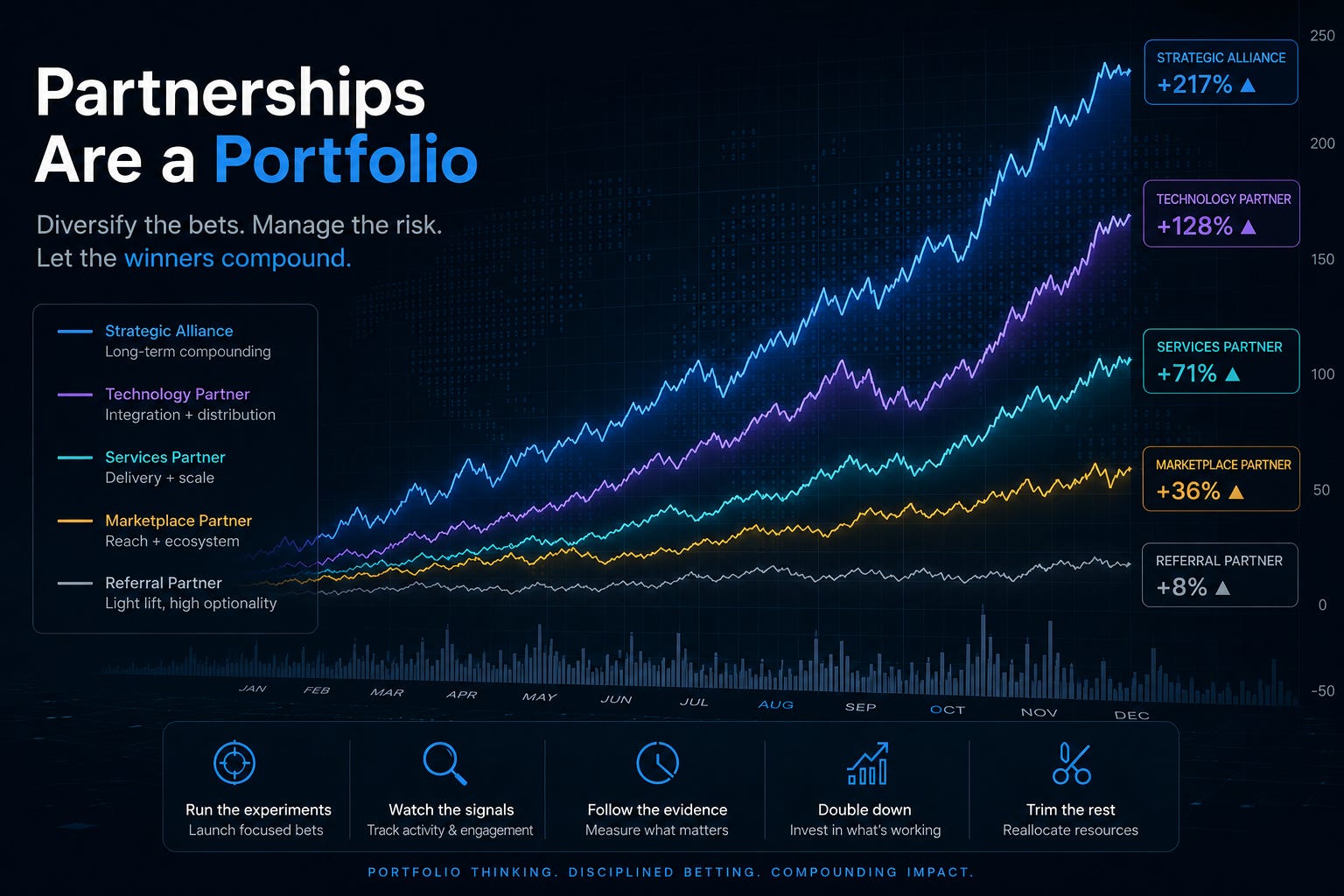
They behave more like a portfolio.
The Hero-Partner Problem
Most partnership teams have a hero-partner story.
“If we can just get Microsoft engaged.”
“If this GSI starts taking us into accounts.”
“If this integration gets listed in their marketplace.”
“If their sales team brings us into three deals.”
The logic feels reasonable. The partner has distribution, customers, brand, or technical reach that your company does not have.
But scale on the partner side does not automatically create attention for you.
Large partners have hundreds or thousands of competing priorities. Their sellers are compensated for specific outcomes. Their technical teams have roadmaps. Their marketing teams have limited campaign capacity.
Being important to your company does not make you important to the partner.
That gap is where a lot of partnership plans stall.
The team builds a strategy around what the partner could do, not what the operating model is actually producing.
Partnerships Are Bets
Every partnership begins with a hypothesis.
We believe this partner serves the right customers.
We believe the integration will increase product adoption.
We believe their sales team will see value in bringing us into deals.
We believe a joint offer will create access we could not create alone.
Those are reasonable beliefs.
They are not yet evidence.
The partnership only becomes real when customers, sellers, and operators begin behaving differently.
Are account teams bringing each other into opportunities?
Are customers using the combined solution?
Are both sides investing time without being chased?
Are introductions becoming opportunities?
Are opportunities converting?
Until those behaviors appear, the partnership is still a bet.
The mistake is pretending every signed agreement is an asset of equal value.
It is not.
Think Like an Investor
A good investor does not expect every company in the portfolio to become the winner.
A good partnership leader should not expect every partnership to scale.
You might launch ten partnership experiments.
Three develop real activity.
Two begin producing repeatable opportunities.
One becomes strategically meaningful.
That is not failure.
That is portfolio math.
The problem is that many partnership teams do the opposite.
They select a small number of large partners, spend heavily on each one, and give them too much time to prove themselves.
By the time the team accepts that the motion is not working, a year has passed.
A portfolio model changes the operating cadence.
You run more focused experiments.
You define the behavior you expect to see.
You invest gradually.
You increase resources when evidence appears.
You reduce investment when it does not.
This is not about treating partners as disposable.
It is about earning conviction.
Not Every Bet Needs to Be Big
One reason companies concentrate on a few large partners is that they assume every partnership requires a major launch.
Executive alignment.
Legal agreements.
Technical integration.
Sales enablement.
Marketplace listings.
Joint marketing.
That is too much investment before the hypothesis has been tested.
Many partnership ideas can begin much smaller.
A shared account mapping session.
A referral experiment in one segment.
A joint customer workshop.
A simple services package.
A campaign aimed at ten mutual accounts.
A technical proof of concept before a full integration.
The goal of the first step is not to prove the partnership can become enormous.
The goal is to learn whether it deserves the next level of investment.
Concentration Risk Exists in Partnerships Too
Companies understand concentration risk when one customer represents too much revenue.
They are often less disciplined when one partner represents too much of the partnership strategy.
That dependence can show up in several ways.
One partner controls most of the sourced pipeline.
One marketplace drives the entire cloud motion.
One services firm holds the key customer relationships.
One technology integration accounts for most partner activity.
One executive relationship keeps the partnership alive.
When the strategy depends on a single relationship, program, or company, the team is more exposed than it realizes.
Leadership changes.
Compensation plans change.
Priorities shift.
Programs get reorganized.
The person who championed you leaves.
The partnership may still exist on paper, but the momentum can disappear overnight.
A portfolio protects against that.
The Portfolio Still Needs a Thesis
Running a portfolio does not mean collecting random partners.
More is not automatically better.
A portfolio without a thesis is just a directory.
The team still needs to know what it is trying to accomplish.
Are you trying to reach a new customer segment?
Increase product adoption?
Improve retention?
Add implementation capacity?
Enter a new geography?
Create credibility in a vertical?
Strengthen a cloud motion?
The thesis determines which bets belong in the portfolio.
It also determines how they should be measured.
A referral partner should not be evaluated like a technology integration.
A GSI should not be evaluated like an app marketplace.
A strategic alliance should not be evaluated like a local services partner.
Different partner types create different forms of leverage.
The portfolio should be diverse, but not confused.
Allocate Resources Based on Evidence
Most partnership teams divide time based on the perceived importance of the partner.
The biggest logo gets the most attention.
A better model is to allocate resources based on evidence and momentum.
An early-stage bet may only deserve a small experiment.
A partner showing repeatable customer activity deserves more enablement.
A partner generating qualified opportunities deserves operational support.
A partner creating consistent revenue may deserve executive sponsorship, dedicated resources, and deeper product investment.
This creates a simple progression:
Hypothesis. Experiment. Evidence. Investment. Scale.
Most teams jump from hypothesis straight to scale.
Then they wonder why the partnership feels expensive.
Your Best Partner May Not Look Strategic Yet
Portfolio thinking also helps teams avoid a second mistake: overlooking smaller partners.
The most productive partnership may not start with the biggest company.
It may begin with a focused services firm that understands the customer.
A specialized ISV with a highly complementary product.
A regional partner with strong relationships.
A consultancy that repeatedly encounters the problem you solve.
A platform team with a specific gap in its offering.
These partners may not look impressive on an ecosystem slide.
But they may have something more valuable than scale.
They have motivation.
And motivation is often the scarce resource in partnerships.
Stop Asking Which Partner Will Win
Partnership leaders are often asked:
“Which partner is going to be the big one?”
It is usually too early to know.
The better questions are:
Which partnership hypotheses are we testing?
What behavior would validate each one?
Where are we seeing real momentum?
Which bets deserve more investment?
Which ones are consuming time without producing evidence?
Where are we overly dependent on one partner?
That is a more honest way to operate.
It is also a more scalable one.
The goal is not to predict the winner perfectly.
The goal is to build a system that recognizes the winner early enough to invest.
Build the Portfolio
The best partnership strategies are not built around one logo.
They are built around a collection of deliberate bets.
Some create access.
Some create product value.
Some create credibility.
Some create delivery capacity.
Some create revenue.
A few may eventually create all five.
But you rarely know which ones at the beginning.
So stop asking one partnership to carry the entire strategy.
Build the portfolio.
Run the experiments.
Watch the behavior.
Follow the evidence.
Then place the bigger bet.