


A few weeks ago, I was sitting in an executive roundtable when a leader shared a story that stuck with me.
Their company had effectively replaced about half of its SDR function with AI agents.
Not completely. There were still humans in the loop. People were overseeing the process, guiding the work, and stepping in where judgment mattered.
But the math was hard to ignore.
Productivity increased.
Output improved.
The experiment worked.
Nobody in the room seemed shocked.
Honestly, neither was I.
If you’ve been paying attention, these stories are becoming increasingly common. Every conference I attend, every executive conversation I join, every boardroom discussion eventually finds its way back to AI.
The excitement is real.
The opportunity is real.
And if we’re being honest, so is the tension.
Because later that evening, I wasn’t thinking about SDR productivity.
I was thinking about my kids.
They’re early in their careers, trying to figure out how to build meaningful futures at the exact moment the rules seem to be changing.
That’s what makes this conversation different for me.
It’s easy to discuss AI in terms of efficiency gains, cost savings, and productivity metrics.
It’s harder when you start asking what happens to the people whose careers are just beginning.
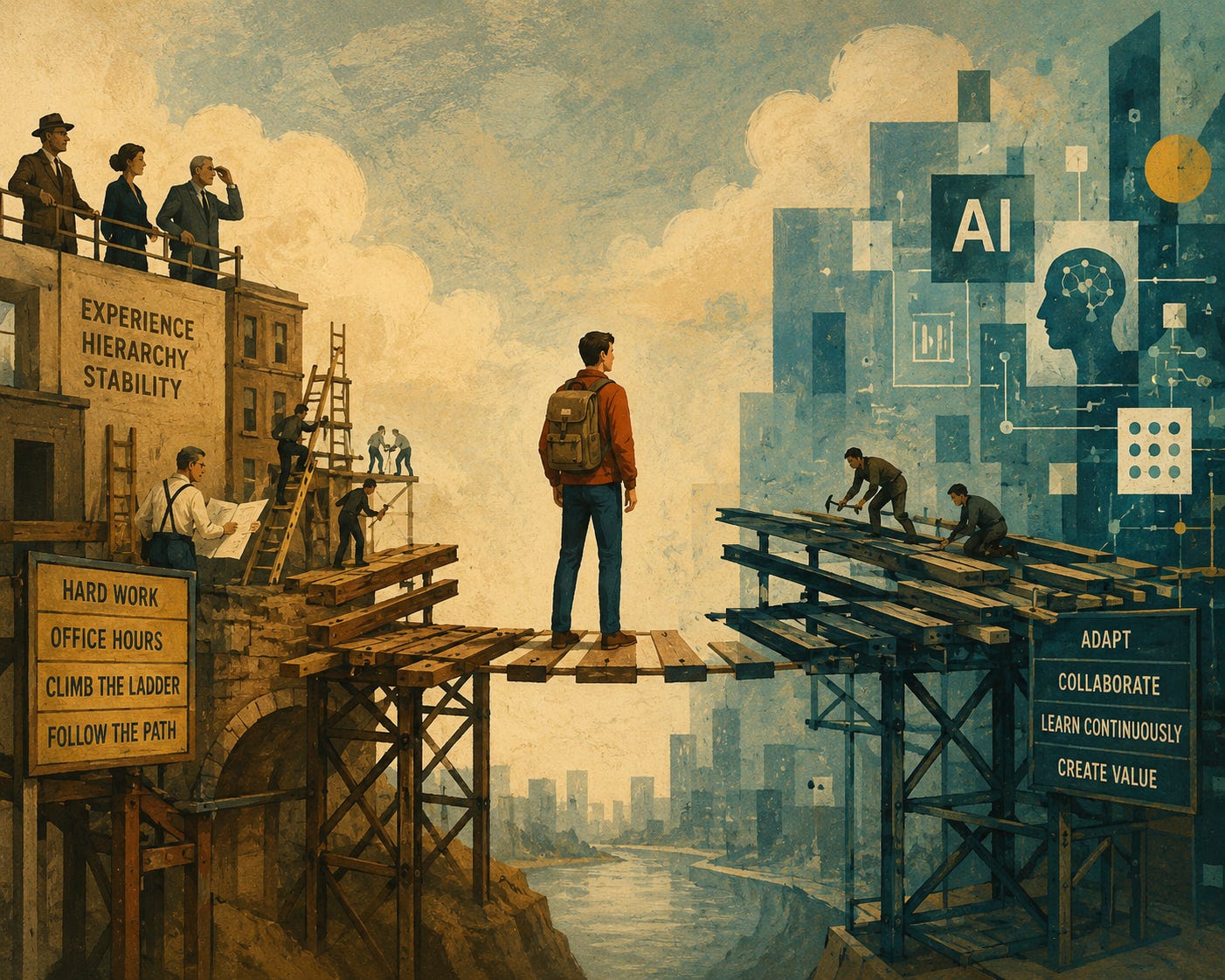
For decades, many careers followed a fairly predictable path.
You joined a company.
You learned the craft.
You gained experience.
You moved up.
The entry-level jobs weren’t always glamorous, but they served an important purpose. They taught people how business worked.
SDR roles are a good example.
They weren’t just about generating pipeline.
They taught people how customers think.
How buyers make decisions.
How to communicate.
How to handle rejection.
How to create value.
If AI can now perform a significant portion of that work, the question isn’t simply whether jobs disappear.
The bigger question is:
How will the next generation gain experience when the traditional entry points are changing?
I think that’s part of what we’re seeing in younger workers today.
Many leaders complain that younger employees seem less loyal to corporations than previous generations.
Maybe.
Or maybe they’re responding rationally to uncertainty.
The old social contract feels less certain than it once did.
If technology can reshape an entire job category in a matter of months, it’s understandable that people might place less faith in long-term corporate promises.
I don’t see that as a failure of commitment.
I see it as adaptation.
And yet, despite all of this, I still find myself landing on the side of hope.
Not because I think AI won’t disrupt jobs.
It will.
Not because I think some careers won’t disappear.
They will.
But because history suggests something important.
Humans are remarkably adaptable.
Every generation faces a technological shift that reshapes work.
My parents’ generation experienced globalization.
Mine experienced the internet.
My kids’ generation is experiencing AI.
The tools change.
The nature of work evolves.
But human ambition has a way of finding new outlets.
In fact, many of the skills that matter most seem to become more valuable as technology advances.
Curiosity.
Judgment.
Creativity.
Trust.
Resilience.
Relationship-building.
The ability to navigate ambiguity.
The ability to help people solve meaningful problems.
Those aren’t becoming less important.
They’re becoming more important.
The people who thrive won’t be the ones competing against AI.
They’ll be the ones who learn how to work alongside it.
That’s the advice I give my kids.
Learn the tools.
Experiment relentlessly.
Stay curious.
Don’t ignore what’s happening.
But don’t let fear paralyze you either.
Every generation gets its defining technology.
This one happens to be AI.
So if you’re asking whether I’m on the side of hope or fear, my answer is both.
I understand the fear.
I feel it myself sometimes.
Especially when I think about young people trying to find their footing.
But in the end, I still choose hope.
Not because the future is guaranteed to be easy.
Because I’ve seen enough of human adaptability to believe that we’ll figure out how to create value in whatever comes next.