


The era of the “Lone Wolf” software vendor is over.
If you are a CRO or a Founder today, you probably remember the old playbook. You hired a legion of expensive enterprise reps and told them to “go hunt.”
Today, that playbook has just been given a facelift. Instead of a data-enriched list, you buy the latest AI GTM tech stack. You set up automation to auto-enrich thousands of leads, you have AI agents writing hyper-personalized emails, and you use signals-based software to predict intent.
But the fundamental motion has not changed. You still own the lead, you own the demo, you own the close, and you own the deployment.
And that is why you are hitting a wall.
Better tools cannot fix a broken economic model. The center of gravity in enterprise IT has shifted. The budget is not sitting in a generic IT bucket anymore. It is locked up in Cloud Committed Spend.
To unlock that budget, you cannot scale alone, no matter how good your AI agents are. You need to adopt the dominant go-to-market model of the Cloud Era: The Power of Three.
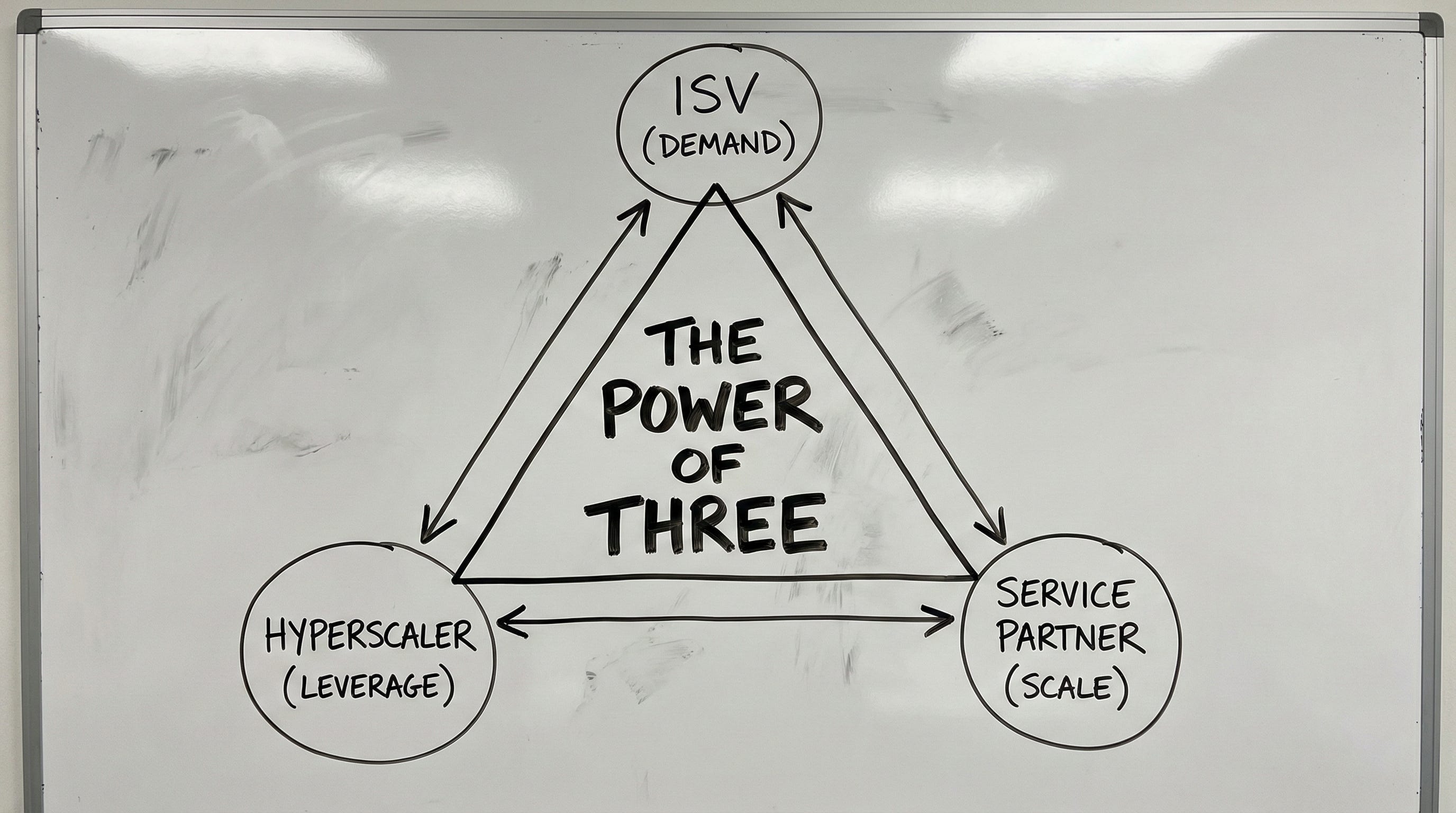
Here is the breakdown of why the model exists, why it prints money, and how to execute it.
The Economics of the Triangle
Hyperscalers (AWS, Azure, GCP) do not think like traditional software vendors. They operate on a single, brutal truth: Consumption is King.
They do not make money when a contract is signed. They make money when the servers spin up.
This reality created a gap. Hyperscalers have the infrastructure, and ISVs (Independent Software Vendors) have the applications, but neither has the manpower to ensure successful deployment at a global scale.
Enter the Power of Three:
The ISV (You): You create the demand.
The Hyperscaler: They create the leverage.
The Service Partner: They create the scale.
When these three align, the friction of enterprise sales disappears.
The Roles (Stay in Your Lane)
The biggest mistake I see in ecosystem sales is role confusion. The model only works if everyone plays their specific position.
1. The Captain: The ISV
Your Job: Demand & Deal Leadership. Do not fall into the trap of thinking the Hyperscaler will sell your product for you. They won’t. AWS and Microsoft are multipliers, not lead-gen agencies.
You must define the Ideal Customer Profile.
You must register the lead.
You must drive the sales cycle.
2. The Multiplier: The Hyperscaler
Their Job: Leverage & Incentives. Once you have momentum, the Hyperscaler steps in to grease the wheels.
They provide access to the C-Suite (Air Cover).
They unlock “committed spend” budgets (MACC/EDP) so the customer effectively buys your software for “free” using pre-allocated funds.
They offer credits to offset migration costs.
3. The Anchor: The Service Partner (GSIs/SIs)
Their Job: Delivery & Durability. This is the most undervalued leg of the stool. The Service Partner (Accenture, Slalom, or a boutique specialist) de-risks the purchase.
They ensure the software actually gets installed.
They turn a one-time license into a long-term managed service.
Key Stat: Customers are 3x less likely to churn when a trusted partner manages the deployment.
The “Missing Leg” Risk Matrix
What happens when you try to cheat the model?
ISV + Hyperscaler (No Services): This is the “Churn Trap.” You close the deal fast using cloud budget, but the customer fails to implement. Next year, you get ripped out.
ISV + Services (No Hyperscaler): This is the “Friction Trap.” You have a great solution and a great implementation team, but you get stuck in Procurement Hell for 9 months because there is no budget incentive.
Hyperscaler + Services (No ISV): This is the “Commodity Trap.” Generic cloud migration with no specific business outcome. Low urgency, low margins.
The Data: Why This Works
This is not just theory. The data supports the triangle.
According to research from Canalys, Tackle.io, and Forrester Consulting:
The Market: There is over $460 Billion in committed cloud spend sitting on the books globally (Canalys/Tackle.io). The only way to tap into that effectively is through this model.
Velocity: Deals transacted through a Marketplace with partner alignment close 40% faster than direct sales (Forrester TEI Study).
Size: Deal sizes increase by 50% to 80% when sold through the ecosystem because buyers are less price-sensitive when using committed cloud budgets (Canalys).
The Playbook: How to Execute
If you want to move from “Lone Wolf” to “Power of Three,” here is your Monday Morning checklist:
1. Pick Your Anchor Do not try to partner with every GSI. Pick 2-3 Service Partners who specialize in your specific domain (e.g., Data, Security, AI). Go deep with them.
2. The “Give-to-Get” Never ask a partner for a lead until you have given them one. Bring a Service Partner into an active deal this week. Even if you do not “need” them to close it, you need them to stay in the account.
3. Transact via Marketplace Make the Cloud Marketplace your default transaction path. It aligns the Hyperscaler comp, it simplifies procurement for the customer, and it allows the Service Partner to be paid on the same invoice (via CPPO/MPO).
4. The Golden Rule The ISV always leads. If you abdicate ownership of the deal, the system collapses. You are the conductor; the Hyperscaler and Service Partner are the orchestra.
The Takeaway
The future of software sales isn’t about how well you pitch. It is about how well you align.
Software creates demand. Services create durability. Hyperscalers create leverage.
Miss one, and you are fighting gravity. Align all three, and you scale.
Enjoyed this post? Subscribe for more deep dives into Cloud GTM strategy.