


I’ve watched this movie a dozen times now. The ending never changes.
A B2B SaaS company, usually Series B or C, sometimes a PE portfolio company that just got a new operating partner with “channel experience,” decides it’s time to get serious about partnerships. The board’s been asking about it. The CEO saw a competitor announce an integration. Someone read a Forrester report about ecosystem-led growth.
So they do what feels logical: they hire a Head of Partnerships.
Six to nine months later, that person is either gone, sidelined, or running a glorified BD function that generates pipeline reports nobody trusts. The company concludes that “partnerships didn’t work for us” and moves on.
Here’s the thing. Partnerships probably would have worked. The hire wasn’t the problem. The sequence was.
The Setup for Failure
When most companies hire their first Head of Partnerships, here’s what that person walks into:
No ICP alignment. Nobody has done the work to define which partners actually matter. There’s a vague list of “integration partners” and maybe a referral agreement someone signed at a conference. The new hire spends their first 90 days trying to figure out who to partner with while leadership wonders why there aren’t results yet.
No infrastructure. The CRM has no partner fields. There’s no way to track partner-sourced or partner-influenced revenue. There are no co-selling workflows, no deal registration process, no shared pipeline visibility. The Head of Partnerships is building the plane while trying to fly it, and also trying to prove the plane works to a skeptical executive team.
No internal alignment. Sales doesn’t know what partnerships is supposed to do for them. Marketing hasn’t thought about co-marketing motions. Product has their own integration roadmap that may or may not align with partner priorities. The new hire has to evangelize internally before they can do anything externally.
No realistic expectations. Leadership expects pipeline in Q1 and revenue by Q2. Partner programs, real ones, not just logo swaps, take 12-18 months to generate meaningful, attributable revenue. By the time the program would have started producing, the person is already on a PIP or has quit.
This is a structural problem, not a talent problem. You could hire the best partnerships operator on the planet, and they’d still struggle in this environment.
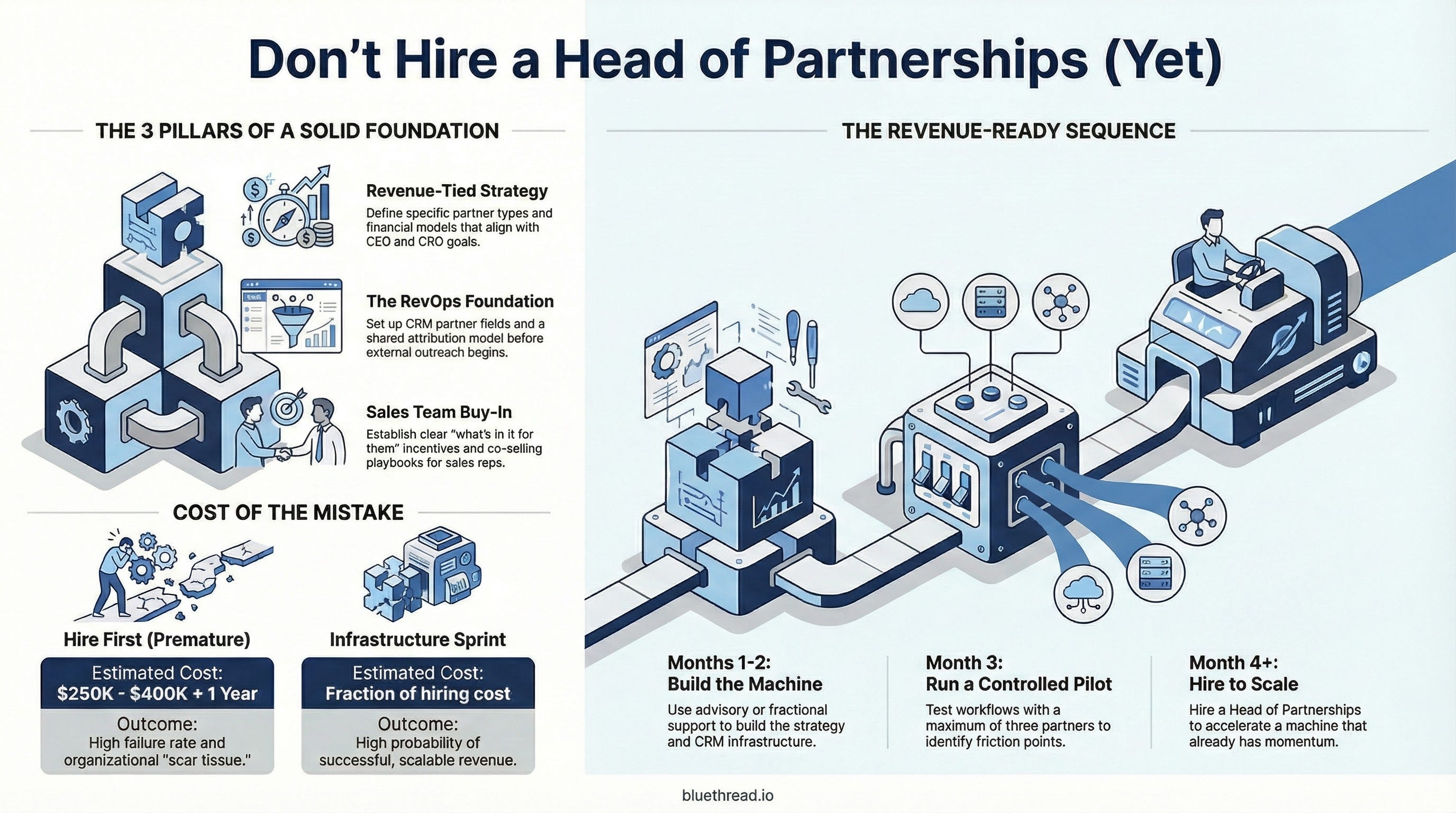
Why Companies Get the Sequence Wrong
The instinct to “hire someone to figure it out” makes sense in a lot of functional areas. Need to build a sales team? Hire a VP of Sales. Need a product marketing function? Hire a PMM lead.
Partnerships is different, and here’s why: it’s a cross-functional motion that touches sales, marketing, product, and ops. It requires infrastructure that doesn’t exist yet. And the person you hire to run it is rarely the right person to build the foundation it needs to run on.
Think about it this way. You wouldn’t hire a VP of Sales before you had a CRM, a defined ICP, and a basic sales process. You’d build those things first, or at least build them alongside the hire with dedicated support. But that’s exactly what companies do with partnerships. They hire the leader before the system exists.
The other issue is measurement. Most companies have no partner attribution model when they make this hire. So the Head of Partnerships is operating in an environment where their impact is literally unmeasurable. They might be generating real value (through influenced deals, faster sales cycles, reduced churn) but none of it shows up in the data. They’re fighting for budget and credibility with no evidence, not because the evidence doesn’t exist, but because nobody built the system to capture it.
What to Build First
Before you hire a Head of Partnerships, you need three things in place. You can build them in 60-90 days with the right support: advisory, fractional ops, whatever model works for your stage.
1. A Partner Strategy That’s Tied to Revenue
Not a slide deck with a partner ecosystem map and the word “synergies” on it. An actual strategy document that answers:
Which partner types matter for your business right now? (Technology, channel, referral, services. Pick one or two to start.)
What’s the financial model? How do partner-sourced deals compare to direct in terms of CAC, ACV, and LTV?
What does “good” look like in 6, 12, and 18 months, and what are the leading indicators you’ll track before revenue shows up?
This doesn’t need to be a 50-page document. It needs to be clear, specific, and bought into by the CEO and CRO. If sales leadership hasn’t signed off on how partnerships will interact with their team, you’re already dead.
2. The Revenue Operations Foundation
This is where most companies skip steps and pay for it later. Before you have a partnerships person making promises to external partners, you need:
Partner fields and objects in your CRM. At minimum: partner account records, partner-sourced and partner-influenced flags on deals, a deal registration workflow, and basic reporting. In HubSpot, this is a few days of work. In Salesforce, maybe a week. It’s not hard. It just needs to be done intentionally.
An attribution model you’ve agreed on. First-touch? Multi-touch? Influenced? There’s no perfect answer, but you need to pick a model, document it, and get finance to agree that partner-influenced revenue counts for something. If your CFO doesn’t trust the numbers, the program will never get the investment it needs.
A basic partner lifecycle workflow. How do partners get recruited? How do they register deals? How do you communicate with them? This doesn’t need to be a full PRM platform on day one. A well-structured CRM setup with some automated workflows handles 80% of what early-stage programs need.
3. Internal Alignment (The Hardest Part)
Your sales team needs to understand three things before a partnerships person starts bringing them co-sell opportunities:
First, what’s in it for them. If reps think partnerships is going to steal their leads or complicate their deals, they’ll sabotage the program before it starts. Comp structure matters here. If partner-sourced deals don’t count toward quota or pay a lower commission, you’ve already lost.
Second, what the engagement model looks like. When a partner brings a lead, what happens? Who owns the deal? Who runs the demo? How does communication work? This needs to be a documented playbook, not a “we’ll figure it out” conversation.
Third, what they’re expected to do. Are reps supposed to actively co-sell? Just accept warm intros? Refer deals back to partners? Set expectations clearly and simply.
The Right Sequence
Here’s what I tell every company I work with, whether it’s a PE portfolio company trying to add a partner channel or a Series B startup thinking about their first integration partnerships:
Months 1-2: Strategy + Infrastructure. Bring in advisory support or a fractional partnerships operator. Define the strategy, build the CRM foundation, establish the attribution model, and get internal buy-in. This is a focused sprint, not a six-month consulting engagement.
Month 3: Pilot. Run a small, controlled partner pilot with two or three partners maximum. Test the workflows. See if deals actually flow through the system. Identify the friction points. This gives you real data and real stories before you hire.
Month 4+: Hire with conviction. Now you’re hiring a Head of Partnerships into an environment where they can actually succeed. They have a strategy to execute, infrastructure to work with, early results to build on, and internal credibility to leverage. The conversation changes from “what should partnerships do?” to “how do we scale what’s already working?”
The difference is night and day. Instead of hiring someone to figure everything out from scratch while also delivering results, you’re hiring someone to accelerate a machine that already has momentum.
The Uncomfortable Truth
Some of you are reading this and thinking, “That’s great, but we can’t afford to spend two months building infrastructure before we hire.”
Here’s my counter: you can’t afford not to. The fully loaded cost of a Head of Partnerships (salary, benefits, ramp time, the opportunity cost of a failed program) is somewhere between $250K and $400K in the first year. If that person fails, and the data suggests most first partnerships hires at companies without infrastructure do fail, you’ve burned through that budget, lost 9-12 months, and created organizational scar tissue that makes the next attempt even harder.
A 60-90 day infrastructure sprint costs a fraction of that and dramatically increases the probability that your partnerships hire succeeds.
The Bigger Point
The companies that build great partner programs don’t start with a hire. They start with a decision about what role partnerships plays in their go-to-market motion, and then they build the system to support it.
The hire is important. It might even be the most important decision you make. But it’s not the first decision. It’s the third or fourth, after strategy, after infrastructure, after alignment.
Get the sequence right, and you’ll be shocked at how quickly a partnerships program can produce real revenue. Get it wrong, and you’ll join the long list of companies that “tried partnerships and it didn’t work.”
It worked. You just built the house starting with the roof.
Rob Moyer is the founder of Bluethread.io, a partnership advisory firm that helps B2B SaaS companies and PE portfolio companies build partner programs that actually produce revenue. He also runs the Bluethread Collective, a free community for partnership professionals.
Spot on. You can’t afford not to build the RevOps infrastructure before you set your partner program in motion