


RPM stands for Revenue Per Motion.
It measures how much revenue a specific partner motion reliably produces per quarter based on how often it runs, how many accounts it reaches, and how effective it is.
Not pipeline.
Not activity.
Not logos.
Actual revenue output.
This framework is a modern revamp of classic channel math, reach, frequency, and yield. The first operationalized at scale in early Microsoft partner execution. What’s changed is the unit of measurement.
Back then, it was applied to programs.
Today, it applies to motions.
That distinction matters.
Why Most Partner Metrics Lie
Most partner metrics don’t fail because they’re wrong.
They fail because they answer the wrong question.
They tell you who’s active.
They tell you who’s engaged.
They tell you who looks strategic.
They don’t tell you what compounds.
Let’s name the common lies:
Pipeline ≠ impact
Logos ≠ leverage
Activity ≠ revenue
Pipeline inflates early and collapses late.
Logos reward breadth, not depth.
Activity measures motion, not outcomes.
If your partner strategy can’t reliably answer “how much revenue does this produce?” it’s you are going to struggle with FP&A.
The Question Leadership Actually Asks
Every executive conversation eventually converges here:
“Which partner motions are worth scaling?”
Not:
Which partners do we like?
Which logos make us feel safe?
Which campaigns looked good in a deck?
They want to know where revenue is predictable.
Most partner teams can’t answer that cleanly, because they don’t operate with a unit of measurement that maps to how revenue is made.
RPM fixes that.
RPM: The Operator Definition
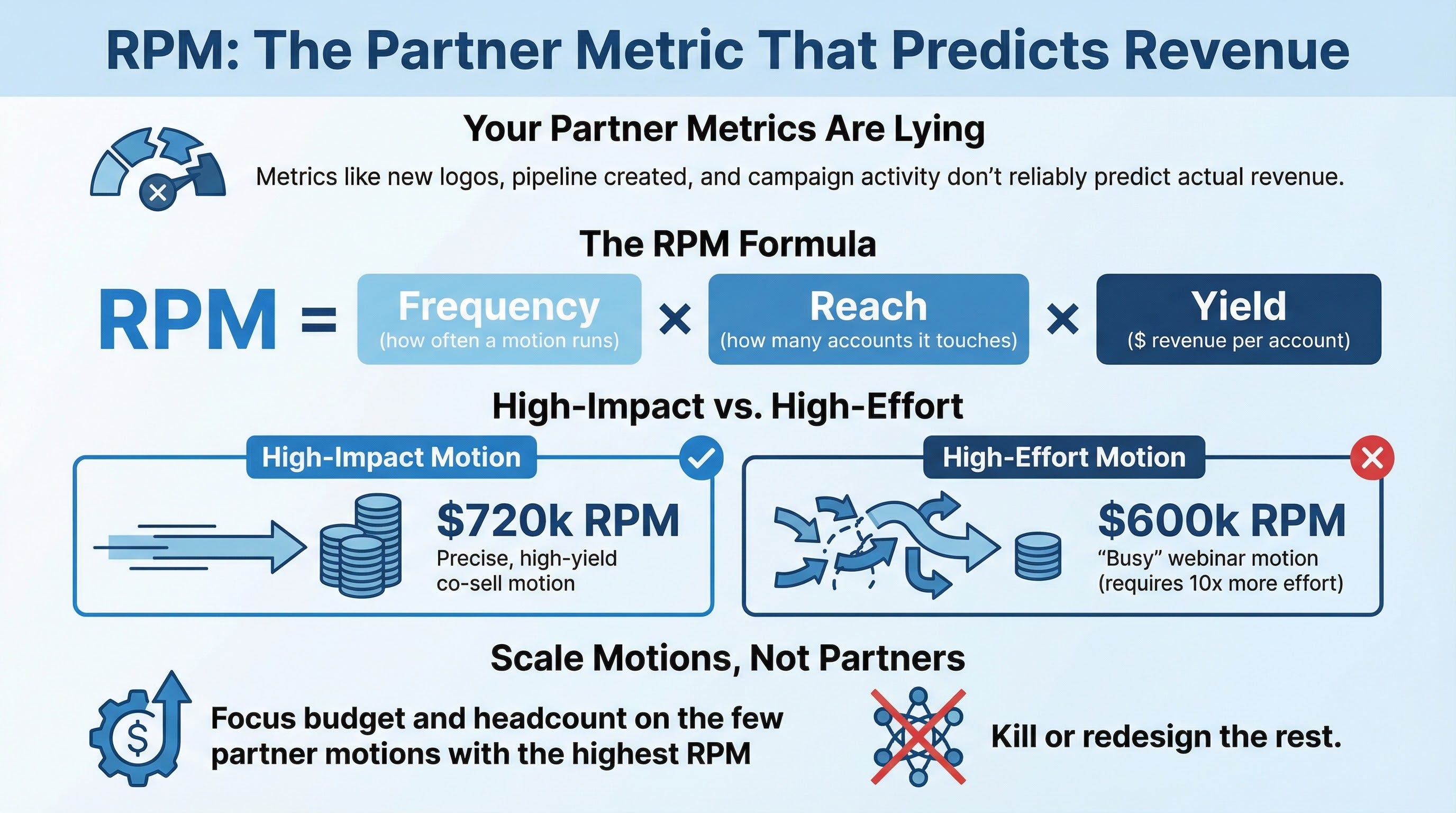
RPM = Frequency × Reach × Yield
Where:
Frequency is how often the motion runs per quarter
Reach is how many qualified accounts it touches per run
Yield is the average revenue per account touched
This is not a vanity metric.
It’s a forcing function.
It turns partner strategy into economics.
RPM in Plain English (Exec-Ready)
If RPM is working, you can say this sentence without hedging:
“This partner motion produces approximately $X in revenue every quarter based on how often we run it, how many accounts it reaches, and how effective it is.”
If you can’t say that sentence, you don’t have a real partner motion.
You have activity wrapped in hope.
RPM Applied: A Real Co-Sell Motion
Motion: Late-stage SI co-sell to de-risk stalled opportunities.
This is not high-volume.
It’s not brand-building.
It’s precise.
Inputs:
Frequency: 6 deals per quarter
Reach: 1 account per deal
Yield: $120k ARR per closed deal
RPM math:
6 × 1 × $120k = $720k ARR per quarter
Low volume.
High precision.
Massive leverage.
Now Compare That to a “Busy” Motion
Motion: Co-branded webinar with an ISV partner.
Looks strong on a dashboard.
Feels scalable.
Inputs:
Frequency: 2 per quarter
Reach: 200 registrants
Yield: $1,500 ARR per account
2 × 200 × $1.5k = $600k ARR per quarter
Here’s what RPM reveals immediately:
The webinar barely matches the co-sell motion, while requiring significantly more effort, coordination, and operational drag.
RPM doesn’t care how impressive something looks.
It only cares what it produces.
How RPM Changes Behavior
Once RPM becomes the metric, behavior shifts fast.
Sales stops asking “which partners do we like?”
Partner teams stop chasing logos
Marketing stops running low-yield plays
Executives stop distrusting partner numbers
Not because attribution improved.
Because the economics are clear.
What RPM Replaces (Kill These Metrics)
If a metric doesn’t ladder to RPM, it’s noise.
That includes:
Number of partners signed
Number of enablement sessions
Number of campaigns launched
“Partner-sourced vibes”
These are inputs.
RPM is the output.
Operator Rules for RPM
If you want partnerships to behave like a revenue engine:
Every partner motion must declare its RPM
If RPM can’t be estimated, don’t run the motion
Scale motions, not partners
One high-RPM motion beats ten low-RPM ones
This is how partner teams earn credibility without begging for it.
The One-Line Exec Summary
RPM tells you which partner motions deserve headcount, budget, and attention and which ones are just loud.
Bonus Operator Tip
Start simple:
Identify three partner motions
Estimate RPM conservatively
Fund the top two
Kill or redesign the rest
That’s how partnerships stop being defended and start being funded.