


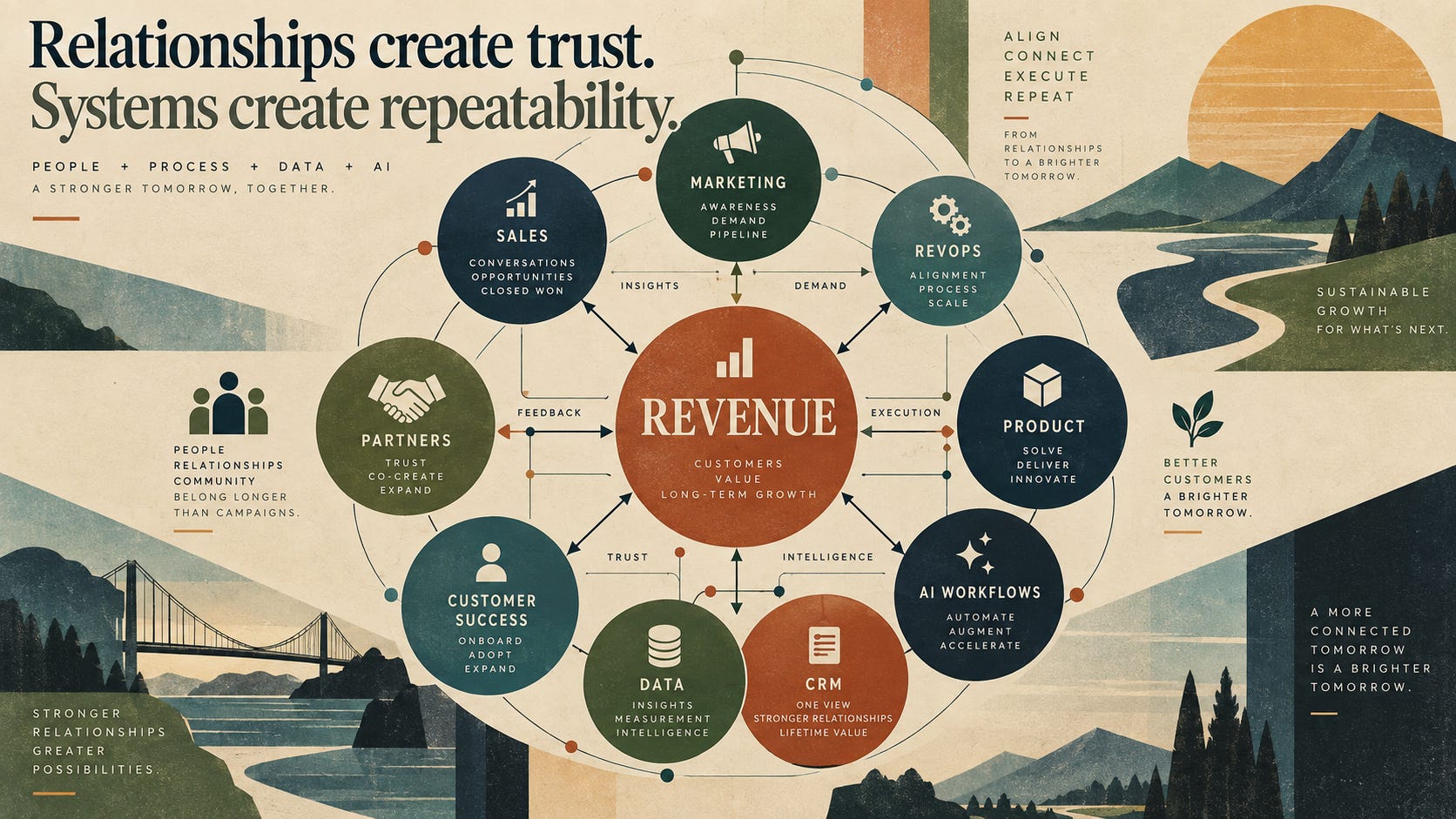
The best partner leaders in the next few years will not be the best relationship managers.
They will be system thinkers.
That does not mean relationships matter less.
They are still the core.
Trust matters.
Credibility matters.
Knowing who to call matters.
Being able to get people aligned around a problem still matters.
But relationships are not a system.
That distinction is becoming more important.
One of the biggest mistakes I see in partnership organizations trying to transform is taking what worked 10 years ago and simply adding more technology around it.
More tools.
More data.
More automation.
More dashboards.
But underneath it all, the operating model is still built around individual relationships.
That does not scale.
The modern partner leader has to understand how the pieces of GTM actually work together.
Sales.
Marketing.
RevOps.
Product.
Customer success.
Partners.
Data.
AI.
Historically, partnerships could operate as a separate function.
Build relationships.
Recruit partners.
Run enablement.
Create some joint pipeline.
Report activity.
That model worked better when companies were smaller, channels were simpler, and much of the motion could live in the heads of a few experienced people.
That is not the environment we operate in now.
The customer does not experience your company in departments.
They experience one system.
And increasingly, the partner sits somewhere inside that system.
The best partner operators are starting with the customer and working backward.
Where does trust come from?
Who already has the relationship?
What signals tell us there is an opportunity?
How does that signal get into the CRM?
Who owns the next action?
Where does the partner enter the sales process?
How do we move from introduction to validation to conversion?
And ultimately, did the partnership help us close the deal?
That is system thinking.
It is also why the lines between Partnerships, RevOps, Sales and GTM Ops are beginning to blur.
The partner leader of the future needs to understand CRM architecture, account mapping, attribution, automation, hyperscaler co-sell, AI workflows, sales process and partner economics.
Not because they need to personally operate every system.
But because they need to understand how the system produces revenue.
This is the shift I think we are underestimating.
AI will automate more of the activity around partnerships.
Research.
Account mapping.
Partner discovery.
Briefing.
Enablement.
Follow-up.
Reporting.
The differentiator will not be who can produce more activity.
It will be who can design a better system.
And this is where the distinction matters most.
Relationships create trust.
Systems create repeatability.
You need both.
If you have systems without relationships, the motion becomes mechanical.
If you have relationships without systems, the motion becomes dependent on individuals.
That is the trap.
A lot of partnership teams are trying to modernize without actually changing how they operate.
They are digitizing the old model instead of building a new one.
The best operators will do something different.
They will look across GTM, find the friction, connect the right pieces and create leverage.
They will use technology to make relationships more valuable, not replace them.
The next generation of partnership leaders will need both.
Human trust.
And system thinking.
Totally agree, Rob. To be successful, you have to have a system that is measurable, and scalable so it can be defensible. In other words, you have to be able to report/prove partner-sourced revenue with metrics that are aligned with other internal stakeholders and that partners also understand and buy into.