


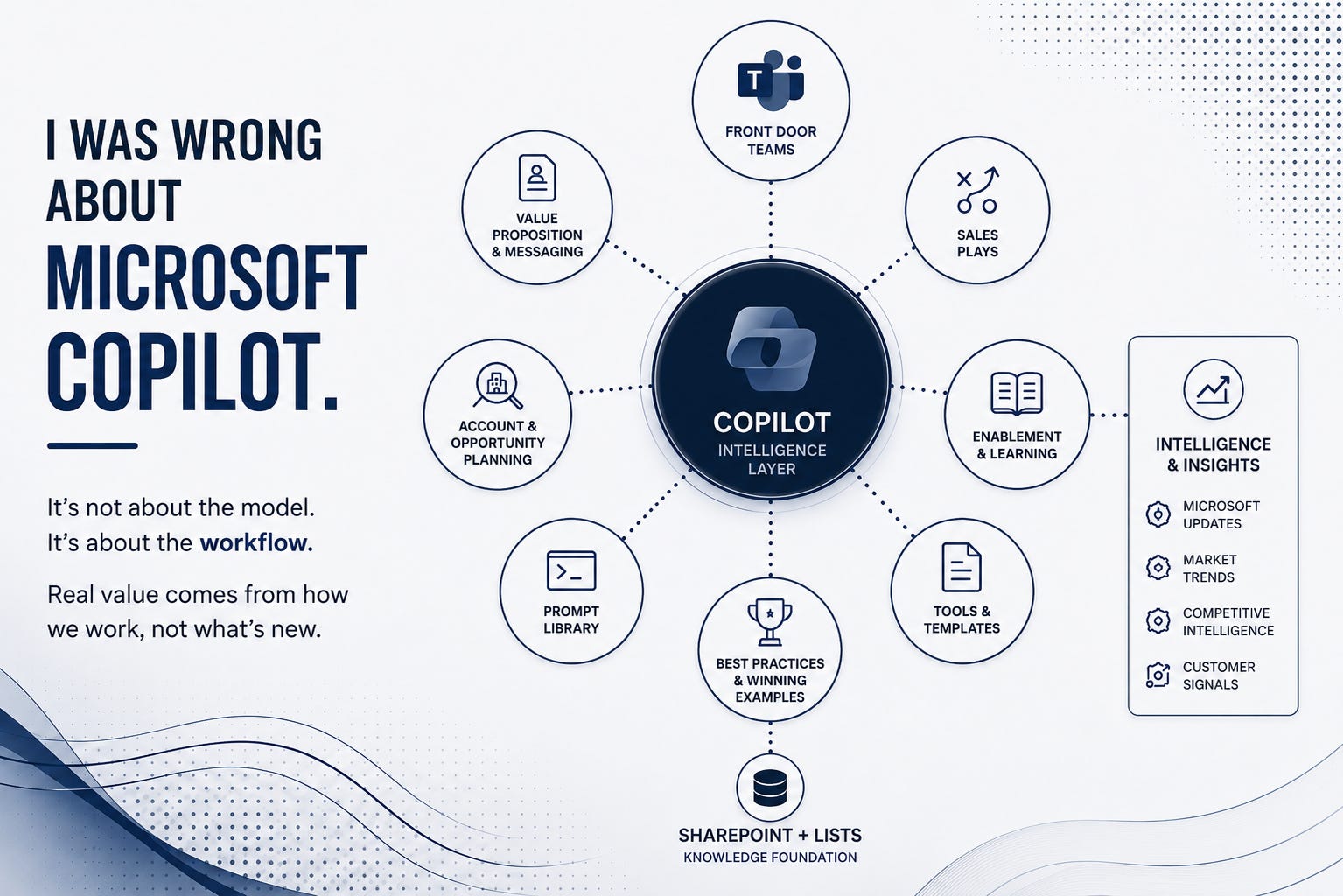
I was wrong about Microsoft Copilot.
Not because I thought it was bad. I just thought about it too narrowly.
I started this week doing what looked like a fairly normal training session. There was some AI involved, some prompt work, some discussion around how a sales team could use Copilot more effectively.
Then the conversation changed.
Instead of asking, “What are the best prompts?” we started asking a much better question:
What would an actual operating system for this team look like if we built it entirely on the Microsoft stack?
That changed everything.
The front door became Teams.
SharePoint became the knowledge layer.
Microsoft Lists became a way to structure content instead of burying it in folders.
Copilot became the interface for finding, summarizing, and applying that knowledge.
Agents started to make sense as a way to guide people through repeatable jobs.
Power Automate became the plumbing underneath the system.
And suddenly this was no longer an AI training exercise.
It was a go-to-market workflow problem.
That distinction matters.
There is so much attention right now on models, benchmarks, agents, and whatever the newest release happens to be. I understand why. The technology is moving incredibly fast.
But most companies do not have a model problem.
They have a workflow problem.
They have a knowledge problem.
They have an execution problem.
They have ten different places where people store the same information, no clear operating rhythm, and too much institutional knowledge sitting in someone’s head.
AI does not magically fix that.
In fact, if the underlying system is messy, AI often just gives you a faster way to interact with the mess.
What became interesting in this project was that we stopped thinking about AI as the destination.
We started thinking about the job.
A seller has a customer meeting.
What do they need?
They need to understand the account.
They need the right value proposition.
They need the relevant product knowledge.
They need discovery questions.
They need the right sales play.
They need competitive context.
They need a call brief.
They need a good follow-up.
They need to know what to do next.
That is the operating system.
AI becomes valuable when it helps move the seller through that workflow faster and with better context.
That is a very different conversation than “Here are 50 great prompts.”
The prompt library still matters.
But a prompt sitting in a library is just another document.
A useful prompt is connected to a workflow.
Account research.
Call preparation.
Opportunity planning.
Executive communication.
Cross-sell.
Competitive strategy.
Next-step recommendations.
The same thing is true for agents.
An agent is much more useful when it is grounded in the way the organization actually works.
Not a generic chatbot.
An agent that understands:
Here is how we prepare for a call.
Here is our value proposition.
Here are our product plays.
Here are the questions we ask.
Here is what good looks like.
Here are the examples from the field.
That is where the technology starts becoming operational.
One of my biggest takeaways from the week was also a reminder of something I have believed for a long time:
Being close to real customers is still one of the best ways to understand where technology actually creates value.
You can read the announcements.
You can watch the demos.
You can follow every AI release.
But when you sit with a team trying to hit a real number, the conversation gets simpler very quickly.
Does this help someone prepare better?
Does this improve a customer conversation?
Does this make the right information easier to find?
Does this create a repeatable process?
Does this help a seller move an opportunity forward?
Those are much better tests than whether something sounds impressive in a keynote.
And that is where I changed my mind on Copilot.
I had been evaluating it too much as an AI product.
I now think the more interesting opportunity is to view it as part of a broader operating layer.
Teams.
SharePoint.
Lists.
Copilot.
Agents.
Automation.
All connected around the actual work.
That combination may not be as exciting as arguing about which model is best this week.
But for go-to-market teams, it may be a lot more useful.
The lesson for me is pretty simple:
Do not start with the AI. Start with the workflow.
Then decide where AI actually makes the workflow better.
That is when the hype starts turning into something useful.
The real magic with Microsoft is building skills. It’s incredible what can be accomplished. 😎