


Everywhere I look, there’s another AI GTM startup.
Agents for prospecting. Agents for research. Agents for outbound. Agents that manage other agents.
Some of this technology is genuinely impressive. I use plenty of it myself.
But after a year of building BlueThread, I’ve come to a different conclusion.
If you’re starting a business today, I think the answer is somewhere in the middle.
Not a business that measures its progress by headcount alone.
Not a fully autonomous AI company with agents doing everything.
Something in between.
A founder-led business that uses AI for leverage, contractors for specialized work, and partnerships to create distribution.
That’s the business I’m slowly building.
And the more I work on it, the more convinced I am that the biggest opportunity isn’t necessarily building another AI agent.
It’s building a business where the right people and technology make each other more effective.
First, a little context
I started BlueThread about a year ago.
My goal wasn’t to build the next giant consulting firm. I’ve spent enough years in corporate life to know what comes with managing large organizations.
I wanted to build a high-performing lifestyle business.
Do interesting work. Work with people I like. Stay close to customers. Make a good living. Have some freedom.
A year in, we’ve worked with 35 clients, hosted three events and three dinner roundtables, and brought roughly 275 people together.
I’ve done this working about three-quarter time, with help from contractors, partners, and increasingly AI.
I’m still figuring things out. But a few patterns are becoming clear.
My AI stack is pretty ordinary
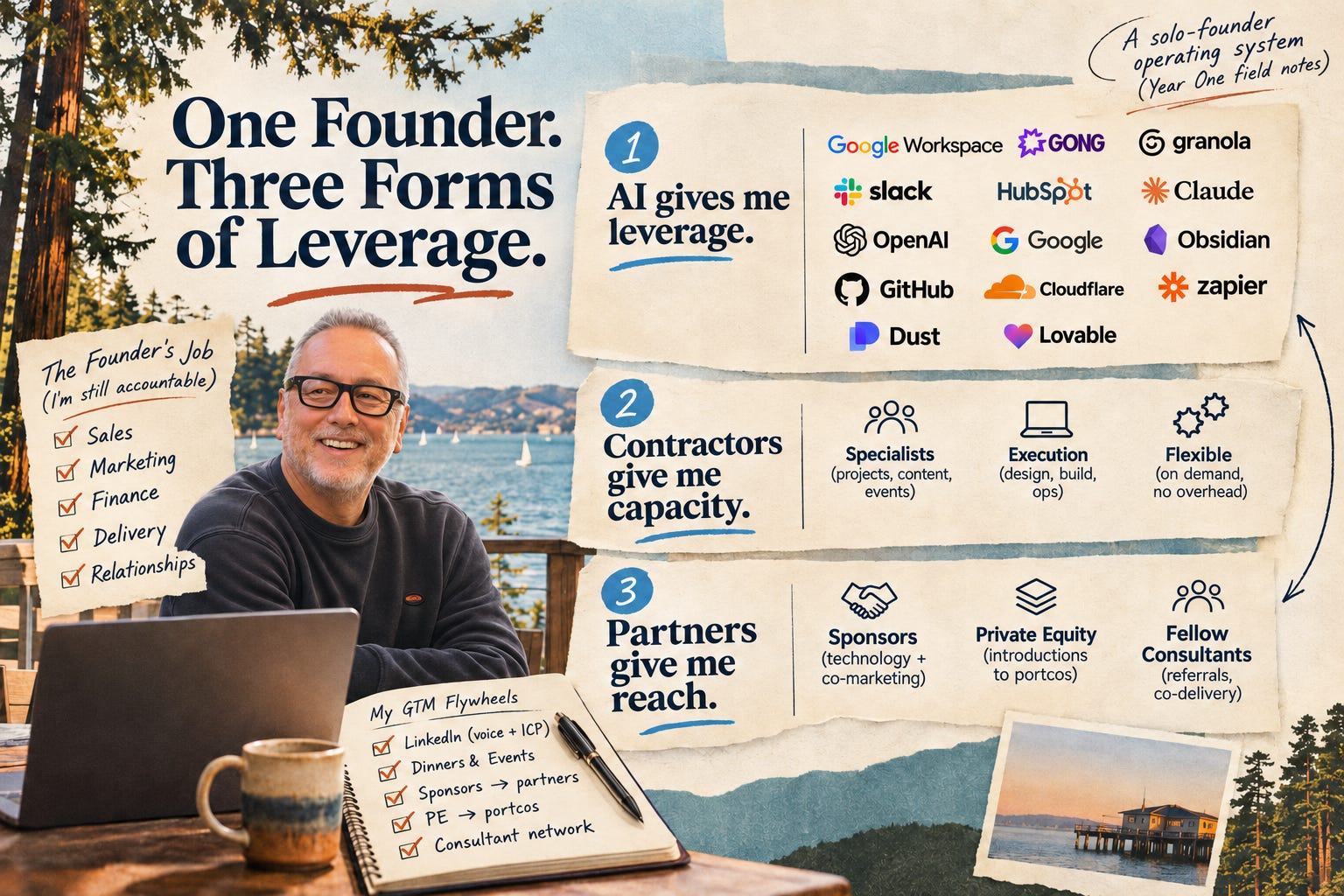
Here’s what I use today.
Google Workspace: Email, calendar, documents, and the foundation of my business.
HubSpot: CRM and pipeline management.
Gong and Granola: Conversations, notes, and customer intelligence.
Slack: Collaboration and communication.
Claude: My AI chief of staff.
OpenAI: My administrative assistant and another thinking partner.
Google AI: My researcher.
Obsidian and GitHub: My knowledge vault and version-controlled working environment.
Lovable and Cloudflare: Building and operating my website and lightweight applications.
Zapier: Connecting systems and automating workflows.
Dust: Exploring more structured AI workflows and agents.
I’m deliberately becoming proficient in both Claude and OpenAI. They have different strengths, and I don’t want my business dependent on one model.
I’ve also been building what I call my Operator Desk.
The concept is simple: Record, Route, Run, Review.
Capture what happens in meetings, email, and CRM. Organize it by client or partner. Route work to the right AI assistant. Run repeatable tasks. Keep a human in the loop before anything important goes out.
My Obsidian vault is becoming a central part of that system.
The goal isn’t to create an impressive diagram of interconnected agents.
It’s to make sure I don’t have to remember everything, repeat the same work, or spend my day doing administration.
I want AI doing the work around the relationships, so I can spend more time building the relationships.
But here’s where my thinking differs from much of what I see in the AI GTM market.
I built my top-of-funnel flywheel before automating it
I see a lot of companies building increasingly sophisticated outbound systems.
More contacts. More enrichment. More sequences. More personalized messages.
I’m not against outbound. I think it has its place.
But I chose a different starting point.
I wanted to build a business where opportunities increasingly came from relationships, reputation, and a network of people who understood what we do.
Here’s how that evolved.
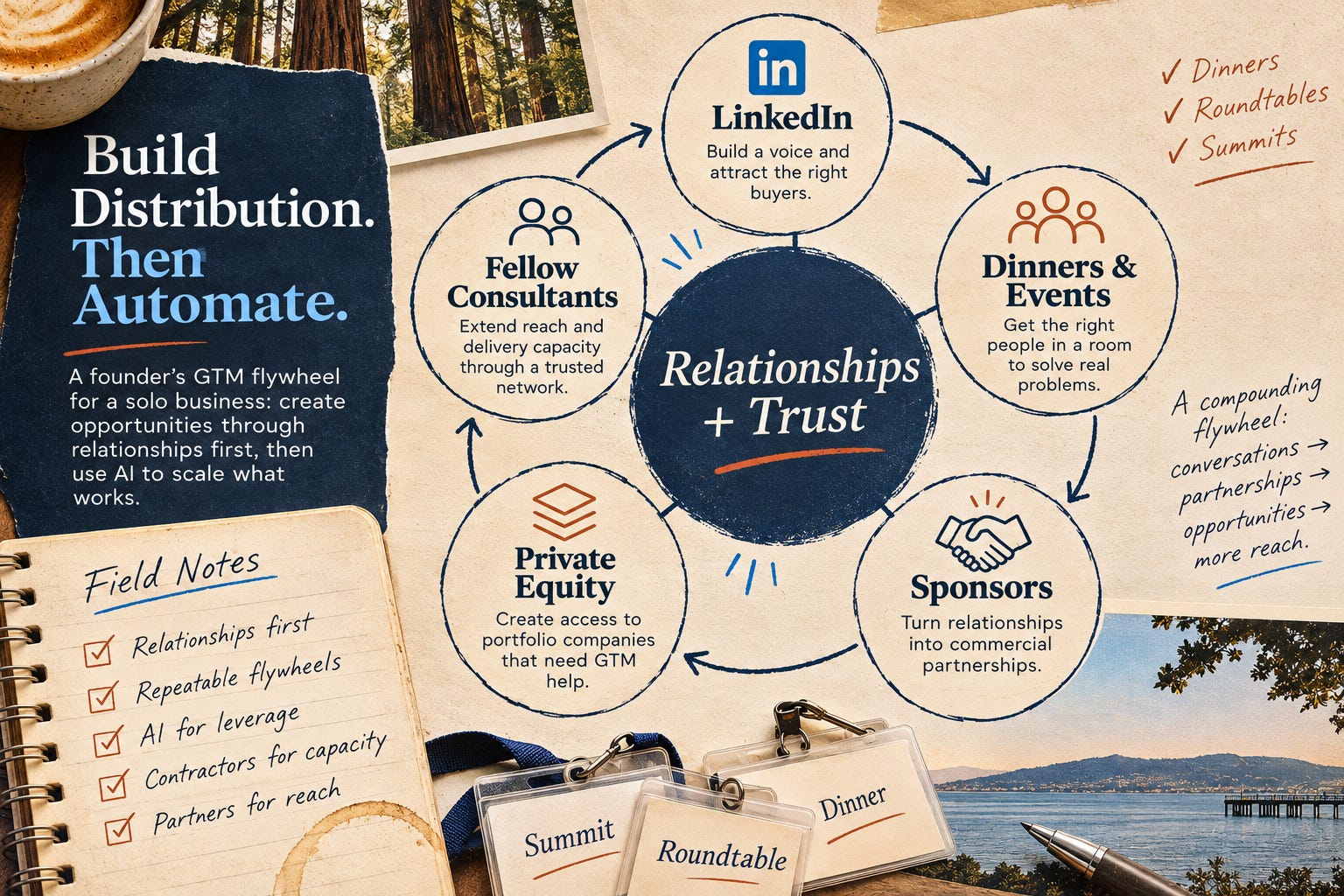
Flywheel 1: LinkedIn became my voice
I started sharing how I think about partnerships.
Not generic thought leadership. Not content designed by an agency to maximize engagement.
My opinions. My experiences. Problems I see in the market. Things I learned the hard way.
I was deliberate about my audience. Partnership leaders, alliance executives, and the people responsible for making partner revenue happen.
I wasn’t trying to reach everyone.
I wanted the right people to understand how I think before we ever had a conversation.
Over time, that created inbound conversations, referrals, and opportunities.
LinkedIn wasn’t just marketing.
It was a way to build trust at scale.
Flywheel 2: Get people in a room
This was probably the biggest bet I made.
I started hosting small dinners.
No elaborate agenda. No product pitches. Just interesting people in partnerships talking about problems they were trying to solve.
Then I graduated to small events.
I discovered something that seems obvious in hindsight.
If you consistently bring the right people together, you become part of the market’s connective tissue.
People remember who introduced them.
They remember good conversations.
They remember being invited into a room where they learned something.
And they often want to come back.
AI helps me plan the events, organize the logistics, develop agendas, manage communications, and follow up.
But AI isn’t what makes the dinner valuable.
The people are.
Flywheel 3: Sponsors became business partners
Once the events started working, sponsors became interested.
Initially, I could have treated sponsorship as a simple transaction.
Find a company willing to pay. Put its logo on the event. Deliver the agreed benefits.
But I wanted something different.
I wanted sponsors whose products I genuinely understood and believed could help the people in our community.
I spent time learning their technology. Understanding their customers. Figuring out where we could work together.
I wasn’t just looking for sponsorship dollars.
I wanted relationships that could eventually lead to delivering work together.
That creates a different flywheel.
Events create access. Access creates partnerships. Partnerships create opportunities to do real work. That work strengthens the next event.
The sponsorship revenue is useful.
The relationship is potentially much more valuable.
Flywheel 4: Private equity became a distribution channel
Our first major event had a very specific theme.
Private equity and software companies.
I recruited ISVs and people from PE firms and brought them together to discuss how partnerships could become a growth lever.
It wasn’t a generic networking event.
There was a reason for both sides to be in the room.
The interesting opportunity came afterward.
PE firms have portfolio companies. Those companies have GTM challenges. Many are trying to figure out how partnerships can accelerate growth.
If a PE operating partner understands what BlueThread does, they can introduce us to multiple portfolio companies.
One relationship can potentially lead to several opportunities.
That’s a very different economic model from constantly trying to acquire one customer at a time.
And it reinforces something I’ve believed throughout my career.
Distribution matters.
Flywheel 5: Fellow consultants aren’t necessarily competitors
This one might surprise people.
I’ve deliberately invited other consultants in my space to my events.
I attend their events, too.
I want to understand what they do, how they think, and where they’re particularly good.
Some people might view that as inviting competitors into your business.
I see it differently.
The market is large, and no single consultant is great at everything.
Sometimes they have a client who needs something I do well.
Sometimes I have a client who would benefit from their expertise.
Sometimes we collaborate.
Sometimes we simply learn from each other.
I don’t need to own every customer relationship or every dollar of work.
I want to be part of a network that creates more opportunities for everyone.
The flywheels start reinforcing each other
This is the part I’m most excited about.
A LinkedIn post leads to a conversation.
That person gets invited to a dinner.
At the dinner, they meet a sponsor or another operator.
The sponsor introduces me to a potential client.
That client introduces me to a PE operating partner.
The PE firm recommends BlueThread to a portfolio company.
A fellow consultant helps deliver a piece of the work.
And the experience gives me something useful to write about on LinkedIn.
The loop continues.
Not every relationship turns into revenue. Nor should it.
But over time, these activities become connected rather than isolated.
That’s what I mean by building a GTM flywheel instead of just a GTM workflow.
A workflow helps you execute a task more efficiently.
A flywheel makes the next opportunity easier to create.
You need both.
So what is the founder’s job?
This first year has reminded me that the founder is ultimately responsible for a handful of things.
Sales. Marketing. Finance. Delivery. Relationships. Direction.
You can delegate pieces of these responsibilities, but you can’t really outsource ownership.
And that’s where AI becomes so interesting.
AI helps us handle recurring operational work so we can focus our time and expertise where they matter most.
Need to build a website? I can use Lovable.
Need to prepare for a client meeting? My AI chief of staff can assemble the context.
Need to research an unfamiliar market? Google AI can help me get up to speed.
Need to organize an event? AI can help with planning, communications, and execution.
Need to capture knowledge from dozens of conversations? Granola, Gong, and my vault help make that possible.
And when I need expertise, judgment, or additional delivery capacity, I work with contractors and partners.
Some of the contractors who helped build BlueThread in year one are now part of its DNA. They’ve shaped how we work, what we deliver, and the business we’re becoming as we head into 2027.
The people are central to the model.
It’s a business built around the right people, with AI giving us more room to do great work together.
There’s an important distinction.
What I’d recommend to someone starting today
If I were starting a new services business tomorrow, I’d think about the sequence carefully.
First, find your voice and your buyer.
Know who you serve, what problems you solve, and what you believe about the market. Start sharing those opinions.
Second, build relationships before building automation.
Get people together. Make introductions. Find complementary partners. Give people a reason to remember you.
Third, create two or three repeatable flywheels.
Don’t try to do everything. Find the motions that consistently create conversations and opportunities.
Fourth, use AI to remove operational friction.
Build the systems that let you manage more relationships, prepare better, deliver consistently, and stay organized.
Finally, build the right team for the business.
Build a team whose expertise, judgment, and relationships strengthen the business. Let the shape of that team evolve with the work.
And one more thing.
Don’t spend six months perfecting your AI stack before talking to customers.
Your first few customers will teach you more about what to automate than any agent framework will.
The answer is in the middle
I’m genuinely optimistic about AI agents.
I expect the technology to get dramatically better. Some of the tools I use today will probably disappear or be replaced.
That’s fine.
My business isn’t built around any particular AI model.
It’s built around relationships, knowledge, reputation, and the ability to help clients solve difficult problems.
AI gives me leverage.
Contractors give me capacity.
Partners give me reach.
And the flywheels create opportunities.
One year in, that’s the model I’m betting on.
Not a company run entirely by AI.
Not a business that treats a bigger team as the only path to growth.
Something in the middle.
And for a solo entrepreneur who wants to build a great business without sacrificing the lifestyle that made entrepreneurship attractive in the first place, I think that’s a pretty interesting place to be.
Great read. Thanks for sharing tour journey!