


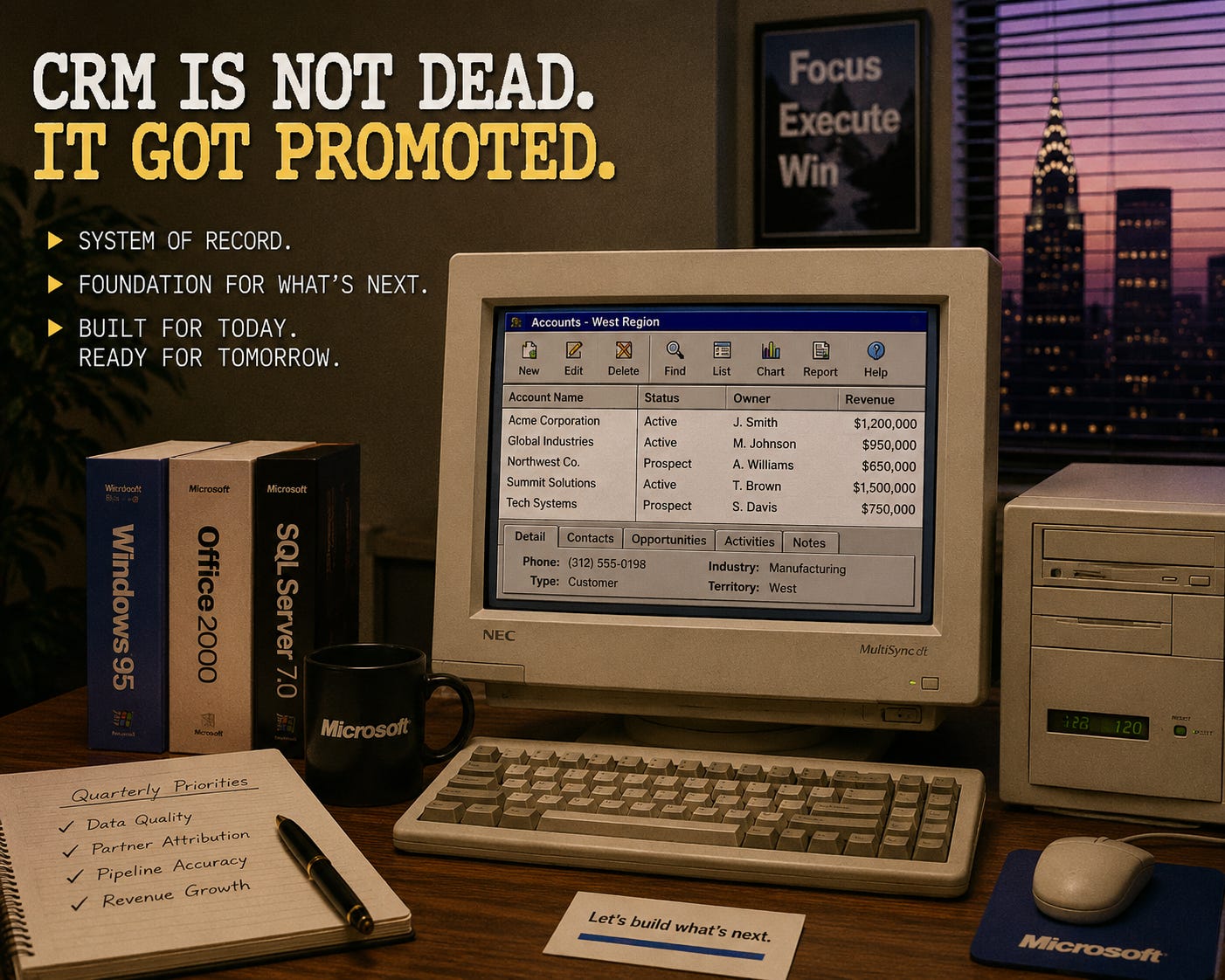
Every few years the industry declares the system of record obsolete. Social was going to kill it. Then data lakes. Now agents.
Here is what I keep seeing instead.
The hype cycle runs ahead of the reality cycle
That’s the whole pattern, and it has never once broken.
I’ve been through a few of these. On-prem to cloud at Microsoft. Two-tier distribution learning to sell subscriptions at SYNNEX. Perpetual license to recurring revenue across every category I’ve worked in. Each one got announced as a one-year shift and delivered as a five-year grind.
The technology arrives fast. The operating model arrives slow. The gap between those two is where most budgets get burned.
Agentic workflows are real. They are also early. The companies that get the most out of them in 2029 are the ones cleaning their record in 2026.
What people actually ask me for
I run an advisory business. I see what lands on the table before anything else does.
The single most requested piece of work right now is CRM. Not agents. CRM.
Field hygiene. Partner attribution that survives a CFO question. Deal registration that doesn’t live in a spreadsheet parked next to the pipeline. Someone who owns the object model.
That surprised me at first. It stopped surprising me around the fifth engagement.
Payroll is a monthly event
This is the part that sounds cynical and isn’t.
Companies are in business to make money this quarter. Payroll clears on the fifteenth whether or not the agent roadmap shipped. That constraint isn’t a failure of imagination. It’s the job.
An operator who spends Q3 on an agent pilot and still can’t tell the board which deals had partner involvement optimized for the wrong horizon. An operator who fixes attribution in Q3 has an asset that pays this year and compounds into whatever comes next.
Both companies believe in AI. Only one of them gets paid for it.
This works the same at 40 people and at 4,000. The small company can’t afford a bet that pays in three years. The big company can’t move the reporting line fast enough to matter in three years. Different reasons, same answer.
Time saved is not an outcome
AI is disruptive. I’m not arguing that. I’m arguing about when the disruption shows up in the numbers.
Right now most of the reported value is time saved. Hours back. Faster first drafts. Fewer clicks. That’s real and it’s worth having, and it is also the easiest thing in the world to claim and the hardest thing in the world to bank.
Time saved shows up on a slide. Outcomes show up on the P&L. Pipeline created. Cycle time compressed. Win rate moved. Partner-sourced revenue up as a percentage of total.
Nobody has ever been able to spend an hour saved. AI becomes disruptive the quarter it starts driving one of those four numbers, and not before.
Which brings me to why it mostly hasn’t yet.
What “evolved” actually means
CRM used to be where reps typed things. That era is over, and good riddance.
CRM is now the substrate. It’s the thing every other system reads from and writes back to. Enrichment writes to it. Product usage writes to it. Ecosystem data writes to it. Agents read from it and then act on what they find.
That last part is the whole argument.
An agent is only as good as the data it pulls from. It doesn’t fix your record. It inherits it. Point a capable model at a field where sourced and influenced mean whatever the rep felt that day, and you get confident, fast, beautifully formatted wrong answers. At volume.
Bad data used to cost you a slow quarter. Now it scales.
Here’s the part nobody wants to say out loud. We are entering the third decade of data cleansing. Same work. New reason.
We cleansed to make reporting trustworthy. We cleansed to make automation fire correctly. Now we cleanse so the agent doesn’t confidently hallucinate a partner attribution model that never existed.
The work didn’t get more glamorous. It got more consequential.
The partner data problem specifically
Partner data is the worst-maintained data in most CRMs. I say that having audited a lot of them.
Common state: a partner field that’s free text. Sourced and influenced with no written definition. Deal reg sitting in a portal that never syncs back. No partner object on the account, so nobody can ask a portfolio-level question. Attribution settled in a quarterly argument instead of by a rule.
If your partner leader can’t answer “which closed-won deals had a partner touch, and what was the touch” in under five minutes, you don’t have a partner program problem. You have a record problem wearing a program costume.
Fix the record and the program becomes measurable. Measurable programs get budget. That’s the whole chain.
What to do this quarter
Not a transformation. Five things.
Write the definitions. Sourced, influenced, co-sold. One page, signed by sales and finance. If two leaders define influenced differently, nothing downstream is real.
Put partner on the object model. A real association with a role, not a text field. Account to partner, opportunity to partner.
Make deal reg write back. If registration lives only in the portal, it doesn’t exist to the business.
Name one owner. One person accountable for the partner data model. Not a committee, not a rotating RevOps ticket queue.
Then pilot the agent. On clean data, against a defined question.
Do the first four and the fifth gets much shorter.
The certain thing
I don’t know what the tooling looks like in three years. Neither does anyone selling you a roadmap.
I do know the business still needs one place where what happened is written down. And I know every layer built on top of it will be worth exactly as much as that layer is trustworthy.
CRM isn’t dead. It stopped being the app and became the foundation.
Build accordingly.