


The question every VP of Alliances asks eventually is not, “Which PRM should we buy?”
It is, “Who actually owns this relationship when the tooling changes?”
That question used to have an easy answer. Whoever held the CRM record owned the relationship. Whoever ran deal registration owned the motion. Ownership was wherever the system of record lived.
AI is breaking that assumption.
We are moving toward a partner tech stack where an agent can identify account overlap, research the partner, recommend an introduction, draft the outreach, update the CRM, and initiate the co-sell handoff without either side opening a portal.
That creates a tempting conclusion: the PRM matters less because AI can sit above the systems and orchestrate the work.
I believe the opposite is true.
As AI handles more of the partner motion, the need for clean data, durable context, clear governance, and human accountability becomes more important. Done right, the PRM becomes the foundation that allows AI to scale a partnership motion without hollowing it out.
Done wrong, AI simply helps companies accumulate relationship debt faster.
The hidden debt inside the partner tech stack
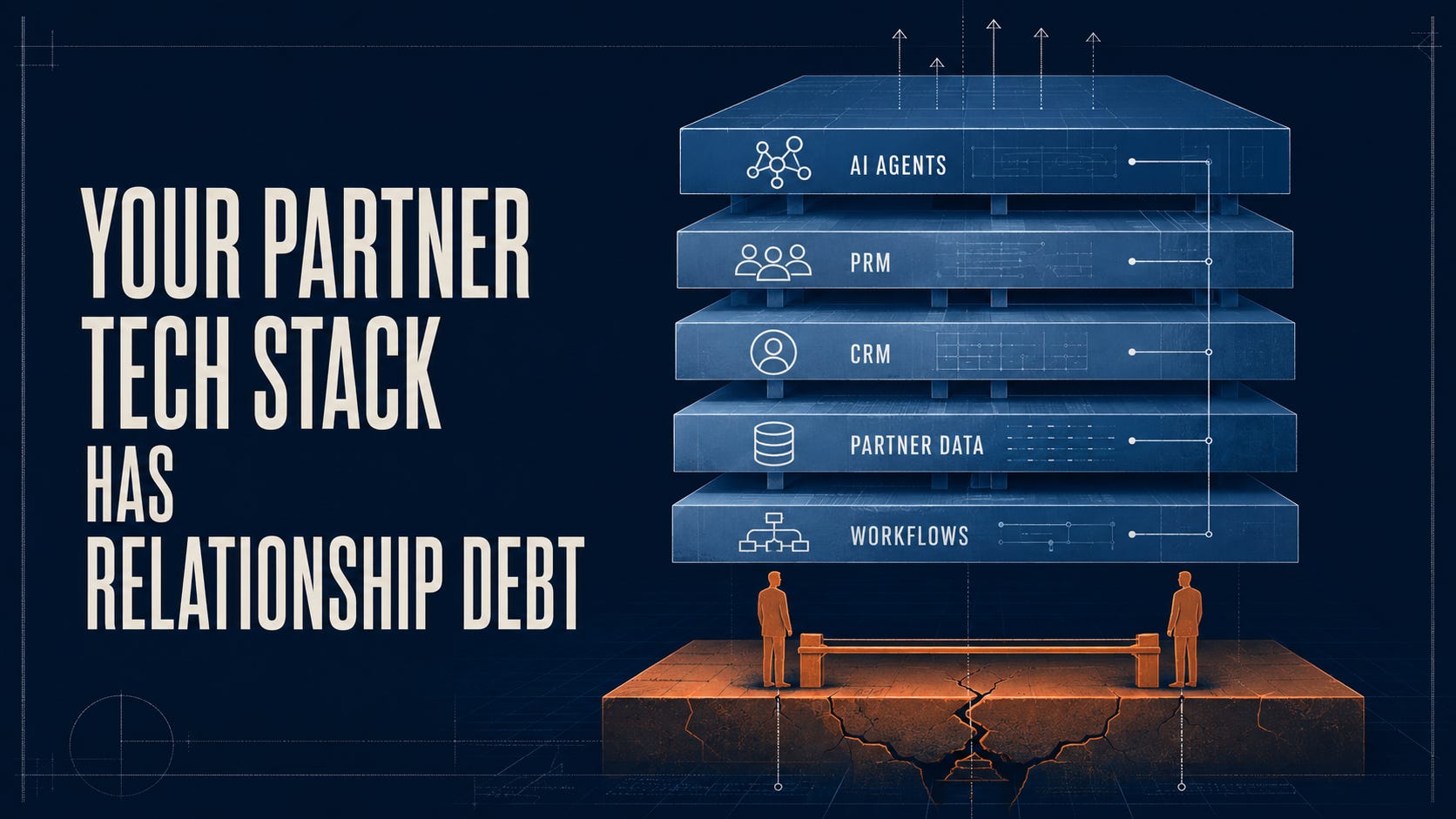
Relationship debt is the gap between the partnerships represented in your systems and the relationships capable of producing a commercial outcome.
It accumulates quietly.
Another account-mapping exercise. Another AI-generated introduction. Another registered opportunity nobody actively co-sells. Another partner added to the program because the data showed overlap, even though neither side has a reason to invest.
The system gets busier. The ecosystem map gets larger. The dashboards look better.
But when an important deal stalls, nobody knows who can make the call.
That is when the debt comes due.
AI does not create this problem. It exposes it, and potentially accelerates it.
An agent can find 500 account overlaps in seconds. That does not mean you have 500 partner opportunities.
It can write a personalized introduction. That does not mean the recipient trusts the person sending it.
It can recommend the next best action. That does not mean anyone is accountable for taking it.
It can update every system perfectly. That does not mean the underlying relationship is real.
The risk is not that AI will take ownership of the partner relationship. The risk is that AI will reveal nobody owned it in the first place.
Why the PRM matters more in an AI stack
To be clear, I am a strong proponent of PRMs.
At scale, spreadsheets, tribal knowledge, and relationships living inside one partner manager’s head are not an operating model. They are a risk.
A PRM should not be viewed as another portal that partners are forced to visit. In an AI-enabled stack, its greater value is as the structured relationship layer between the CRM, partner data, workflows, and people.
The CRM tells you what is happening with the customer.
The PRM should tell you what is happening with the partner.
The AI layer should use both to recommend and execute the next best action.
But the operating model still has to determine who owns the outcome.
A well-designed PRM gives AI the context it needs to be useful:
Which partners actually matter
What each partner is trying to accomplish
Which relationships exist on both sides
What has been committed
What has already been tried
Which opportunities are active
Who owns the next action
How the partnership creates economic value
Without that context, AI does not create intelligence. It creates more activity.
This is why I do not believe AI replaces the PRM. I believe it changes the job of the PRM.
The old PRM was often designed as a destination: log in, complete training, register a deal, download content.
The next PRM needs to operate more like infrastructure. It should preserve partner context, govern workflows, feed the right data to agents, and capture the outcomes of work happening across email, meetings, CRM, collaboration tools, and marketplaces.
The partner may never open the portal. The PRM can still be essential.
AI can scale trust, or scale noise
I have watched partner motions survive major technology changes.
At SYNNEX, scaling Microsoft’s cloud business from roughly $100 million to more than $1 billion required technology. We could not have operated at that scale without platforms, data, and repeatable processes.
But the relationships survived changes in distribution platforms, programs, incentives, and systems because the trust between the people predated the tooling. When something changed, the reps still knew whom to call. They understood the shared economics and knew how to get work done together.
The technology scaled the motion. It did not create the reason for the motion.
I saw the same thing at Gong.
The partners who mattered were not necessarily the ones who logged into the portal most often. They were the ones whose reps picked up the phone when our reps called. They had context. They understood the customer. They had earned the right to make an introduction or ask for help.
Portal activity was a signal. It was never the relationship itself.
That distinction matters even more with AI. If the underlying motion is built on trust, shared economics, clear ownership, and consistent execution, AI and the PRM can scale it.
If those things are missing, the same technology scales noise.
Three tests for your AI-enabled partner stack
Before adding another agent or automation, ask three questions.
1. If the tool disappeared tomorrow, would the relationship survive?
If the answer depends on a login, an account map, or an automated workflow, you do not have a partnership. You have a technology dependency.
2. Can the AI see context, or only activity?
Deal registrations, logins, certifications, and account overlaps are useful signals. But they do not explain why the relationship matters, what each side has committed to, or who can move an opportunity forward.
AI acting on incomplete context will automate the wrong work with impressive speed.
3. Who is accountable when the agent completes the handoff?
An automated introduction is not co-selling. A recommended action is not execution. A registered deal is not pipeline.
The agent can coordinate the motion. A person still has to own the outcome.
The more autonomous the tooling becomes, the more explicit human accountability needs to become.
Build the stack in the right order
The AI-enabled partner stack should have distinct jobs.
The CRM owns the customer and opportunity record.
The PRM owns the partner context, program rules, commitments, and relationship history.
The data layer supplies ecosystem and account intelligence.
The AI layer identifies signals, recommends actions, and automates execution across the stack.
The human owner applies judgment, builds trust, and remains accountable for the commercial outcome.
This is where Partner RevOps becomes critical. Partner RevOps is not simply connecting the PRM to the CRM and adding an agent on top. It is designing an operating model in which the data, workflows, incentives, systems, and people reinforce the same commercial motion.
Before deploying more AI, pull up your ten most important partners and ask:
Who on our team can call whom?
What have we actually built together?
What context does the system preserve?
What actions could AI safely automate?
Who owns the next commercial outcome?
Would the partner still take the call?
That is your real ecosystem. The rest is infrastructure.
AI is going to transform the partner tech stack. It will eliminate administrative work, surface opportunities humans miss, and make smaller partner teams far more productive.
But it will not manufacture trust, judgment, or accountability.
The winners will not be the companies with the most agents or the largest ecosystem maps. They will be the companies that use a PRM to preserve the right context, AI to accelerate the right actions, and people to own the relationships and outcomes that matter.
Build the relationship. Design the motion. Structure the data. Then let AI scale it.
Done in that order, the partner tech stack becomes an unlock.
Done in reverse, it becomes a very efficient way to accumulate relationship debt.