


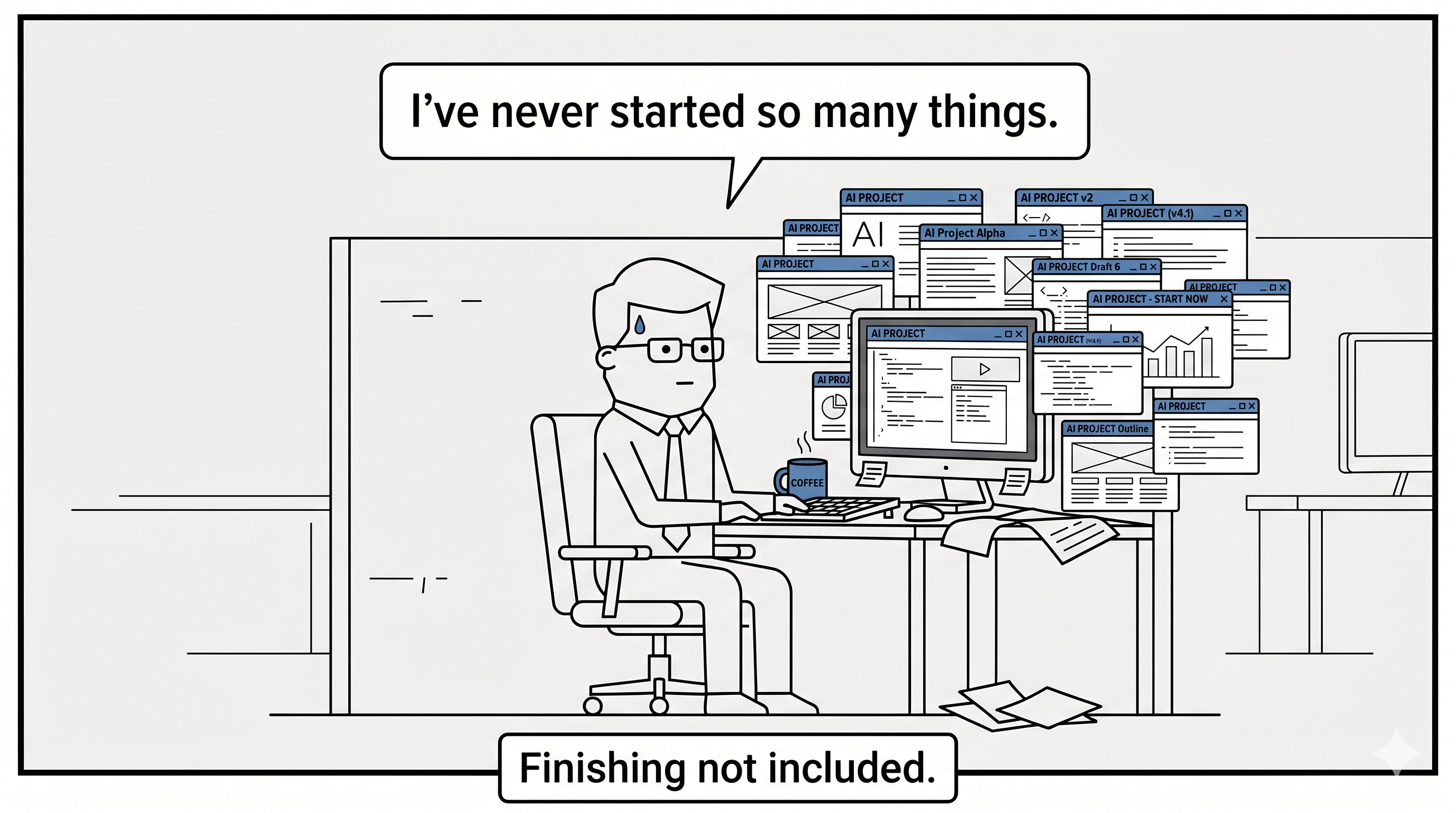
I have a theory about why so many operators feel busier than ever and shipped less than ever.
AI lowered the cost of starting to zero.
It did not touch the cost of finishing.
The thing that used to be hard
For most of the last decade, your judgment showed up in what you chose to build. Execution was expensive. You had to want something badly enough to spend the time, the budget, the political capital. The cost of doing was a filter. It killed your bad ideas before they ate your calendar.
That filter is gone.
Now anyone can spin up a deck in an afternoon. A microsite before lunch. A scraper, a fifteen-question assessment, a full content calendar, a custom GPT trained on the whole back catalog. The friction that used to protect you from your own enthusiasm has been removed.
This is sold to you as a feature. For some of you it is. For a lot of you it is the most dangerous thing that has happened to your focus in years.
The shiny ball tax
Every AI project you start has a hidden cost. It is the attention you pulled off the thing that was already working.
The problem was never a lack of ideas. It was finishing. AI did not fix that. It gave the idea-rich, finish-poor crowd a faster way to start more things they will not finish.
You are not behind because you are using AI too little. Some of you are behind because you are using it to manufacture motion. Fourteen experiments open. None of them in market. All of them feeling like progress.
Motion is not the same as progress. AI is very good at producing motion.
No is the off switch
Here is the skill the next era rewards. The ability to say no to a use case you are fully capable of building.
That sentence is harder than it sounds. When something was hard to build, no was easy. The work said no for you. Now that everything is one prompt away, the no has to come from you. From judgment. From a point of view about what should exist, not just what can.
No is a positioning statement. When you say you do not do something, you are telling the market what you actually stand for. A partner program that does everything with AI stands for nothing. The operators who win are the ones who can say we do not do that with a straight face.
Judgment does not scale, and that is the point
AI scales production. It does not scale taste.
This is the part people get backwards. They want AI to replace the judgment. The judgment is the only thing that was ever scarce. A framework has value precisely because it is a set of opinionated nos. An Ideal Partner Profile without a buyer persona is a no. Treating your ecosystem as a relationship program instead of a P&L unit is a no. The method is the discipline of refusing the lazy version, over and over, in public.
Strip the nos out of your work and you are left with output. The market is about to be flooded with output. It will be worth nothing.
The assistive era runs on what you point it at
We are in the assistive era of these tools. Not autonomous. Assistive. That word matters.
Assistive tools amplify whatever you aim them at. Point them at clarity and they compound it. Point them at confusion and they manufacture more of it, faster and at higher resolution. The tool is neutral. The aim is not.
So the question is not how much AI you are using. The question is what you have decided not to do with it this quarter.
The job
AI made starting free. That is real and it is permanent.
Finishing is still the job. So is choosing. So is the no.
The operators who matter in five years will not be the ones who started the most. They will be the ones who finished the few things that mattered and had the judgment to leave the rest on the table.
The off switch is a skill. Start practicing it.