


Every new technology comes with the same promise:
“This will level the playing field.”
It never does.
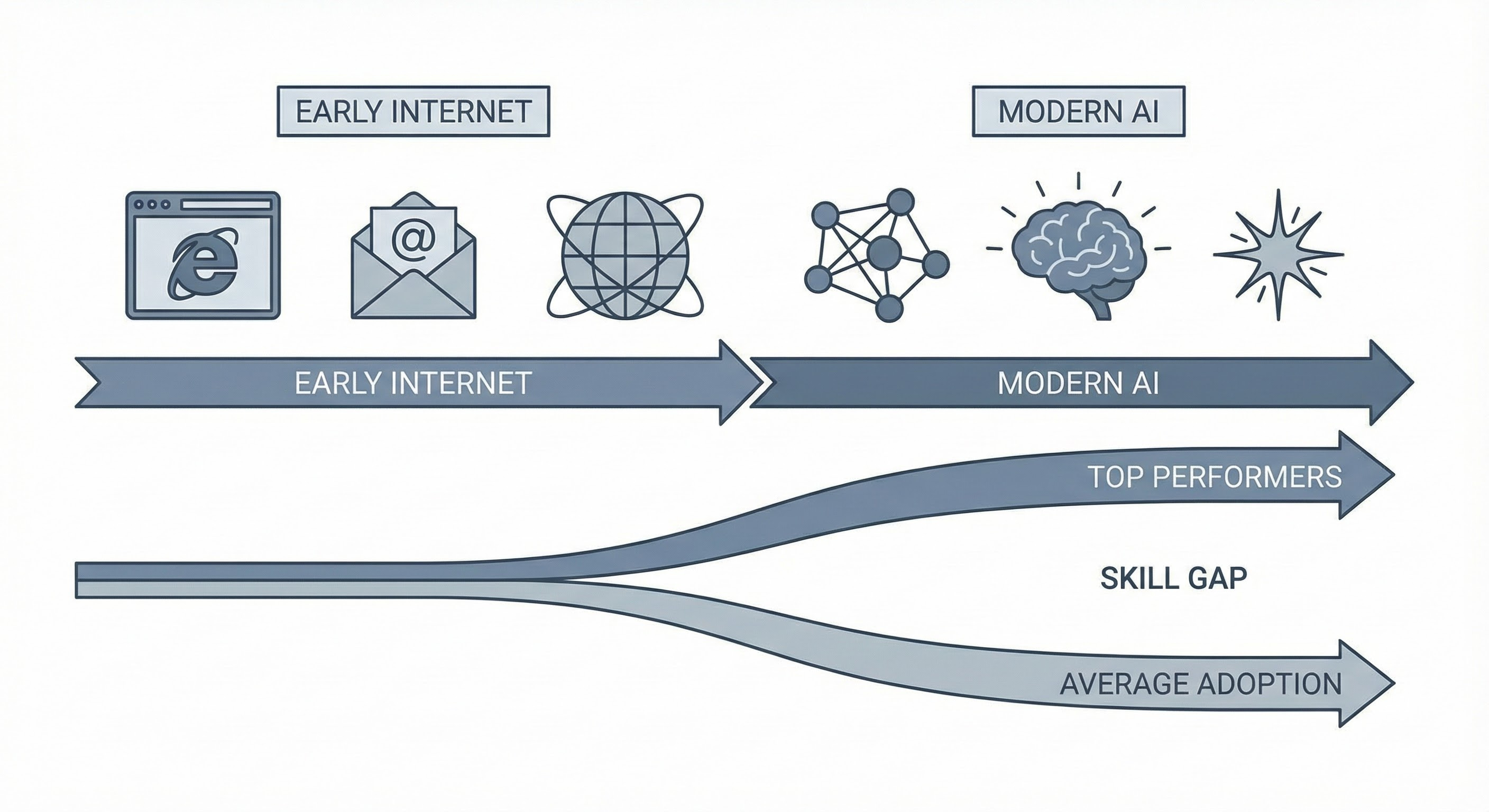
AI is not replacing salespeople or partner leaders. What it’s doing is far more uncomfortable. It’s collapsing the middle of the performance curve and stretching the gap between the top and everyone else.
If you work in sales or partnerships, this isn’t about job loss. It’s about relevance.
The Real Shift Happening Right Now
AI has already automated baseline competence.
Research summaries.
Meeting notes.
Follow-ups.
CRM hygiene.
Deck drafts.
Account snapshots.
These used to differentiate “good” operators from average ones. Now they’re table stakes. Everyone gets them for free.
That raises the floor. It does not raise the ceiling.
And when the floor rises but the ceiling stays open, the middle disappears.
Why the “Middle Class” of Productivity Is Fading
The traditional middle performer thrived on three things:
Effort
Organization
Access to information
AI neutralizes all three.
If your value is being responsive, thorough, or organized, you are now competing with software that never gets tired and costs almost nothing.
What’s left is leverage.
Some people are using AI to move faster at the same work.
Others are using AI to fundamentally change how the work is done.
That difference compounds quickly.
Speed vs Leverage
There are two ways people are using AI right now.
Mode 1: Efficiency
Write emails faster
Prep meetings quicker
Clean up pipeline
Summarize calls
This is helpful. It is also marginal.
Mode 2: Leverage
Identify patterns across accounts and partners
Pressure-test deal strategy before engaging
Redesign co-sell motions instead of optimizing them
Decide where not to spend time
Speed saves minutes.
Leverage changes outcomes.
AI rewards the second group disproportionately.
Why Partnerships Feel This First
Partnerships have always been non-linear.
One insight.
One introduction.
One ecosystem move.
That can unlock more value than a hundred perfectly executed tasks.
AI is exceptionally good at surfacing patterns across messy, interconnected systems. But only if the human knows what questions to ask.
This is where the divide sharpens:
Some partner leaders use AI to automate coordination.
Others use it to improve judgment.
Coordination scales linearly.
Judgment scales exponentially.
This Already Happened Once
If this feels familiar, it should.
When the internet went mainstream, the story was “information for everyone.” What actually happened was different.
Access became universal.
Advantage shifted to interpretation and application.
Everyone could Google.
Very few could synthesize, decide, and act well.
The internet didn’t eliminate sales or partnerships. It eliminated the advantage of simply knowing things or having access.
It crowned a different kind of operator.
Sales reps who researched deeply instead of broadly
Marketers who understood distribution, not just content
Partner leaders who orchestrated ecosystems instead of managing checklists
The internet killed gatekeepers.
It rewarded orchestrators.
AI Is the Same Shift, Compressed
The internet multiplied distribution.
AI multiplies decision quality.
The key difference is speed.
The internet transition took a decade to fully play out.
AI is compressing that timeline into years.
The old middle didn’t disappear overnight last time. It thinned slowly as tools got better and expectations rose.
This time, the compression is faster and less forgiving.
The Uncomfortable Truth
AI doesn’t democratize performance. It polarizes it.
It rewards people who already think in systems.
It exposes people who were surviving on hustle and process.
Not because those people are bad.
Because the value of their strengths has been automated.
This isn’t about being “good with AI.”
It’s about what you use it for.
If AI is your assistant, you’ll stay competitive.
If AI is your thinking partner, you’ll pull away.
The New Line That Matters
The divide is no longer:
Hard workers vs lazy ones
Experienced vs inexperienced
Connected vs unconnected
It’s:
People who do tasks
People who shape outcomes
AI forces everyone up the value stack whether they’re ready or not.
Some will climb.
Some will stall.
The middle will keep shrinking.
And the gap between the top and the rest will keep widening.
Not because AI replaced people.
But because it revealed who was actually driving value all along.
Loved this, thank you.