


I’m fortunate to sit in on calls with partnership leaders across startups, scale-ups, and enterprise organizations.
Lately, I’ve noticed a consistent trend.
Partnership teams are becoming dramatically more efficient.
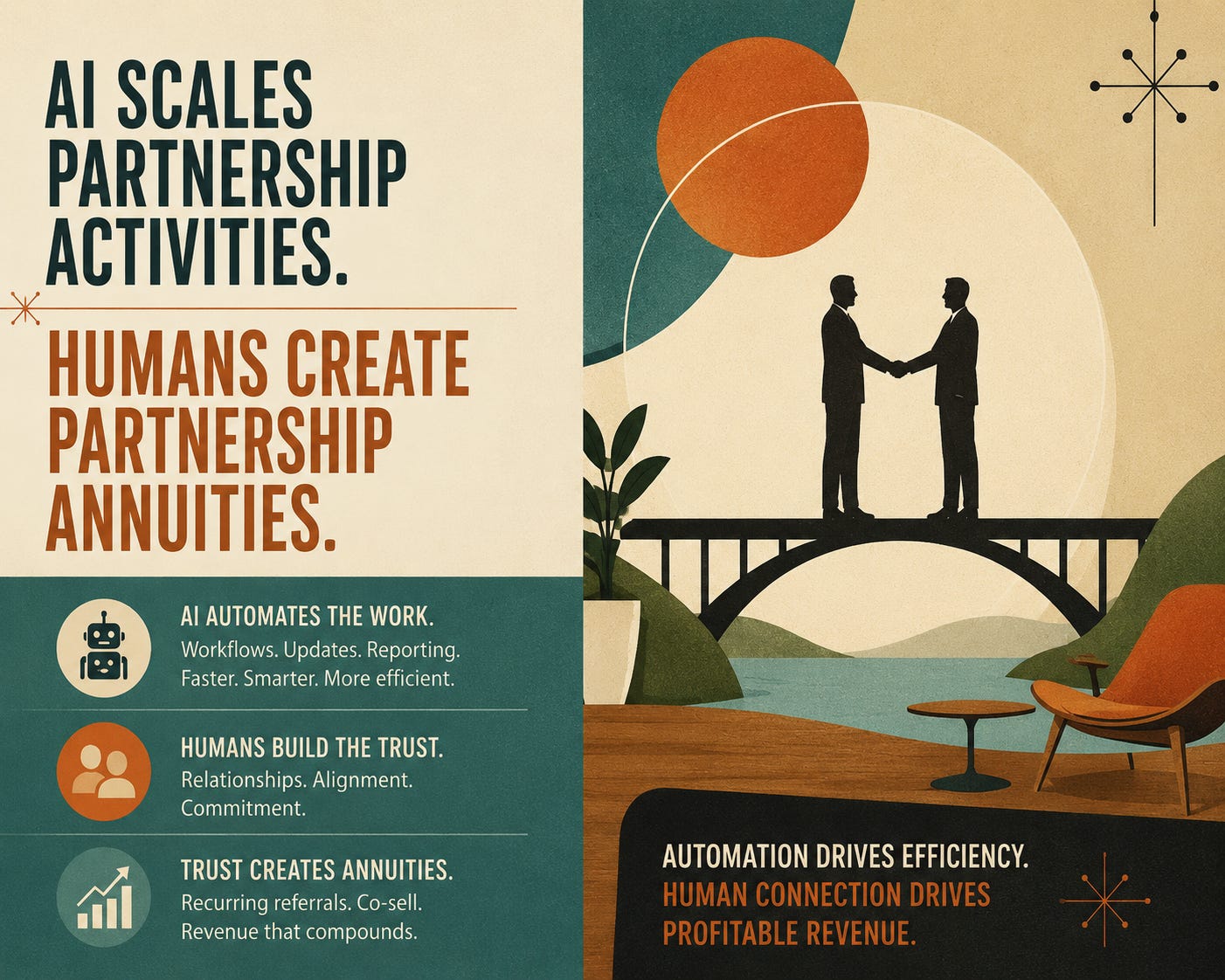
AI is helping automate partner recruitment, account mapping, content creation, communications, reporting, pipeline management, and dozens of other operational tasks that used to consume valuable time.
This is a good thing.
Most partnership organizations are resource constrained. Anything that helps teams eliminate manual work creates capacity to focus on higher-value activities.
But as I listen to these conversations, I think many partnership leaders are asking the wrong question.
The conversation is often centered around:
“How much of our partnership motion can we automate?”
A better question might be:
“Where does the human need to stay in the loop?”
Because if we’re honest about the purpose of partnerships, the answer matters.
Let’s Not Confuse Activity With Outcomes
Nobody builds partnerships because they’re running a nonprofit.
Partnerships exist to drive profitable revenue for both sides.
That’s the job.
The goal isn’t meetings.
The goal isn’t partner satisfaction scores.
The goal isn’t having hundreds of logos on a partner page.
The goal is creating economic value that benefits both organizations.
The best partnerships accomplish this by creating something incredibly valuable:
An annuity.
Not a financial product.
A business annuity.
A stream of recurring value that continues producing results long after the initial introduction, campaign, integration, or deal.
You see it when referrals continue to flow.
When co-sell motions become repeatable.
When marketplace transactions happen consistently.
When executive relationships create new opportunities year after year.
When customers continue buying because multiple companies are aligned around their success.
The most successful partnerships aren’t constantly starting over.
They’re compounding.
AI Can Scale Activities. It Can’t Create Trust.
This is where I think many organizations misunderstand the role of automation.
AI can help scale activity.
It can help identify prospects.
It can draft communications.
It can summarize meetings.
It can analyze partner performance.
It can automate workflows.
What it cannot do is create trust.
Trust is still built between people.
Trust is built when a partner answers the phone during a difficult customer situation.
Trust is built when an account executive gives a partner an opportunity in a competitive deal.
Trust is built when executives make introductions before there’s an obvious transaction attached.
Trust is built when two organizations invest in each other without knowing exactly when the return will show up.
Those moments matter because partnerships are fundamentally asymmetric.
Someone almost always has to go first.
Someone has to take a risk.
Someone has to make an investment before the outcome is guaranteed.
That’s where trust becomes the operating system.
And trust remains stubbornly human.
The New Competitive Advantage
For years, partnership leaders were rewarded for managing complexity.
The best operators could coordinate programs, communications, reporting, enablement, and execution across multiple organizations.
Many of those activities are becoming easier.
The advantage is shifting.
The future belongs to partnership leaders who understand exactly which activities should be automated and which moments require human involvement.
The winners won’t be the teams that automate everything.
They’ll be the teams that automate the repeatable work so they can spend more time on the irreplaceable work.
Building executive alignment.
Creating partner confidence.
Navigating conflict.
Making introductions.
Developing trust.
Finding opportunities where others don’t see them.
Those activities create leverage that compounds over time.
Relationships Are Not The Goal
One of the biggest misconceptions in partnerships is that relationships are the end objective.
They’re not.
Relationships are the mechanism.
Profitable recurring revenue is the outcome.
The relationship matters because it creates the trust required to produce that outcome repeatedly.
That’s why the best partnership leaders are never focused solely on transactions.
They’re focused on building the conditions that make future transactions inevitable.
The more AI handles the operational work, the more obvious this becomes.
Technology can accelerate relationships.
Technology can support relationships.
Technology can help scale relationships.
But technology cannot replace the human trust that sits underneath them.
And that’s ultimately where partnership annuities come from.
AI scales partnership activities.
Humans create partnership annuities.