


Matt Shumer’s recent piece, “Something Big Is Happening”, captures something important: the emotional reality of what it feels like to be inside an AI transition you can’t fully see the edges of. It’s racked up over 50 million views for a reason. He’s not wrong to feel the weight of it. A lot of smart people are feeling it right now.
But there’s a difference between the emotional truth and the strategic truth. Shumer’s article is a snapshot of how it feels inside the transition, not a map of where the economy actually settles. That distinction matters enormously if you’re trying to make decisions rather than just process anxiety.
So let’s talk about what’s actually happening.
The Reframe That Changes Everything
Most people are treating AI like a product wave. The next mobile, cloud, or crypto cycle. Build the thing, ride the wave, profit.
But AI is closer to a labor market and coordination wave, more like electricity meets the internet. And that matters because it doesn’t just create new companies. It rearranges who does what, who owns value, and what becomes “default.”
That’s a fundamentally different kind of disruption. Product waves create winners and losers among companies. Coordination waves restructure entire ecosystems.
The Pattern Everyone Forgets
Every step-change technology shift produces the same sequence of miscalculations. We overestimate near-term job replacement. We underestimate near-term business confusion. We underestimate the long-term emergence of new roles and new leverage. And we consistently underestimate the rise of operators who can translate chaos into systems.
We’re doing all four right now.
AI is not “taking all jobs.” AI is taking all unstructured work that isn’t defended by distribution, trust, or accountability.
That’s a much more useful line to organize your thinking around, because it tells you exactly where the vulnerability is and where the durability is.
What’s Actually Happening (The Ecosystem View)
This is the part most AI discourse misses entirely.
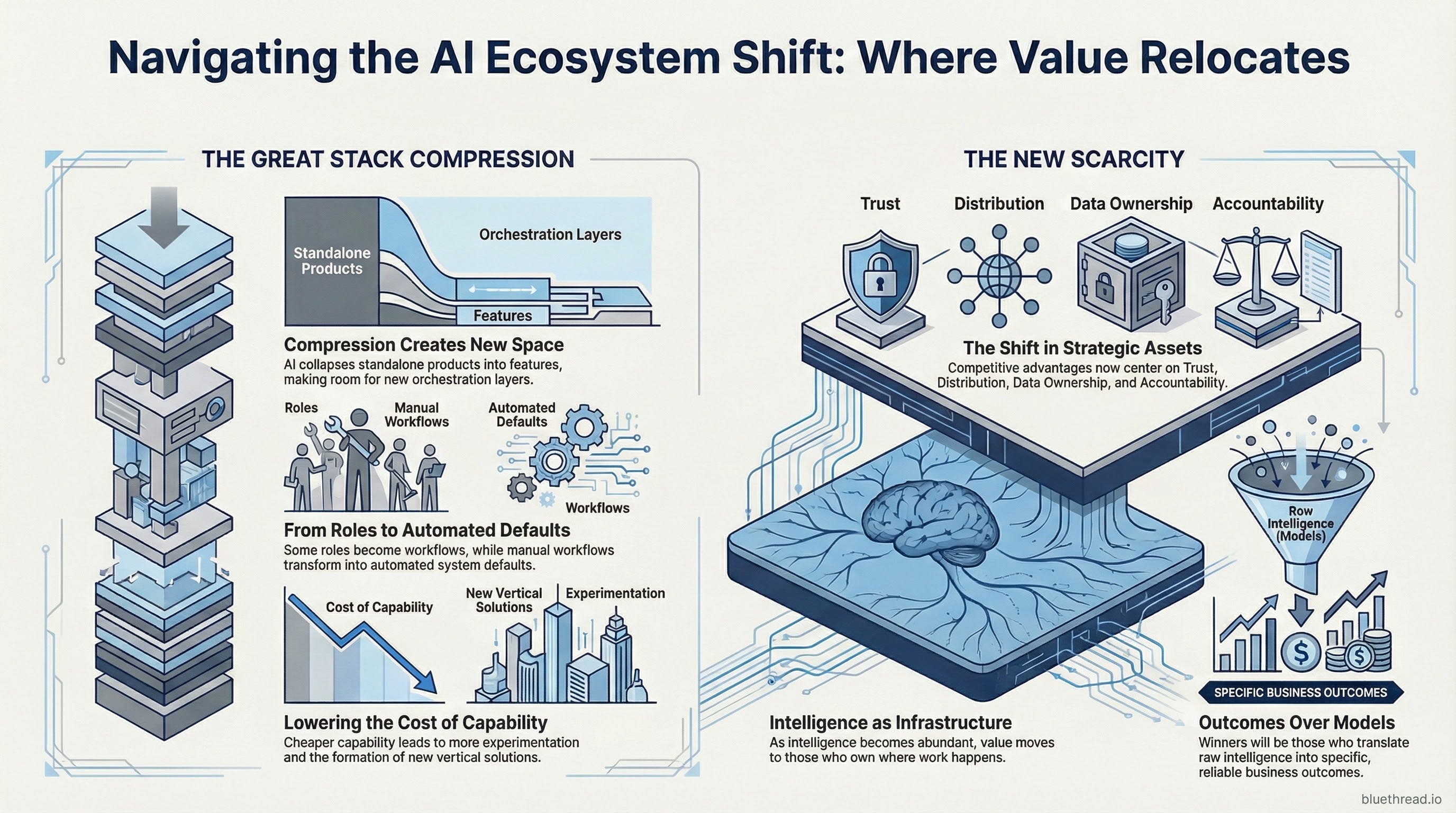
AI is not just a model race. It’s a re-platforming of the software economy. And whenever you get re-platforming, you get new chokepoints, new bundling wars, new distribution advantages, and a massive land grab for “default tools.”
This is classic ecosystem behavior. We’ve seen it before: with cloud infrastructure, with mobile app stores, with SaaS vertical rollups.
The angst everyone’s feeling? It’s people sensing that the ground layer is moving, and they don’t know where they sit in the stack anymore. That’s the real fear. Not that AI is smarter than them. That their position might not exist in the next configuration.
AI Is Compressing the Stack
Here’s the structural dynamic that’s making people nervous, even if they can’t articulate it: AI turns a lot of software categories into a feature inside something else, a workflow, or a commodity API.
So a lot of companies will die not because their tech is bad, but because their category stops being a category.
Think about that for a moment. Your competitive moat doesn’t matter if the lake drains. Your differentiation is irrelevant if the buyer stops thinking in your terms.
This is why the “build a better AI-powered X” strategy is mostly wrong. You’re optimizing inside a category that may not exist in 18 months.
The Replacement Narrative Is Built on False Assumptions
The Shumer-style fear (that AI will delete roles and companies wholesale) rests on assumptions that history repeatedly disproves. It assumes static org structures, static buyer behavior, static trust systems, and static distribution.
Those are precisely the things that change first in a coordination wave.
Org structures are already flattening. Buyer behavior is already shifting toward workflow-native purchasing. Trust systems are already being rebuilt around data provenance and accountability loops. Distribution advantages are already being contested.
The replacement narrative treats the current configuration of work as the permanent one, then imagines AI slotting in to do what humans currently do. That’s not how it works. The configuration itself changes.
Where the Value Actually Lands
The winners in this transition are not going to be “AI companies.” They’re going to be distribution-native companies that absorb AI into a workflow people already live inside.
Which means the moat shifts from “we built the thing” to “we own the workflow, the data exhaust, and the accountability loop.”
That’s also why the fear is so intense. Because “I can build the thing” used to be enough. Technical capability was the differentiator. Now it’s table stakes.
The new differentiator is position. Specifically, your proximity to the decision, the data that feeds the decision, and the accountability for the outcome of the decision.
AI Is Not Replacing People. AI Is Replacing Interfaces.
This is the line I keep coming back to.
AI is replacing the interfaces between systems, between teams, between decisions and data. It’s collapsing the layers of translation that used to require headcount.
And when interfaces change, ecosystems rewire. New chokepoints emerge. New defaults get established. New power positions open up for the people who can see the new configuration before it becomes obvious.
The angst is rational. The ground really is shifting.
But the conclusion that “AI replaces us” is a failure of imagination. The better conclusion is that AI replaces the current arrangement, and the people who understand how ecosystems reorganize are the ones who end up in stronger positions than they started in.
One More Thing
I want to end with something that gets lost in all the breathless AI discourse: people are resilient. Remarkably, stubbornly, historically resilient.
We’ve been through this before. The loom didn’t end craft. The assembly line didn’t end skilled labor. The internet didn’t end retail (it rewired it). The spreadsheet didn’t end accounting (it made accountants more valuable). Every single time, the predictions of mass obsolescence turned out to be wrong. Not because the technology wasn’t real, but because people adapt faster and more creatively than forecasters give them credit for.
The people reading Shumer’s article and feeling a knot in their stomach are doing something healthy. That’s pattern recognition. That’s awareness. But awareness is the starting line, not the finish.
Nobody has this figured out yet. Not the AI labs. Not the VCs. Not the pundits. And certainly not me. What I do know is that the people who’ve navigated every prior wave of disruption weren’t the ones with the best predictions. They were the ones who stayed curious, stayed useful, and refused to sit still.
History doesn’t bet against that. Neither do I.
Well articulated Rob. Reminds me of the theory of evolution. It’s not about being the strongest or fastest .. the ones that survive have an exceptional ability to adapt to change.