


Every week I see a new pitch deck claiming AI agents will replace the sales motion.
Outbound is automated. Inbound is triaged. SDRs are augmented. BDRs are deprecated. Pipeline is generated by software that never sleeps and never asks for equity.
It’s a compelling story. It’s also missing something obvious.
The funnel isn’t a series of touchpoints. It’s a series of decisions made by humans putting their reputation on the line inside their own company.
That’s the first principle. Everything else is implementation detail.
What B2B buying actually is
Strip away the tooling. A B2B purchase is one person inside a company, betting some portion of their internal credibility, on the claim that a piece of software will deliver a specific outcome.
That bet has three failure modes. The product doesn’t work. The vendor doesn’t show up. The buyer ends up looking foolish.
Everything in GTM exists to reduce one or more of those three risks.
Marketing reduces unfamiliarity. Sales reduces uncertainty. Customer success reduces post-purchase regret. The whole funnel is a risk-laundering exercise dressed up in CRM stages.
This is where partners earn their keep. Partners reduce all three risks at the same time, by attaching their existing credibility to your unproven offer.
That’s not a tactic. That’s a structural advantage. And it doesn’t get cheaper or weaker because you bolted an LLM onto your outreach.
The funnel partners actually cover
Most operators only think about partnerships at one stage. Usually the middle. Co-sell, joint accounts, deal registration. That’s the visible part.
The full picture is wider. Partners are working at every stage of the funnel, whether you’ve systematized it or not.
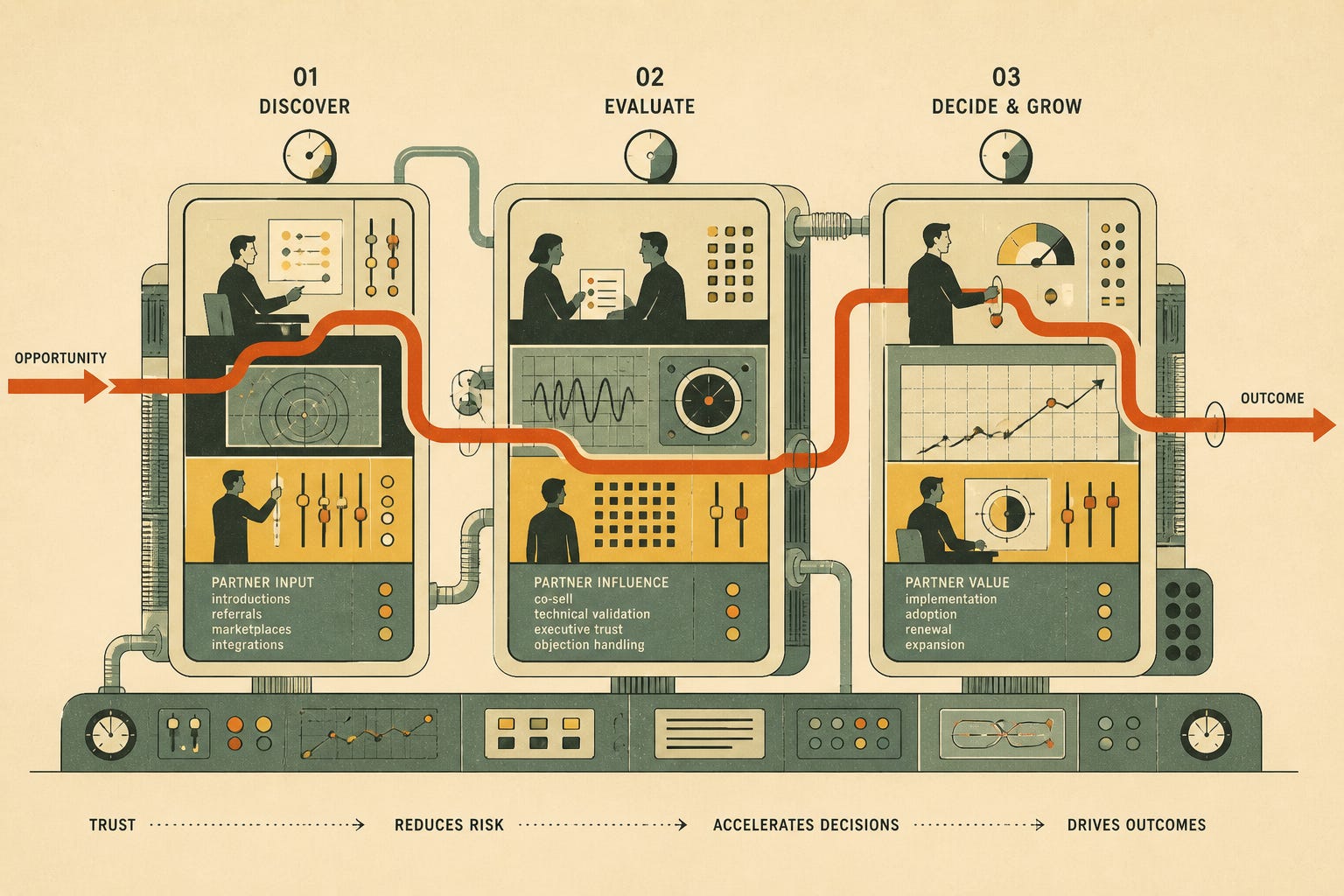
Top of funnel: partner-sourced. A referral from a trusted services firm. A marketplace listing on a platform your buyer already uses. A co-marketed webinar with an adjacent vendor. An integration that surfaces in a buying committee’s research. These are not awareness plays. They’re pre-qualified introductions. The buyer is already in motion. The partner has already done the trust work.
Middle of funnel: co-sell. A joint account plan with a tech partner whose AE knows the customer. A consulting partner who walks into the deal with executive relationships you don’t have. A platform owner who validates that you’re a serious vendor. The deal moves faster because the partner is collapsing objections in real time.
Bottom of funnel: services, retention, expansion. Implementation partners who turn your software into outcomes. MSPs who own the customer’s environment and renew them by default. Services partners who find expansion opportunities you’d never see from a usage dashboard. The renewal conversation happens inside the partner relationship, not yours.
That’s not three separate motions. It’s one continuous handoff system, where partners are doing work at every stage that you cannot do yourself.
Where AI actually fits
Now the AI question gets interesting.
If the funnel is fundamentally about reducing risk through trusted humans, AI doesn’t replace any of that. It accelerates the parts of the partner motion that are slow because they’re manual.
Partner research that used to take a week now takes an afternoon. Account mapping that lived in spreadsheets now runs in software. Co-sell briefs that used to be written by hand can be drafted in seconds. Deal registration triage. Lead scoring across overlap data. Personalized partner enablement at scale.
This is the right way to think about AI in partnerships. Not as a replacement for the partner. As a force multiplier on the partner manager.
The partner manager who uses AI to build twenty co-sell briefs in a day will outperform the one who writes three. The partnerships team that uses AI to map a partner’s portfolio against their ICP in an hour will outperform the team that takes a quarter. The org that uses AI to surface the highest-leverage partner moves every week will compound advantages the rest can’t match.
But none of that works without partners. AI agents don’t have customers. They don’t sit in a buyer’s existing stack. They don’t show up to renewal conversations. They don’t validate your offer to a CFO.
Partners do. AI helps you work with more of them, faster.
The operator move
If you run a partnerships function, the move is not to defend yourself against AI. The move is to reframe what your team is actually doing.
You are not a channel. You are not a referral source. You are not a logo collection.
You are the trust infrastructure the whole funnel runs on. Top, middle, and bottom. Partner-sourced, co-sell, services and retention.
AI doesn’t change that. It makes it cheaper to operate at scale.
The companies that win the next decade will not be the ones with the cleverest automation. They will be the ones who realized that distribution has always been the deciding variable, and that partners are how distribution gets done.
Direct sales is the experiment. Distribution is the default.
Build accordingly.