


You were hired to manage partners.
You are actually judged on how reliably you produce revenue through other teams.
That mismatch explains why the Partner Manager role often feels vague, political, and constantly under scrutiny. On paper, you own partners. In practice, you are evaluated on pipeline influence, deal velocity, and whether sales leadership trusts you near a number.
No one says this explicitly. But leadership expects you to figure it out.
Below are three skills most Partner Managers are never formally taught, along with practical ways to build them.
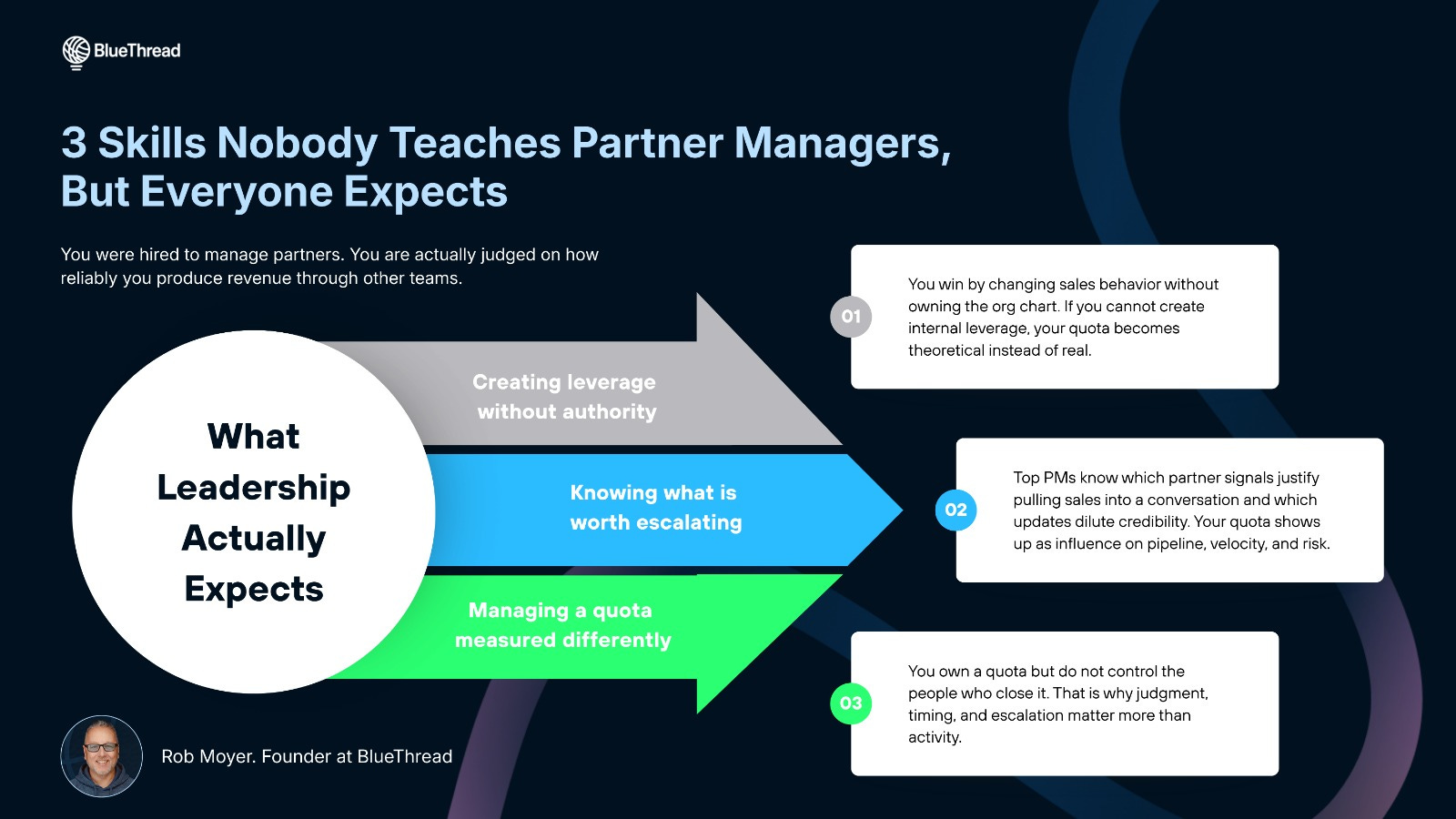
1. Creating leverage without authority
You do not win this role by being liked.
You win by changing sales behavior without owning the org chart.
Partner Managers sit in a strange position. You are accountable for revenue outcomes, but you do not manage the sellers, the SEs, or the deal desk. That means influence matters more than activity.
What this actually looks like in practice
Leverage is created when working with you makes sales easier or safer.
That usually comes from three places:
a. Deal clarity, not deal hype
Sales teams respond to signal, not enthusiasm. When you bring a partner into a deal, be precise about:
What the partner changes in the deal
What risk they remove
What outcome they accelerate
If you cannot answer those in one minute, the partner is noise.
b. Relevance over reach
Stop trying to be helpful everywhere. Focus on the segments, motions, or deal types where partners actually move the needle. Depth in a few areas builds more leverage than shallow coverage across all of them.
c. Pre-work before pulling sales in
Before looping in sales, validate:
The partner has context on the account
There is a clear next step
There is a reason this happens now
Leverage grows when sellers trust that a meeting with you will not waste their time.
2. Knowing what is worth escalating
Your quota is not just closed won deals.
It shows up in pipeline quality, velocity, and risk reduction.
One of the fastest ways to lose credibility as a Partner Manager is escalating everything. One of the fastest ways to miss impact is escalating nothing.
The skill is judgment.
What top Partner Managers do differently
They treat escalation as a scarce resource.
a. They escalate signals, not updates
An update sounds like:
“The partner is excited and wants to engage.”
A signal sounds like:
“The partner has mapped into three buying centers we are blocked in and already has exec air cover at one of them.”
Only one of those earns attention.
b. They tie escalation to a decision
Before escalating, ask yourself:
What decision does this unlock?
What risk does this reduce?
What changes if leadership engages?
If the answer is “visibility,” it is probably not worth it.
c. They protect sales from partner noise
Great Partner Managers filter aggressively. They do not forward every intro request or co-sell idea. They curate the few moments where partner involvement materially changes the deal.
That restraint builds trust fast.
3. Managing a quota measured differently
You do own a quota.
You just do not control the people who close it.
This is where many Partner Managers struggle. They try to compensate by doing more activity. More meetings. More partners. More updates.
That rarely works.
What matters more than volume is timing and judgment.
How to manage a quota you do not directly close
a. Think in influence, not attribution
Stop obsessing over sourced versus influenced labels. Start tracking:
Deals where partner involvement changed the path
Deals where partners shortened cycles
Deals where partners reduced competitive risk
Those stories matter more in reviews than raw counts.
b. Be early or be absent
Partners rarely save late-stage deals. Your highest impact comes when you engage before the deal shape hardens. That means aligning with sales early, even if it feels uncomfortable.
Late heroics feel good but rarely scale.
c. Optimize for sales confidence
Ask yourself a simple question:
Does sales feel more confident about their number because I am involved?
If the answer is no, activity will not save you. Confidence comes from predictability, not busyness.
The hard truth about the Partner Manager role
If sales does not trust you to make their number more predictable, your quota will always be questioned.
The Partner Managers who break out do not do more partner work.
They change how revenue teams behave.
They create leverage without authority.
They escalate with discipline.
They manage a quota through judgment, not control.
That is the real job, whether anyone ever taught you or not.